
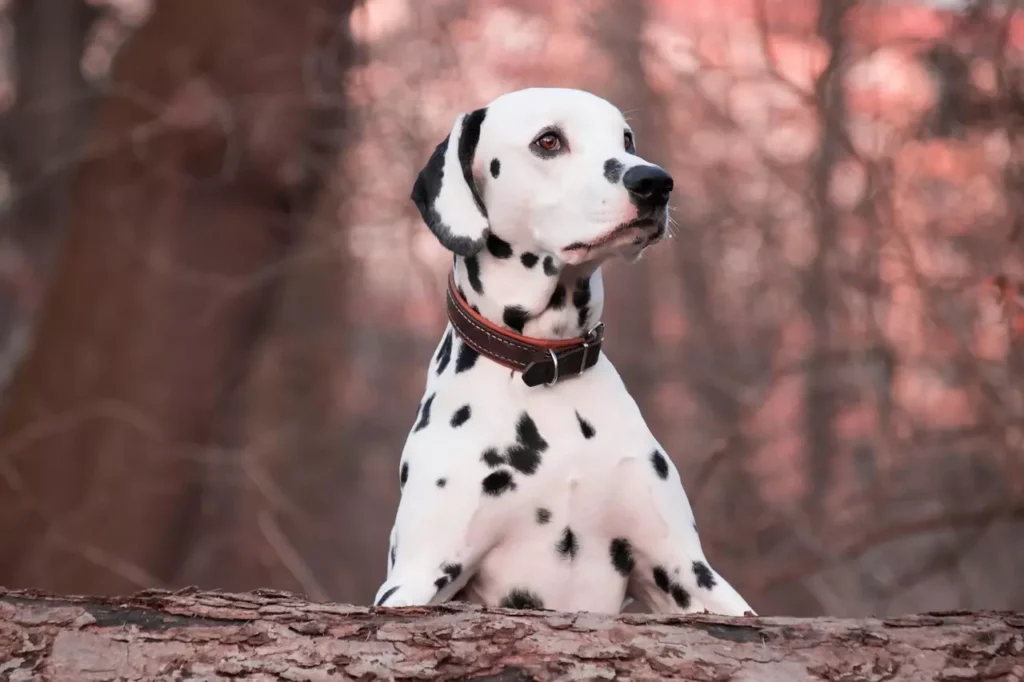
Dalmatian
The Dalmatian is an athletic, intelligent and unmistakable dog with a long history as a carriage companion. Known for its spotted coat and impressive stamina, the breed needs considerably more than an attractive appearance to thrive. Dalmatians are best suited to active households that can provide consistent training, plenty of company and substantial daily exercise.
Quick Facts
| Attribute | Details |
|---|---|
| Group | Utility |
| Country of origin | Exact origins are disputed; historically associated with Dalmatia and later established as a coach dog in Britain |
| Original purpose | Accompanying horse-drawn carriages and guarding passengers, cargo and stables |
| Size & weight | Large; ideal height approximately 56–61 cm, with adult weight varying according to sex and build |
| Life expectancy | Typically over 12 years |
| Coat & colours | Short, dense white coat with clearly defined black or liver-coloured spots |
| Exercise needs | High — adult Dalmatians commonly need around two hours or more of varied daily activity |
| Grooming needs | Low-maintenance coat, but regular brushing is helpful because the breed sheds heavily |
| Trainability | High — intelligent and capable, but may be strong-willed and requires consistent reward-based training |
| Barking tendency | Low to moderate; may become more vocal when bored, unsettled or left alone |
| Suitable for | Active households able to provide substantial exercise, companionship, training and secure outdoor opportunities |
History & Origin
The precise origin of the Dalmatian remains uncertain. Although the breed’s name connects it with the historical coastal region of Dalmatia, there is limited evidence that the modern breed developed there. Spotted dogs resembling Dalmatians have appeared in art and written records from several parts of Europe.
By the late eighteenth century, the breed had become closely associated with horse-drawn transport in Britain. Dalmatians were valued for their ability to travel beside carriages, guard passengers and cargo, and watch over horses and stables. During the Regency period, a well-marked Dalmatian running alongside a carriage also became a sign of status.
What Were Dalmatians Bred to Do?
Dalmatians became best known as coach dogs. Their stamina, athletic build and natural affinity with horses allowed them to cover considerable distances beside horse-drawn vehicles. They could also help protect a carriage, its occupants and the horses when travelling or resting.
The breed was later associated with horse-drawn fire engines, particularly because dogs could run alongside or ahead of the vehicles. Modern Dalmatians are primarily companions, but their history remains evident in their endurance, alertness and need for purposeful physical activity.
Dalmatian Size, Weight & Appearance
The Dalmatian is a balanced, muscular and athletic large dog. The Royal Kennel Club breed standard gives an ideal height of approximately 58–61 cm for males and 56–58 cm for females. Weight varies according to sex, height and build, so maintaining an appropriate body condition is more useful than aiming for one fixed number.
The coat is short, hard, dense and glossy. Its ground colour is white, with clearly defined black or liver-coloured spots. Puppies are generally born with white coats, and their spots become visible as they develop. Colour should never take priority over health, temperament or responsible breeding.
Dalmatian Temperament & Personality
Dalmatians are commonly energetic, intelligent and strongly attached to their households. Many enjoy being involved in daily family life and can find long periods without activity or company difficult. Temperament nevertheless varies between individuals and is influenced by genetics, socialisation, training and previous experience.
A well-supported Dalmatian can be affectionate, playful and responsive. Their size, strength and enthusiasm may be overwhelming in an unsuitable home, particularly during adolescence. Calm boundaries, predictable routines and enough physical and mental activity help them settle more successfully.
Exercise & Mental Stimulation
Healthy adult Dalmatians commonly need around two hours or more of exercise each day. This should not consist only of repetitive lead walking. A varied routine can include brisk walks, opportunities to run safely, sniffing, play, training and activities that make use of their stamina and intelligence.
Because Dalmatians are powerful, teaching them to walk nicely on the lead is particularly useful. Exercise must be adjusted for the individual dog’s age, health and fitness. Puppies should not be pushed into prolonged running or repetitive high-impact activity while they are still developing.
Training & Socialisation
Dalmatians are intelligent and capable of learning quickly, but some can be independent, excitable or sensitive to harsh handling. Short, engaging sessions based on rewards are generally more effective than punishment or physical correction. Consistency between household members is important.
Early socialisation should introduce a puppy gradually and positively to different people, friendly dogs, surfaces, sounds, handling and everyday environments. Socialisation should build confidence rather than overwhelm the puppy. Training should continue into adulthood, with particular attention to recall, calm greetings, settling and safe behaviour around roads and horses.
A deaf or partially deaf Dalmatian may benefit from visual cues, vibration-based attention signals and particularly careful management in unsecured places. An appropriately qualified reward-based trainer can help owners develop a suitable training plan.
Dalmatian Shedding & Grooming
Dalmatians have short coats, but they are not light shedders. Fine hairs may be shed throughout the year and can become embedded in clothes, upholstery and carpets. Brushing once or twice a week can remove loose hair and help owners check the skin for irritation, lumps or changes.
A suitable rubber grooming mitt or soft brush is often sufficient. Our guide to brushing your dog’s coat explains how to make grooming comfortable and productive. Bathing is only needed when necessary, using a dog-appropriate product. Nails, ears and teeth also require routine attention.
Dalmatian Health & Lifespan
Dalmatians typically live for more than 12 years, although no lifespan can be guaranteed. Preventative veterinary care, an appropriate diet, regular exercise and maintaining a healthy body condition all contribute to long-term wellbeing.
Deafness is an important consideration in the breed. A BAER test evaluates the hearing response in each ear and can identify dogs with hearing in both ears, one ear or neither ear. When choosing a puppy, ask for the individual puppy’s BAER result rather than relying only on information about its parents or littermates.
Dalmatians may also inherit hyperuricosuria, usually shortened to HUU. This affects the way uric acid is processed and can increase the risk of urate crystals or stones forming in the urinary system. A DNA test can identify a dog’s genetic status. Straining to urinate, repeated unsuccessful attempts to pass urine, blood in the urine or obvious discomfort require prompt veterinary attention; an inability to urinate is an emergency.
Current Royal Kennel Club guidance also lists hip and elbow screening and a DNA test for disproportional dwarfism, known as DD-PRKG2, among the relevant pre-breeding checks. Prospective owners should ask to see original health-test results and discuss them with the breeder or their vet.
Feeding & Urinary Care
Feed a complete, balanced diet appropriate for the dog’s age, body condition, health and activity level. Our guide to feeding your dog a balanced diet covers the basic principles. Treats and training rewards should be included when judging the dog’s total daily intake.
Fresh drinking water should always be available, and regular opportunities to urinate are sensible. A low-purine or therapeutic diet is not something every Dalmatian owner should introduce automatically. If a dog has HUU, urinary symptoms or a history of urate stones, dietary management should be planned with a vet according to that individual dog’s test results and medical needs.
Living with Children & Other Pets
A suitably socialised Dalmatian can live successfully in a family home, but the breed’s size and exuberance must be considered. Younger dogs may accidentally knock over small children during play. Interactions between dogs and children should always be supervised, and every dog should have a quiet place where it can rest undisturbed.
Many Dalmatians can live with other dogs and household pets following careful introductions. Compatibility depends on the individuals involved rather than breed alone. Introductions should be gradual, and smaller animals should not be left with a dog without appropriate supervision and management.
Ethical Sourcing & Adoption (UK)
Dalmatians sometimes become available through general rescue organisations and breed-specific rescues. An established rescue should assess the individual dog and explain any known behavioural, hearing or medical needs before adoption.
When buying a puppy, choose a breeder who prioritises health and temperament over markings. Ask to see the puppy with its mother in the place where it was raised, and request documented results for BAER hearing assessment and the health tests relevant to the parents. A responsible breeder should answer questions openly, ask about the prospective home and remain available after the puppy leaves.
Avoid sellers who always have puppies available, refuse visits, offer to meet in a public place, cannot show health documentation or use unusual colouring as the main reason for a higher price.
Legal Note (UK)
Dalmatians are not named as a prohibited type in current UK government guidance. However, laws concerning identification, control, livestock, public spaces and dangerous dogs apply regardless of breed. Owners must keep their dog under effective control and should check the rules applicable in their part of the UK and in any place they plan to visit.
Is the Dalmatian Right for You?
Best for:
- Active households with time for substantial daily exercise
- Owners who enjoy training and involving their dog in regular activities
- Homes prepared for a large, lively and physically capable dog
- People able to provide companionship and consistent routines
Think twice if:
- You are looking for a dog with modest exercise requirements
- You dislike dog hair on clothing, furniture and floors
- The dog would regularly be left alone for long periods
- You cannot provide continued training and mental stimulation
- You are unwilling to check documented hearing and health-test results
FAQs
How long do Dalmatians live?
Dalmatians typically live for more than 12 years. Individual lifespan varies according to genetics, health, lifestyle and veterinary care.
How much exercise does a Dalmatian need?
A healthy adult commonly needs around two hours or more of varied activity each day. Puppies, older dogs and dogs with medical conditions require an individually adjusted routine.
Do Dalmatians shed?
Yes. Despite having a short coat, Dalmatians can shed heavily throughout the year. Regular brushing helps remove loose hair but will not eliminate shedding.
Are Dalmatians hypoallergenic?
No dog is completely hypoallergenic, and the Dalmatian’s substantial shedding makes the breed unlikely to suit someone specifically seeking a low-shedding dog.
Are Dalmatians good family dogs?
They can be affectionate family companions in an active and well-prepared household. Their strength and exuberance require training, management and supervision around children.
Are all Dalmatians deaf?
No. Dalmatians may have hearing in both ears, hearing in one ear or bilateral deafness. BAER testing is used to establish an individual dog’s hearing status.
Do all Dalmatians need a low-purine diet?
No. Dietary requirements should be based on the individual dog’s genetic status, urinary health and veterinary advice. A therapeutic diet should not be introduced solely because of breed.
Are Dalmatian puppies born with spots?
Dalmatian puppies are generally born with white coats, with their characteristic spots becoming visible as they develop.
Sources
- Royal Kennel Club — Dalmatian breed information and health testing
- Royal Kennel Club — Dalmatian breed standard
- Dogs Trust — Dalmatian breed information
- PDSA — Dalmatian health and care
- GOV.UK — Controlling your dog in public
Information checked: September 2026. Breed descriptions provide general guidance; every dog is an individual. Health concerns and dietary changes should be discussed with a veterinary professional.