
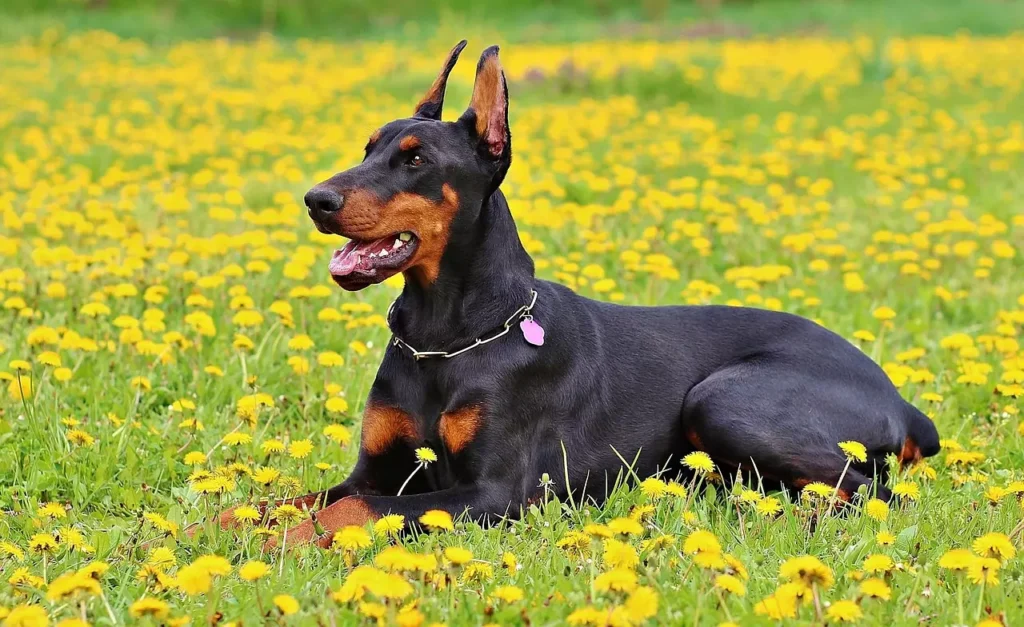
Doberman
The Doberman, officially known as the Dobermann in the UK breed standard, is a large, intelligent and athletic working dog developed in Germany. Dobermans often form close bonds with their families and can be highly responsive to training, but they need substantial daily activity, company, careful socialisation and responsible handling. Their strength, sensitivity and important breed-related health risks mean that prospective owners should research both the individual dog and its source carefully.
Quick Facts
| Attribute | Details |
|---|---|
| Group | Working |
| Country of origin | Germany |
| Original purpose | Personal protection, guarding and later police, military and service work |
| Size & weight | Large; commonly around 65–69 cm and 30–40 kg, although sex, build and individual development affect size |
| Life expectancy | Typically over 10 years; individual lifespan varies and breed-related heart disease is an important consideration |
| Coat & colours | Short, smooth coat; recognised colours include black, brown, blue or fawn with rust-red markings |
| Exercise needs | Around 2 hours or more daily for many healthy adults, together with training and mental stimulation |
| Grooming needs | Low; usually weekly brushing, with routine nail, ear and dental care |
| Trainability | High; intelligent and responsive but requires consistent, reward-based training |
| Barking tendency | Moderate; may alert to unfamiliar activity, but vocal behaviour varies between individuals |
| Suitable for | Experienced, active households able to provide company, structured training and responsible management |
History & Origin
The Doberman, called the Dobermann in the UK and much of Europe, was developed in Germany during the late nineteenth century. The breed takes its name from Louis Dobermann, a tax collector in Apolda who wanted an alert, capable dog to accompany and protect him while he worked.
Complete records of the breed’s early development are limited. The Royal Kennel Club describes its ancestry as including Pinscher and several other working and hunting breeds selected for intelligence, strength, speed and courage. The developing breed was recognised in Germany in 1899 and subsequently became established as a police, military, guard and companion dog.
What Were Dobermans Bred to Do?
Dobermans were initially developed for personal protection and guarding. Their alertness, athleticism and ability to learn later made them suitable for police, military, tracking and other service roles.
Modern Dobermans are commonly kept as companions, but their working background still matters. Many need purposeful activity, regular interaction and carefully taught responses around visitors, other dogs and unfamiliar situations. Protective behaviour should never be deliberately encouraged without appropriate professional knowledge.
Doberman Size, Weight & Appearance
Dobermans are large, powerfully built dogs with an athletic, balanced outline. PDSA gives an average height of approximately 65–69 cm and an average weight of around 30–40 kg. Dogs outside these averages are possible, and healthy weight should be assessed from body condition as well as the number on the scales.
The breed has a wedge-shaped head, naturally folded ears, a long natural tail and a short, close-fitting coat. Royal Kennel Club recognised colours include black, brown, blue and fawn with clearly defined rust-red markings. Colour should never take priority over health, temperament or responsible breeding.
Temperament & Living with a Doberman
Dobermans are often intelligent, attentive and strongly attached to the people caring for them. Many prefer to be involved in everyday family life rather than spending long periods alone. Individual temperament, however, is shaped by genetics, early development, health, learning and previous experiences.
The breed’s size, speed and potential guarding instinct require responsible management. A Doberman may live successfully with children or other animals, but this cannot be guaranteed by breed alone. Introductions should be gradual, children must always be supervised around dogs, and each dog’s history and behaviour should be considered.
Some Dobermans find prolonged separation difficult. Prospective owners should be able to provide regular company and gradually teach the dog to feel secure during manageable periods alone.
Exercise & Mental Stimulation
The Royal Kennel Club places the Dobermann in its highest exercise category, while PDSA recommends a minimum of around two hours per day. The appropriate amount for an individual dog depends on age, health, fitness, weather and temperament.
A healthy adult may enjoy brisk walks, controlled running, scent work, training games and suitable canine activities. Exercise should include opportunities to explore and think rather than relying only on repetitive physical exertion. Secure spaces and reliable management are important where wildlife, livestock, traffic or other dogs are present.
Puppies should not follow an adult exercise programme. Their activity should be age-appropriate and increased gradually while they develop. Older dogs and those with heart, joint or neurological conditions may require an exercise plan agreed with their vet.
Training & Socialisation
Dobermans usually learn quickly, but intelligence does not remove the need for patient teaching. Positive, reward-based training can build reliable everyday behaviour without using intimidation or deliberately provoking defensive responses.
Early socialisation should introduce a puppy carefully to different people, friendly dogs, handling, transport, household sounds and varied environments. The aim is calm confidence, not uncontrolled exposure. Experiences should remain safe and appropriate for the puppy’s age and vaccination status.
Useful priorities include recall, settling calmly, polite greetings and loose lead walking. Because an adult Doberman is large and powerful, owners should seek help from an appropriately qualified, reward-based trainer before small difficulties become established.
Do Dobermans Shed? Grooming & Coat Care
Dobermans do shed, although their short coat is generally straightforward to maintain. Loose hair may be noticeable throughout the year, and a weekly brush is usually a practical starting point. Our guide to brushing a dog’s coat correctly explains how grooming can be adapted to different coat types.
Nails, teeth, ears and skin should be checked regularly. Bathing is normally needed only when the dog is dirty or on veterinary advice. The short coat provides limited insulation, so some Dobermans may need suitable protection and shorter periods outside during cold weather.
Owners of blue or fawn dogs should be aware that dilute coat colours can be associated with colour dilution alopecia. A vet should assess persistent hair loss, irritated skin or changes in coat condition rather than assuming that they are purely cosmetic.
Doberman Health, DCM & Lifespan
Dobermans are generally described as living for more than 10 years, but lifespan varies between individuals. Dilated cardiomyopathy (DCM) is one of the breed’s most important health concerns. It affects the heart muscle and can be present before obvious outward signs develop.
Published European Society of Veterinary Cardiology guidance recommends screening Dobermans for hidden DCM from three years of age using both echocardiography and 24-hour Holter monitoring, repeated annually. A single normal examination cannot guarantee that the condition will not develop later. Owners should discuss an individual screening plan with their vet or a veterinary cardiologist.
Other recognised concerns include von Willebrand disease, which affects blood clotting, hip dysplasia, persistent hyperplastic primary vitreous (PHPV) and DINGS2. The current Royal Kennel Club Health Standard lists DNA testing for von Willebrand disease as Good Practice and identifies eye examination, DINGS2 testing and hip assessment as Best Practice measures for breeding dogs.
Additional conditions can occur, including gastric dilatation-volvulus, sometimes called GDV or bloat, thyroid disease and cervical spinal problems. Not every Doberman develops these conditions, but owners should understand the possible risks and arrange prompt veterinary assessment when their dog’s health, breathing, movement, appetite or normal behaviour changes.
Feeding & Care Basics
Dobermans should receive a complete, balanced diet appropriate for their age, size, activity and health. Large-breed puppies need food designed to support controlled growth, while adult portions should be adjusted according to body condition rather than activity assumptions alone.
Fresh water should always be available. Treats used during training count towards the dog’s daily intake. Owners should discuss feeding routines and the signs of GDV with their vet instead of relying on feeding changes as a guarantee against the condition.
Dobermans generally need regular company, comfortable indoor accommodation and a predictable routine. They should not be expected to live primarily outside or to function as security equipment.
Ethical Sourcing & Adoption (UK)
Dobermans are available through general and breed-specific UK rescue organisations. A responsible rescue should explain the individual dog’s known history, health, temperament and home requirements and should assess whether the proposed household is suitable.
Anyone buying a puppy should meet the mother with her litter where they were raised, examine original health documentation and ask how the puppies have been socialised. Relevant questions include von Willebrand disease testing, hip and eye results, DINGS2 testing and evidence of appropriate cardiac assessment in the family line.
DCM cannot be responsibly addressed by presenting a single DNA result as proof that a dog will remain free from the disease. Buyers should ask detailed questions about cardiac screening and longevity across the family and discuss the evidence with a vet when necessary.
Avoid sellers advertising cropped ears, unusually coloured puppies at inflated prices, immediate collection, several unrelated breeds or delivery without a home visit. Never allow appearance or pressure from a seller to replace proper health and welfare checks.
Legal Note (UK)
Dobermans are not named as a prohibited type in current UK government guidance. However, the law requires every dog to be kept under proper control, and prohibited-type assessment can depend on physical characteristics rather than the breed name recorded by an owner or seller.
Dobermans naturally have folded ears and long tails. Cosmetic ear cropping is illegal in the UK. Tail-docking legislation and limited exemptions differ across the UK nations, so owners should consult current official guidance applicable to where they live. Veterinary treatment that is genuinely necessary for an individual dog is different from cosmetic alteration.
Is the Doberman Right for You?
Best for:
- Active households able to provide substantial daily exercise and mental stimulation
- Owners committed to patient, reward-based training and careful socialisation
- People who want an intelligent dog involved in everyday family life
- Homes prepared for the financial and practical implications of cardiac screening and veterinary care
Think twice if:
- The dog would regularly be left alone for long periods
- You cannot safely manage a large, fast and physically powerful dog
- You want a naturally independent dog requiring little training or interaction
- You are unwilling to investigate health testing and the risk of DCM
- Your choice is based mainly on an intimidating appearance or guarding reputation
FAQs
How long do Dobermans live?
Dobermans are commonly described as living for more than 10 years. Individual lifespan varies, and dilated cardiomyopathy is an important breed-related health consideration.
How much exercise does a Doberman need?
Many healthy adult Dobermans need around two hours or more of daily activity together with training and mental stimulation. Exercise should be adapted to the dog’s age, health, fitness and veterinary advice.
Do Dobermans shed?
Yes. Dobermans shed their short hair, although weekly brushing is usually sufficient for routine coat care. Shedding varies between individual dogs and may become more noticeable seasonally.
Are Dobermans aggressive?
A breed name cannot predict whether an individual dog will behave aggressively. Genetics, early experiences, health, training and management all matter. Dobermans can be alert and protective, making careful socialisation and responsible handling particularly important.
Are Dobermans good family dogs?
Some Dobermans are affectionate and successful family companions, but suitability depends on the individual dog and household. Their size, energy and potential guarding behaviour must be considered, and children should always be supervised around dogs.
Can a Doberman be a first dog?
It is possible, but the breed can be demanding for an inexperienced owner. A first-time owner would need sufficient time, realistic expectations and early support from an appropriately qualified trainer, together with the ability to manage a large working dog safely.
What health tests should a Doberman breeder complete?
Current Royal Kennel Club recommendations include DNA testing for von Willebrand disease, with eye examination, DINGS2 testing and hip assessment also identified. Because DCM is a major concern, buyers should additionally ask about repeated cardiac screening and discuss suitable evidence with their vet.
Are Dobermans banned in the UK?
No. Dobermans are not named on the current list of prohibited dog types. Nevertheless, laws concerning control and dangerous behaviour apply to all dogs, and legal assessment of a prohibited type can be based on appearance rather than its stated breed.
Why do some Dobermans have pointed ears and short tails?
Dobermans naturally have folded ears and long tails. The pointed-ear appearance results from cropping, while a short tail may result from docking. These cosmetic alterations raise serious welfare and legal concerns and are not part of a dog’s natural appearance.
Sources
- Royal Kennel Club — Dobermann breed characteristics and health testing
- PDSA — Dobermann breed information, care and health
- Dogs Trust — Doberman care and adoption information
- The Dobermann Club — UK breed health information
- Veterinary Cardiovascular Society — Doberman cardiac screening information
- European Society of Veterinary Cardiology — DCM screening guidelines
- RSPCA — Ear cropping and dog welfare
- GOV.UK — Current prohibited dog types and legal assessment
- Dobermann Rescue Ltd — UK breed-specific rehoming
Information checked: September 2026. Breed descriptions provide general guidance; every dog is an individual. Health concerns should be discussed with a veterinary professional.