
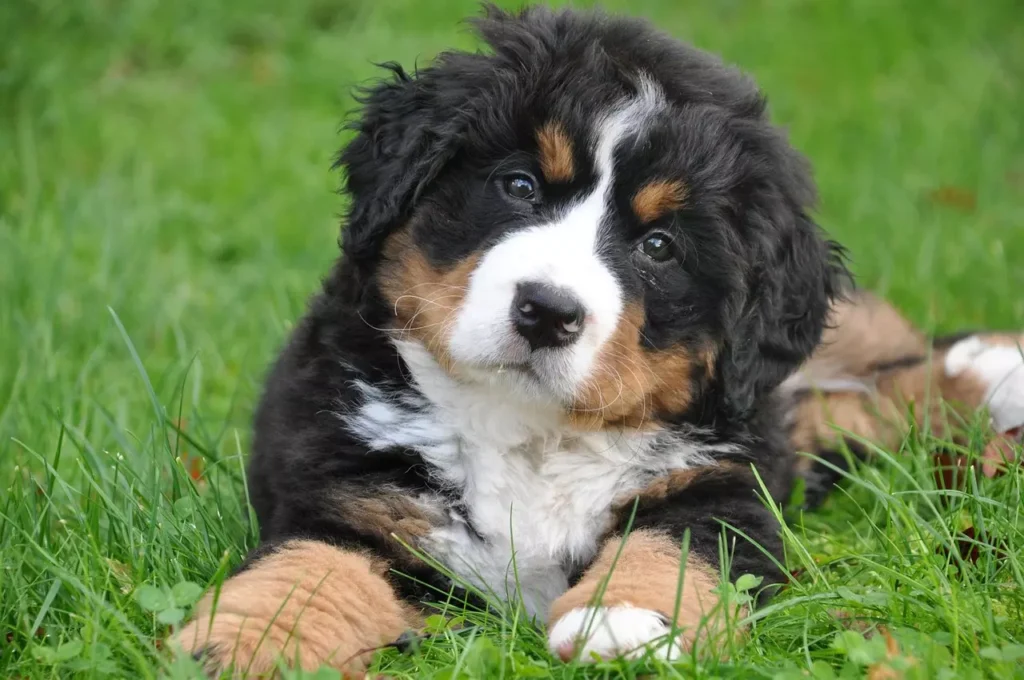
Bernese Mountain Dog
The Bernese Mountain Dog is a large Swiss working breed developed as a versatile farm and draught dog. Recognisable by its long tricolour coat, it is often friendly and devoted, although every dog has an individual temperament. Prospective owners should be prepared for heavy shedding, patient reward-based training, suitable exercise, careful management in warm weather and informed health screening, including discussion of hips, elbows, degenerative myelopathy and family longevity.
Quick Facts
| Attribute | Details |
|---|---|
| Group | Working |
| Country of origin | Switzerland |
| Original purpose | Versatile farm work, including draught work, guarding and moving livestock |
| Size & weight | Large; the UK breed standard gives a height of 64–70 cm for dogs and 58–66 cm for bitches, without specifying a fixed weight |
| Life expectancy | Published estimates vary; recent research reported a median of about 10.1 years in a UK population, while a Swiss cohort reported 8.4 years |
| Coat & colours | Long, usually slightly wavy tricolour coat: black with rich reddish-brown markings and white markings |
| Exercise needs | Moderate; many healthy adults may need up to around one hour daily, adjusted for age, health, fitness and weather |
| Grooming needs | High; sheds heavily and normally needs brushing several times a week |
| Trainability | Generally responsive to patient, consistent and reward-based training |
| Barking tendency | Variable; alert barking and individual behaviour depend on temperament, learning and environment |
| Suitable for | Households able to accommodate a large dog and provide companionship, training, grooming and suitable daily activity |
History & Origin
The Bernese Mountain Dog originated in Switzerland and takes its English name from the canton of Bern. It is one of the Swiss mountain-dog breeds and developed as a versatile working companion on farms rather than for one narrowly defined task.
Its sturdy build allowed it to perform draught work, including pulling carts, while the breed also helped with general farm duties and moving livestock. Modern Bernese Mountain Dogs are principally companions, but their size, working background and relatively slow physical maturity still influence their everyday care.
What Were Bernese Mountain Dogs Bred to Do?
Bernese Mountain Dogs were bred as adaptable farm dogs. Their historic roles included pulling light carts, watching over the farm and assisting with cattle. Strength, steadiness and a willingness to work closely with people were therefore valuable qualities.
Today, suitable activities can include steady walks, scent work, reward-based training and other low-impact tasks that engage both body and mind. Exercise should always suit the individual dog rather than trying to recreate demanding historic work.
Bernese Mountain Dog Size, Weight & Appearance
The Bernese Mountain Dog is a large, strong and sturdy breed. The current UK breed standard gives a height at the shoulder of 64–70 cm for dogs and 58–66 cm for bitches. It does not prescribe a fixed weight, so healthy weight should be judged from the individual dog’s frame and body condition with veterinary guidance where needed.
The coat is long and may be straight or slightly wavy. Its characteristic colouring is black with rich reddish-brown markings on the cheeks and legs, together with defined white markings. The overall appearance should be balanced and capable of working, without exaggeration.
Bernese Mountain Dog Temperament & Everyday Life
The breed standard describes the Bernese Mountain Dog as good-natured, friendly and self-confident. Many form close bonds with their household, but breed descriptions are only a guide: temperament also depends on genetics, early experiences, socialisation, training, health and environment.
Their substantial adult size means calm household manners are especially important. Interactions with children should always be supervised, and introductions to dogs or other animals should be gradual. Prospective owners should also plan for the space, transport, grooming and veterinary costs associated with a large dog.
Exercise & Mental Stimulation
The Royal Kennel Club lists up to around one hour of daily exercise as a broad guide, while Dogs Trust recommends adjusting activity to the individual. A healthy adult may enjoy daily walks, time to sniff and explore, suitable play and gentle opportunities to learn. Needs vary with age, fitness, health and personality.
Puppies are still developing and should not be pushed through repetitive, forced or high-impact exercise. Older dogs and those with joint, heart or other health conditions may also need an adapted plan. Because Bernese Mountain Dogs have a thick, dark coat, activity should be reduced or rescheduled in warm weather and fresh water and shade should be available.
Training & Socialisation
Patient, consistent and reward-based training should begin early. Useful priorities include recall, settling, polite greetings, cooperative handling and walking calmly on the lead. These skills become increasingly important as a puppy grows into a powerful adult.
Socialisation should be gradual and positive rather than overwhelming. Introduce a puppy carefully to different people, friendly dogs, surfaces, sounds, travel and routine care while allowing them space to retreat. An accredited reward-based trainer can help if fear, overexcitement or handling difficulties appear.
Do Bernese Mountain Dogs Shed? Grooming & Coat Care
Bernese Mountain Dogs shed, often heavily, and loose hair may increase seasonally. Their long coat normally needs brushing several times a week, with particular attention to areas that can mat, such as behind the ears and around the legs and tail. This guide to brushing and coat care explains how to make routine grooming more comfortable.
Introduce grooming through short, positive sessions and check the skin, ears, paws and nails regularly. Seek veterinary advice for persistent itching, hair loss, sore skin or ear problems. Clipping or shaving the coat is not a substitute for routine grooming and should be discussed with a suitably qualified groomer or vet if there is a medical or welfare reason.
How Long Do Bernese Mountain Dogs Live? Health & Lifespan
Published lifespan figures vary according to the population and research method. A 2024 UK study reported median survival of approximately 10.1 years for Bernese Mountain Dogs, while a 2016 Swiss study of 389 dogs reported a median of 8.4 years. These are population estimates, not a prediction for an individual dog.
The breed has recognised risks involving the hips and elbows, certain cancers including histiocytic sarcoma, and degenerative myelopathy. UK breed-club guidance recommends checking hip and elbow scores and discussing DNA testing for both known degenerative myelopathy variants, Exon 1 and Exon 2. Screening can inform breeding decisions but cannot guarantee that a dog will remain healthy.
Owners should also know the signs of gastric dilatation-volvulus, commonly called bloat or GDV. A suddenly swollen abdomen, repeated unproductive retching, marked restlessness, weakness or collapse requires immediate veterinary attention. Routine veterinary care, appropriate body condition and prompt investigation of changes in appetite, movement, breathing, energy or new lumps are important throughout life.
Feeding & Care Basics
Feed a complete, balanced diet appropriate for the dog’s life stage, size, activity and health. Growth should be steady rather than deliberately accelerated, and portions should be adjusted using body condition rather than relying on a generic breed weight.
Fresh water should always be available. Owners should ask their vet about an appropriate feeding routine, particularly for a growing puppy or a dog with digestive or other medical concerns. Healthy weight management matters because excess body weight increases strain on joints and can make movement and temperature regulation more difficult.
Ethical Sourcing & Adoption (UK)
Adoption may be possible through breed rescue or a general UK rehoming charity. Rescue staff should share what is known about the individual dog’s health, behaviour and home requirements and help decide whether the match is suitable.
Anyone buying a puppy should meet the mother with the litter and choose a breeder who is open about health, temperament and living conditions. Ask to see verifiable hip and elbow results, discuss testing for both degenerative myelopathy variants, and ask about cancer and longevity in the wider family. Results should be explained honestly: no screening programme removes every risk.
Legal Note (UK)
The Bernese Mountain Dog is not specifically named as a prohibited type in current UK government guidance. However, laws concerning dangerously out-of-control dogs apply to every breed, including incidents in private places. Owners must keep their dog under proper control and should also check local rules concerning leads, public spaces, livestock and access.
Is the Bernese Mountain Dog Right for You?
May suit you if:
- You have enough room, time and budget for a large dog
- You can provide daily companionship, suitable exercise and mental stimulation
- You are comfortable with frequent grooming and substantial shedding
- You will use patient, reward-based training from puppyhood onwards
- You understand the breed’s health risks and will choose a responsible source
Think carefully if:
- You want a low-shedding or low-maintenance coat
- You cannot comfortably manage or transport a large adult dog
- The dog would routinely be left alone for long periods
- You cannot keep exercise safe and comfortable during warm weather
- Large-dog food, insurance and veterinary costs would be difficult to accommodate
FAQs
How long do Bernese Mountain Dogs live?
Published estimates differ. A 2024 UK study reported median survival of about 10.1 years, while a 2016 Swiss cohort reported 8.4 years. An individual dog may live for a shorter or longer time.
How big is a Bernese Mountain Dog?
The UK breed standard gives heights of 64–70 cm for dogs and 58–66 cm for bitches. It does not set a fixed weight, and healthy weight depends on the individual dog’s frame and body condition.
Do Bernese Mountain Dogs shed?
Yes. They have a long double coat and can shed heavily, with seasonal increases. Brushing several times a week helps remove loose hair and prevent tangles.
How much exercise does a Bernese Mountain Dog need?
Up to around one hour a day is a broad guide for many healthy adults, but activity must be adjusted for age, fitness, health and weather. Puppies and dogs with health conditions need an individual approach.
Are Bernese Mountain Dogs good family dogs?
Many are friendly and form close family bonds, but suitability depends on the individual dog and household. Their size requires training, sufficient space and careful supervision around children.
Are Bernese Mountain Dogs easy to train?
They can respond well to patient, consistent, reward-based training. Starting early is important because they grow into large, strong adults and may mature slowly.
Can a Bernese Mountain Dog live in a flat?
It may be possible for the right individual if the building, access, indoor space, temperature and daily routine are suitable. Stairs, lifts, transport and access to comfortable outdoor exercise should be considered before choosing the breed.
Do Bernese Mountain Dogs cope well with hot weather?
Their large body and thick, dark coat can make warm conditions difficult. Exercise should be moved to cooler times, with shade and fresh water available, and signs of heat-related illness require prompt veterinary help.
What health tests should Bernese Mountain Dog breeders use?
In the UK, ask about hip and elbow scoring and DNA testing for both known degenerative myelopathy variants, Exon 1 and Exon 2. Family history, longevity and cancer occurrence should also be discussed openly.
What were Bernese Mountain Dogs bred for?
They were versatile Swiss farm dogs used for tasks including pulling carts, guarding the farm and helping to move livestock.
Sources
- Royal Kennel Club — Bernese Mountain Dog breed information
- Royal Kennel Club — Bernese Mountain Dog breed standard
- Dogs Trust — Bernese Mountain Dog information
- Scientific Reports — Longevity of companion dog breeds in the UK
- BMC Veterinary Research — Longevity and causes of death in Swiss Bernese Mountain Dogs
- Bernese Mountain Dog Club of Great Britain — Breed health issues
- WSAVA — What you need to know about the Bernese Mountain Dog
- GOV.UK — Controlling your dog in public
Information checked: September 2026. Breed descriptions and population statistics are general guidance; every dog is an individual.