
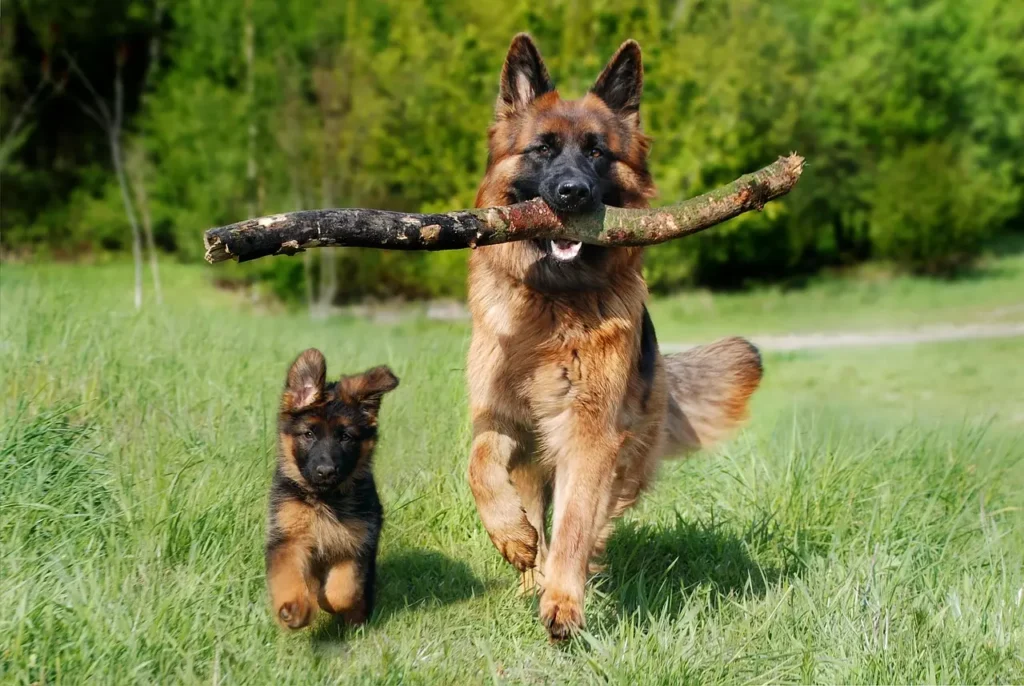
German Shepherd
The German Shepherd is an intelligent, athletic and highly trainable working breed developed in Germany for herding and protecting livestock. Today, German Shepherd Dogs work in assistance, detection, police and rescue roles as well as living as companions. Their loyalty and ability should be matched by careful breeding, early socialisation, consistent training and close attention to physical soundness.
Quick Facts
| Attribute | Details |
|---|---|
| Group | Pastoral |
| Country of origin | Germany |
| Original purpose | Herding and protecting livestock; later developed for service and working roles |
| Size & weight | UK ideal height: males 63 cm and females 58 cm, with 2.5 cm variation permitted; many adults weigh approximately 22–40 kg |
| Life expectancy | Approximately 10–11 years in large UK studies, although individual lifespan varies |
| Coat & colours | Standard or long double coat; black and tan, black and gold, sable, bi-colour, solid black and recognised grey shades |
| Exercise needs | High — substantial daily activity, structured training, mental enrichment and adequate rest |
| Grooming needs | Moderate to high — regular brushing with heavier seasonal shedding |
| Trainability | Very high — intelligent and responsive, but requires consistent, reward-based handling |
| Barking tendency | Moderate to high — naturally alert and may become vocal without suitable training or stimulation |
| Suitable for | Active, committed households able to provide training, companionship and appropriate physical activity |
History & Origin
The German Shepherd Dog was developed in Germany during the late nineteenth and early twentieth centuries from regional herding dogs. Captain Max von Stephanitz played a central role in establishing a consistent working breed selected for intelligence, usefulness, endurance and trainability.
As traditional livestock work changed, German Shepherds became valued in police, military, search, detection, assistance and rescue roles. Their international popularity also made them familiar family companions, although different breeding programmes have continued to prioritise different combinations of working performance, appearance and temperament.
What Were German Shepherds Bred to Do?
German Shepherds were originally used to manage and protect livestock. This work required sustained movement, awareness of the surrounding environment and close cooperation with a handler.
The same qualities later supported a wide range of service roles. Modern German Shepherds can excel in tracking, scent detection, assistance work, obedience and dog sports, but most companion dogs do not need formal working duties. They do need appropriate opportunities to think, explore and learn.
Working Lines and Show Lines
German Shepherd breeding lines can differ substantially. Some are selected primarily for working performance, while others are bred more closely for show-ring appearance. There are also dogs produced mainly for companionship.
Working-line dogs may have particularly high drive, endurance and environmental awareness. These traits can be valuable in experienced working or sporting homes but challenging in an ordinary household without appropriate structure.
Show-line appearance also varies between countries and breeding traditions. Labels alone do not prove health, stability or suitability. Prospective owners should assess the parent dogs, health results, movement, temperament and intended purpose of the litter rather than relying on terms such as “working line” or “champion line”.
German Shepherd Size, Weight & Appearance
The current UK breed standard gives an ideal height of 63 cm for males and 58 cm for females, with approximately 2.5 cm above or below the ideal tolerated. Many adults weigh between approximately 22 and 40 kg, depending on sex, height and build.
The German Shepherd should be strong and well muscled without appearing excessively heavy. The body is slightly longer than tall, with upright ears, a bushy tail and a weather-resistant double coat.
Both standard and long coats occur. Recognised colours include black and tan, black and gold, solid black, sable, bi-colour and grey variations. Health, temperament and functional movement are more important than fashionable colour.
German Shepherd Backs, Hindquarters & Movement
A healthy German Shepherd should have a firm, strong back and balanced construction that supports efficient movement. The UK standard describes a topline that falls away slightly in a straight line towards a gently sloping croup.
An extremely curved back is not required by the standard. Excessive hindquarter angulation, weak hocks and other structural exaggerations are undesirable because they can reduce stability and endurance.
Puppy buyers should watch adult relatives moving naturally rather than judging dogs only from posed photographs. Movement should appear controlled and balanced, without obvious weakness, discomfort or difficulty supporting the hindquarters.
German Shepherd Temperament
A typical German Shepherd temperament is intelligent, attentive and closely connected to its household. Many learn quickly and are strongly motivated to work with a familiar handler.
The breed may be naturally watchful, but confidence should not be confused with aggression. A suitable companion needs the ability to recover from surprises, remain manageable around unfamiliar people and settle when nothing is happening.
Genetics, early development, health, training and experience all influence behaviour. Some German Shepherds are sociable, while others are more reserved or sensitive. Pain and physical discomfort can also contribute to behavioural change and should not be overlooked.
Exercise & Mental Stimulation
Healthy adult German Shepherds generally require substantial daily exercise. A useful routine can combine walks, sniffing, exploration, training and controlled opportunities to run or play. The appropriate amount depends on age, health, fitness and the individual dog.
Activities such as tracking, scent searches, obedience, hoopers and carefully managed agility can provide mental and physical engagement. Repeated high-impact jumping or uncontrolled chasing should not be used simply to exhaust the dog.
Puppies should not undertake forced long-distance running or repetitive strenuous exercise while developing. Older dogs and those with joint, spinal or mobility concerns require an individually adjusted exercise plan developed with veterinary guidance.
Training & Socialisation
German Shepherds are highly capable learners, but intelligence does not remove the need for patient training. Their size, strength and alertness make reliable everyday skills particularly important.
Early priorities should include recall, settling, cooperative handling, disengaging from distractions, calm greetings and walking nicely on the lead.
Positive, reward-based methods help build reliable behaviour without creating unnecessary fear or conflict. Amateur protection training should be avoided. Anyone considering specialised work should use an appropriately qualified and welfare-focused professional.
Socialisation should consist of gradual, positive experiences with people, animals, surfaces, sounds and environments. Forcing a worried puppy into close interaction can increase rather than reduce fear.
Children, Other Dogs & Smaller Pets
A German Shepherd may live successfully with children, but suitability depends on the individual dog and household. Their size, strength, herding tendencies and excitement require active supervision.
Children should not disturb a dog while it is sleeping, eating or resting. The dog should have access to a quiet area where it will be left alone.
Compatibility with other dogs varies. Some German Shepherds are sociable, while others are selective or uncomfortable with unfamiliar dogs. Cats and smaller animals require gradual introductions, appropriate supervision and separation whenever safety is uncertain.
German Shepherd Grooming & Shedding
German Shepherds shed throughout the year and may lose very large amounts of undercoat seasonally. They are not a low-shedding or hypoallergenic breed.
Regular brushing helps remove loose coat and identify changes in the skin. Long-coated dogs may require additional attention around the ears, legs and tail. Our guide to brushing a dog’s coat correctly explains how to introduce grooming comfortably.
The double coat should not routinely be shaved. Nails, ears, teeth and skin should also be checked, and persistent itching, hair loss, odour or inflammation should receive veterinary attention.
German Shepherd Health & Lifespan
Large UK studies have produced different longevity estimates. A 2017 VetCompass study reported median longevity of 10.3 years, while the broader 2024 UK analysis estimated approximately 11.3 years for German Shepherd Dogs.
These figures reflect different populations and methods. Neither predicts how long an individual dog will live. Genetics, body condition, physical structure, lifestyle, preventive care and access to veterinary treatment all influence longevity.
Important health considerations include hip and elbow dysplasia, degenerative joint disease and other mobility problems. German Shepherds can also be affected by digestive, skin, ear and neurological conditions.
Current UK guidance places hip and elbow assessment in its Good Practice category. DNA testing for degenerative myelopathy and eye examination are included under Best Practice. A genetic result indicates risk or carrier status for a particular variant; it is not a complete prediction of whether an individual dog will develop neurological disease.
Feeding & Weight Management
Feed a complete and balanced diet appropriate for the dog’s age, activity and health. Portions should be measured and should include calories supplied through treats, chews and training rewards.
Maintaining an appropriate body condition is particularly important for a large, active breed with recognised joint concerns. A healthy dog should not be kept underweight to create an exaggerated athletic appearance, and excess weight should not be mistaken for substance or strength.
Rapid changes in appetite, weight, drinking, digestion or activity require veterinary advice rather than repeated unsupervised changes of food.
German Shepherd vs Belgian Malinois
German Shepherds and Belgian Malinois are separate breeds, although both are intelligent working dogs used in demanding service roles. Malinois are generally lighter and can be exceptionally fast and intense, while German Shepherds are usually heavier and vary widely across working, show and companion lines.
Neither breed should be selected simply for its protective appearance. Our Belgian Shepherd Dog guide explains why the Malinois is only one of four Belgian Shepherd varieties.
Ethical Sourcing & Adoption in the UK
A responsible breeder should prioritise health, stable temperament and functional movement. Buyers should meet the mother with her puppies, discuss both parents’ behaviour and view documentary evidence of hip, elbow and other relevant results.
Watch the parent dogs move naturally. Avoid breeders who celebrate extreme hindquarter angulation, weak movement, excessive nervousness or aggression as desirable breed characteristics.
German Shepherds and their crosses are also available through rescue organisations. A responsible rescue should assess the individual dog and explain its known health, behaviour, handling needs and compatibility with children or other animals.
Legal Note in the UK
German Shepherd Dogs are not specifically named as a prohibited type in current UK government guidance. Laws concerning dangerously out-of-control dogs apply to every breed and crossbreed in public and private places.
Owners must also comply with identification requirements and rules affecting livestock, roads and particular public spaces. Current official guidance should be checked whenever legal certainty is required.
Is a German Shepherd Right for You?
May suit you if:
- You want an intelligent dog for consistent training and active participation
- You can provide substantial daily physical and mental activity
- You understand the importance of calm socialisation and rest
- You can manage a large, powerful adolescent dog
- You are prepared to research health, movement and breeding lines carefully
Think carefully if:
- You want a naturally undemanding or low-shedding companion
- The dog would regularly be left alone for long periods
- You cannot provide secure exercise and consistent training
- You are choosing primarily for guarding appearance or reputation
- You cannot manage the possible cost of joint, digestive or neurological care
German Shepherd FAQs
What is a German Shepherd’s temperament like?
German Shepherds are commonly intelligent, attentive and closely bonded to their household. Individual confidence, sociability and working drive vary according to genetics, health, socialisation and experience.
How much exercise does a German Shepherd need?
Healthy adults generally need substantial daily activity combined with training and mental enrichment. The correct amount depends on age, fitness, physical health and the individual dog.
How long do German Shepherds live?
Large UK studies have reported population estimates of approximately 10.3 to 11.3 years. These figures are statistical guides rather than guarantees for an individual dog.
Do German Shepherds shed a lot?
Yes. They shed throughout the year and commonly lose considerably more undercoat during seasonal moults.
Are German Shepherds good family dogs?
They can be successful family companions in households that meet their training, exercise and management needs. Their size and strength mean children must always be supervised around them.
Are German Shepherds easy to train?
They are highly trainable, but their intelligence and awareness can make inconsistent handling problematic. Reward-based training should continue throughout the dog’s life.
Should a German Shepherd have a sloping back?
The UK standard describes a firm topline that falls away slightly towards a gently sloping croup. An extremely curved or weak back and excessive hindquarter angulation are not required and can interfere with functional movement.
Are long-haired German Shepherds a separate breed?
No. Standard-coated and long-coated German Shepherds are coat varieties within the same breed.
Are German Shepherds banned in the UK?
No. German Shepherd Dogs are not named as a prohibited type in current government guidance, but control laws apply to all dogs.
Sources
- Royal Kennel Club — German Shepherd Dog breed standard
- Royal Kennel Club — German Shepherd health information
- Canine Genetics and Epidemiology — German Shepherd health and longevity study
- Royal Veterinary College — German Shepherd VetCompass research summary
- Scientific Reports — longevity of UK companion dog breeds
- GOV.UK — controlling your dog in public
Information checked: September 2026. Breed descriptions provide general guidance; every dog is an individual.