
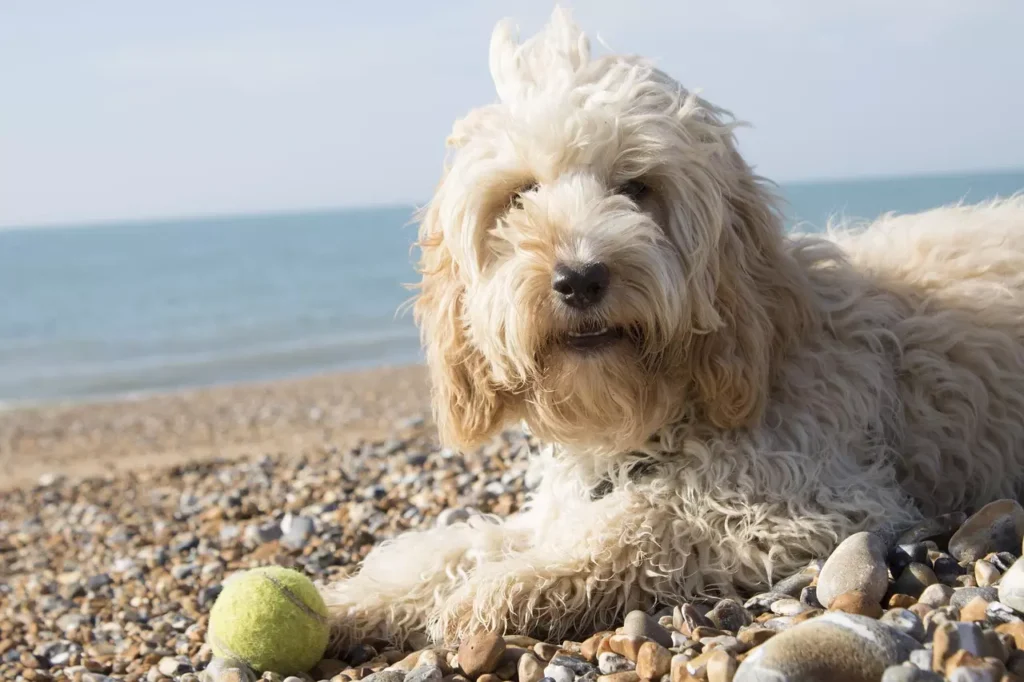
Cockapoo
The Cockapoo is a cross between a Cocker Spaniel and a Poodle, most commonly a Miniature Poodle in the UK. Size, coat, temperament and care needs can vary because Cockapoos do not have a single breed standard. They can be active and people-focused companions, but prospective owners should be prepared for regular grooming, reward-based training and health checks relevant to both parent breeds.
Quick Facts
| Attribute | Details |
|---|---|
| Group | Crossbreed: Cocker Spaniel × Poodle |
| Country of origin | Modern cross associated with the United States; now widely bred in the UK |
| Original purpose | Primarily developed as a companion dog |
| Size & weight | Usually small to medium; commonly around 5–12 kg, but larger and smaller dogs are possible depending on parentage |
| Life expectancy | Approximately 12–15 years as a broad guide; individual lifespan varies |
| Coat & colours | Straight, wavy or curly coat in many colours and combinations; shedding varies |
| Exercise needs | Often around one hour per day, adjusted for age, health, size and individual energy level |
| Grooming needs | Moderate to high; frequent brushing and regular professional grooming may be required |
| Trainability | Often responsive to consistent, reward-based training, but individual behaviour varies |
| Barking tendency | Variable; may bark through excitement, alerting, frustration or anxiety |
| Suitable for | Households able to provide companionship, exercise, training and ongoing coat care |
History & Origin
The Cockapoo is a cross between a Cocker Spaniel and a Poodle. The modern cross is commonly associated with the United States, where deliberate breeding began during the twentieth century, before Cockapoos became widely established as companion dogs in the UK.
There is no single Cockapoo breed standard recognised by the Royal Kennel Club. Dogs described as Cockapoos can differ according to whether the Cocker parent is an English or American Cocker Spaniel, which Poodle variety is involved and how traits are inherited.
In the UK, many Cockapoos have an English Cocker Spaniel and Miniature Poodle background, but buyers should confirm the exact parentage rather than relying on the name alone.
What Were Cockapoos Bred to Do?
Cockapoos have primarily been developed as companion dogs rather than for a fixed working role. However, both parent breeds have working ancestry. Cocker Spaniels were developed to find and flush game, while Poodles originated as water retrievers.
A Cockapoo may therefore inherit an interest in searching, carrying objects, following scents or entering water. These characteristics are not guaranteed, and their strength varies between individual dogs.
Activities such as scent games, retrieving, reward-based training and exploring varied walking routes can provide constructive outlets for these behaviours.
Cockapoo Size, Weight & Appearance
Cockapoo size is not standardised. Many adults are small to medium and weigh approximately 5–12 kg, but dogs outside this range are possible. The size of the Poodle parent is particularly important: Toy, Miniature and Standard Poodles can produce very different outcomes.
A Cockapoo may have a finer Poodle-like build, a sturdier Spaniel outline or a mixture of features. Ear length, muzzle shape, leg length and adult proportions can all vary, including among puppies from the same litter.
Coats may be relatively straight, loosely waved, tightly curled or a combination of textures. Common colours include black, cream, red, apricot, chocolate and parti-colour, but appearance should never take priority over health and temperament.
What Do F1, F1b and F2 Cockapoo Mean?
An F1 Cockapoo usually has one Cocker Spaniel parent and one Poodle parent. An F1b is normally produced by crossing a Cockapoo back to one of the parent breeds, most often a Poodle. An F2 generally has two F1 Cockapoo parents.
These labels describe ancestry, not guaranteed characteristics. They cannot reliably promise a particular adult size, coat, level of shedding, temperament or suitability for someone with allergies.
Buyers should ask for clear information about every parent involved, including breed or cross, size, temperament and verified health-test results.
Cockapoo Temperament & Home Life
Cockapoos can be active, affectionate and interested in spending time with people. However, no cross guarantees a particular personality. Genetics, early development, socialisation, training, health and previous experiences all influence behaviour.
Some Cockapoos are confident and outgoing, while others may be cautious, sensitive or easily excited. They should not automatically be described as ideal first dogs, because grooming, training and activity requirements can be considerable.
Many enjoy company, but separation-related distress is not an inevitable breed trait. Time alone should be introduced gradually and positively. A dog showing persistent distress when left needs an individual plan developed with an appropriately qualified professional.
Cockapoos can live in flats or smaller homes if their needs are met. Access to a garden does not replace walks, training or enrichment. Our guide to dog breeds for apartments explains why behaviour and daily routine matter more than size alone.
Are Cockapoos Good with Children and Other Pets?
Some Cockapoos live happily with children, dogs or other pets, but suitability must be assessed individually. A friendly parent does not guarantee that every puppy will develop the same behaviour.
Children should be taught not to disturb a dog while it is eating, sleeping or trying to move away. All interactions between dogs and children require adult supervision.
Introductions to other animals should be gradual and controlled. Some Cockapoos may inherit a strong interest in chasing birds or small animals, while others may show little inclination to do so.
Exercise & Mental Stimulation
Many adult Cockapoos need around one hour of daily exercise, although individual requirements can be lower or higher. Parentage, age, size, health and energy level all affect the appropriate amount.
Exercise can include walks, safe opportunities to run, sniffing, retrieving and suitable play. Physical activity should be combined with training, food-search games and other forms of mental stimulation.
Puppies should receive shorter, age-appropriate activity with opportunities to rest. Repetitive jumping, forced running and excessive high-impact exercise should be avoided while the dog is developing.
A Cockapoo that remains unsettled does not necessarily need increasingly strenuous exercise. Lack of sleep, frustration, anxiety or difficulty switching off may also contribute, so rest and calm activities are important parts of the daily routine.
Training & Socialisation
Cockapoos often respond well to reward-based training, but they are not automatically easy to train. Some may be highly motivated by food or toys, while others can become distracted by scents, movement, people or dogs.
Useful early skills include recall, comfortable handling, calm lead walking, settling, releasing objects and returning attention to the owner. Training should progress gradually from quiet environments to more distracting places.
Socialisation means creating safe, positive experiences rather than exposing a puppy to as much as possible. Puppies should be allowed to observe and move away rather than being forced into contact with unfamiliar people or animals.
Harsh corrections can damage confidence and do not address the reason for a behaviour. Sudden or persistent changes in behaviour should also prompt a veterinary check because discomfort can affect how a dog responds.
Do Cockapoos Shed?
Cockapoos can shed. Some lose relatively little visible hair, while others shed more noticeably. Coat inheritance is variable, and neither appearance nor generation label can guarantee a non-shedding adult coat.
No dog breed or cross can be guaranteed to be hypoallergenic. Dog allergens are found in substances including saliva and skin particles, not only loose hair. Anyone with an allergy should seek medical advice and spend time around adult dogs with similar coats before making a commitment.
Cockapoo Grooming & Coat Care
Cockapoo coats can require substantial maintenance. Curly and dense coats may trap loose hair and form mats close to the skin even when the surface appears tidy. Areas behind the ears, under the collar or harness, around the legs and in the armpits require particular attention.
Many Cockapoos need brushing several times a week or daily, depending on coat length and texture. Our guide to brushing a dog’s coat explains how to make grooming more comfortable and effective.
Regular professional grooming may be needed, but the interval should be agreed with a competent groomer according to the individual coat. Owners must still maintain the coat between appointments.
Hanging ears can reduce airflow around the ear canal. Owners should check for redness, discharge, odour, discomfort or repeated head shaking and contact a vet if these occur. Hair should not be removed from the ear canal without appropriate professional advice.
Cockapoo Health & Lifespan
Around 12–15 years is commonly used as a broad lifespan guide for Cockapoos, but there is no official breed standard and an individual dog’s lifespan cannot be predicted precisely.
Cockapoos may inherit health risks found in either parent line. Potential concerns can include inherited eye disease, hip problems, kneecap instability, ear disease and certain inherited neurological, kidney or skeletal conditions. The relevant risks depend on the exact Cocker Spaniel and Poodle ancestry.
Crossbreeding does not automatically remove inherited disease. A puppy can still inherit a harmful genetic variant or physical predisposition when it is present in one or both parental lines.
Current Royal Kennel Club guidance for English Cocker Spaniels includes tests and schemes relating to progressive retinal atrophy, acral mutilation syndrome, adult-onset neuropathy, familial nephropathy, eyes and hips. Recommendations for Poodles vary by size; Miniature Poodle guidance includes progressive retinal atrophy, osteochondrodysplasia, eye testing and hip assessment.
This is why buyers should first establish the exact parentage and then compare both parents’ results with the current recommendations for their respective breeds. A routine veterinary examination is not a substitute for DNA testing or formal screening schemes.
Feeding & Everyday Care
A Cockapoo should receive a complete diet suitable for its age, size, health and activity. Because adult size varies, feeding amounts should be based on the individual dog’s body condition and the guidance for the chosen food rather than the name of the cross.
Our guide to feeding a dog a balanced diet covers the main principles. Treats used for training should be included when considering the dog’s overall daily intake.
Fresh water should always be available. Teeth, nails, ears, skin and body condition should be checked regularly, with veterinary advice sought when anything changes.
Ethical Sourcing & Adoption in the UK
Cockapoos are not registered as a pedigree breed by the Royal Kennel Club, so buyers cannot rely on the Cockapoo name as evidence of consistent type, responsible breeding or completed health tests.
A responsible breeder should explain the puppy’s precise ancestry, allow buyers to meet the puppy with its mother where it was raised and provide verifiable health-test documentation for both parents. Results should be appropriate for the specific Cocker Spaniel and Poodle varieties involved.
Statements such as “vet checked”, “healthy lines” or “hybrid vigour” are not replacements for certificates and searchable results. Buyers should also ask how the puppies have been reared, socialised, identified and matched with suitable homes.
Avoid sellers who refuse home visits, offer several types of puppy continuously, arrange delivery or handover in a public place, or use coat colour and generation labels as guarantees of health or allergy suitability.
Adoption is another option. Rescue organisations should help prospective owners understand an individual dog’s known history, behaviour, grooming requirements and preferred home.
Legal Note (UK)
The Cockapoo is not named as a prohibited type under current UK government guidance. However, identification, welfare and control laws apply to crossbreeds as well as recognised breeds.
Owners must keep their dog under control and follow current national and local requirements. Legal guidance can change, so official government information should be checked when necessary.
Is the Cockapoo Right for You?
May suit you if:
- You can provide daily exercise, enrichment and reward-based training
- You are prepared for frequent brushing and possible professional grooming
- You understand that adult size, coat and behaviour cannot be guaranteed
- You can introduce time alone gradually rather than leaving the dog for long periods immediately
- You will verify health testing for both parental lines
Think carefully if:
- You need a dog guaranteed not to shed or trigger allergies
- You want a predictable size, coat or temperament
- You are looking for a low-maintenance coat
- You cannot provide regular training, exercise and companionship
- You are unwilling to check the exact parentage and health-test documentation
FAQs
What is a Cockapoo?
A Cockapoo is a cross between a Cocker Spaniel and a Poodle. It is not currently recognised as a pedigree breed by the Royal Kennel Club.
How big do Cockapoos get?
Size varies with parentage. Many adults weigh around 5–12 kg, but smaller and considerably larger dogs are possible, particularly when different Poodle varieties are involved.
How long do Cockapoos live?
Approximately 12–15 years is often used as a broad guide. Genetics, size, health and care all affect an individual dog’s lifespan.
Do Cockapoos shed?
Yes, they can. Some Cockapoos shed relatively little visible hair, while others shed more. Coat type and shedding cannot be guaranteed in a crossbreed.
Are Cockapoos hypoallergenic?
No dog can be guaranteed hypoallergenic. A Cockapoo may shed less than some dogs, but allergens are not limited to loose hair.
How much exercise does a Cockapoo need?
Many adults need around one hour per day, together with mental stimulation. The appropriate amount depends on the individual dog’s age, health, size and energy level.
Are Cockapoos easy to train?
Many respond well to patient, reward-based training, but behaviour and motivation vary. Parentage does not guarantee an easy or naturally obedient dog.
Are Cockapoos good family dogs?
Some make suitable family companions, but compatibility depends on the individual dog and household. Children should always be supervised around dogs.
How often does a Cockapoo need grooming?
Many require brushing several times a week or daily and may need regular professional grooming. The schedule depends on coat texture, length and lifestyle.
What health tests should a Cockapoo breeder complete?
Testing should match both parents’ exact breeds and varieties. Buyers should compare the documented results with current Royal Kennel Club guidance for the relevant Cocker Spaniel and Poodle parents.
Sources
- Royal Kennel Club — Spaniel (Cocker)
- Royal Kennel Club — Poodle (Toy)
- Royal Kennel Club — Poodle (Miniature)
- Royal Kennel Club — Poodle (Standard)
- Royal Kennel Club — Health testing and screening
- Cockapoo Club of Great Britain — Searching for a puppy
- British Cockapoo Society — Health testing
- GOV.UK — Controlling your dog in public
Information checked: September 2026. Crossbreed descriptions provide general guidance; every dog is an individual.