
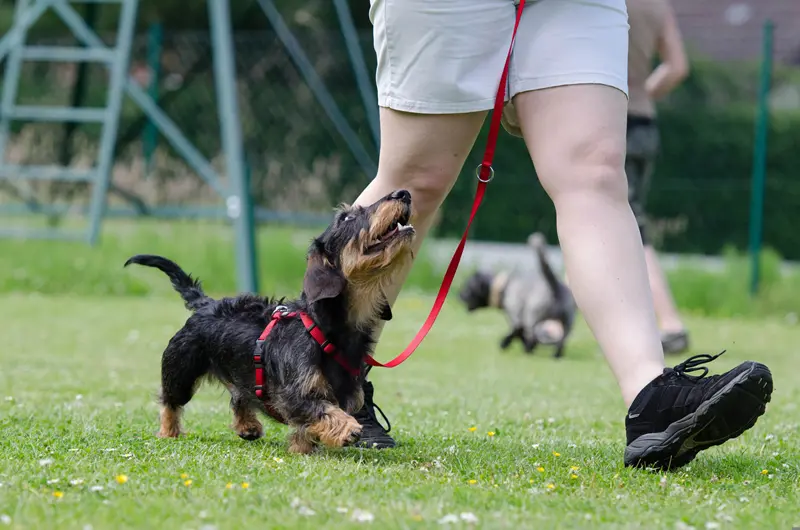
Dog Reactivity Training: How to Help a Reactive Dog
Dog reactivity can look dramatic: barking, lunging, growling or pulling towards another dog, person, vehicle or other trigger. But reactivity does not automatically mean aggression. Dogs may react because they are frightened, frustrated, over-excited, overwhelmed or uncomfortable.
Effective dog reactivity training starts with understanding what triggers the behaviour, creating enough distance for the dog to cope and rewarding calmer responses. The aim is not to force a dog to tolerate difficult situations, but to help them feel safer and make better choices around their triggers.
What does dog reactivity mean?
Dog reactivity describes an unusually strong emotional and behavioural response to something in the dog’s environment. Common triggers include other dogs, unfamiliar people, children, cyclists, runners, vehicles, noises and unexpected movement.
A reactive dog might bark, growl, pull, lunge, freeze, try to escape or become unable to pay attention to their owner. According to Dogs Trust guidance on reactive dogs, these reactions can be associated with fear, frustration, excitement, feeling overwhelmed, pain or illness.
Reactivity and aggression are not interchangeable terms. A frightened dog may bark and lunge because it wants more space, while another dog may react because it desperately wants to greet another dog and is frustrated by the lead. However, reactive behaviour can escalate and may include aggressive behaviour, so safety should always come first.
Why do dogs become reactive?
There is rarely one explanation that applies to every dog. Understanding what drives the reaction is an important part of choosing the right training approach.
Fear and anxiety
A dog that feels threatened may bark, growl or lunge to increase the distance between itself and whatever it finds worrying. If the other dog or person then moves away, the reaction may appear to have worked from the dog’s point of view, making it more likely to happen again.
Frustration
Some dogs genuinely want to approach another dog or person but become frustrated when the lead prevents them from doing so. The resulting pulling, whining and barking can look similar to fear-based reactivity even though the underlying emotion is different.
Over-arousal
A busy walk containing traffic, unfamiliar dogs, exciting smells and repeated encounters can sometimes become too much for an individual dog. As arousal increases, concentrating on familiar cues may become increasingly difficult.
Previous experiences
An unpleasant or frightening encounter can affect how a dog responds to similar situations later. At the same time, a dog does not need to have experienced a dramatic event to develop reactivity. Genetics, early experiences, learning history, environment and individual temperament can all play a part.
Pain or illness
A sudden behaviour change should not simply be treated as a training problem. Pain can reduce a dog’s tolerance of handling, other dogs or close interactions. PDSA advises owners to contact their vet when aggressive behaviour develops or changes unexpectedly so that possible medical causes can be investigated.
Start with management before training
Training is much harder when a dog repeatedly finds itself in situations it cannot cope with. Management is therefore not a failure or a way of avoiding the problem. It creates safer conditions in which learning can take place.
For the time being, that might mean:
- walking at quieter times of day;
- choosing open routes where you can see approaching dogs or people;
- avoiding narrow paths with few escape options;
- crossing the road before your dog begins to react;
- using parked cars, hedges or other safe visual barriers;
- keeping sufficient distance from known triggers;
- using secure private exercise areas where appropriate;
- avoiding forced greetings with unfamiliar dogs or people.
If lead handling itself is difficult, Dogify UK’s guide to teaching your dog to walk nicely on the lead covers the foundations of loose-lead walking.
Learn to recognise when your dog is struggling
Training works best before the dog reaches the point of barking or lunging. Watch for earlier changes in body language.
Depending on the individual dog, these can include:
- staring or becoming unusually still;
- a tense body;
- turning the head away;
- lip licking or repeated yawning;
- ears moving backwards;
- trying to increase distance;
- panting when the weather or exercise does not explain it;
- stopping taking food that the dog would normally enjoy;
- stopping responding to familiar cues.
If your dog can no longer eat, disengage from the trigger or respond to you, the situation is probably too difficult for useful training at that moment. Increasing distance is usually more productive than demanding greater obedience.
Dog reactivity training step by step
A behaviourist may adapt the details considerably for an individual dog, but a reward-based training plan usually relies on controlled exposure rather than forcing the dog into close contact.
1. Find a workable distance
Begin far enough from the trigger that your dog notices it but can still remain relatively relaxed, eat a reward and move away with you.
There is no universal distance. One dog may cope with another dog ten metres away while another needs the opposite side of a large field. Weather, location, previous encounters and the behaviour of the other dog can change that distance from one day to another.
2. Pair the trigger with something positive
When your dog notices the trigger without reacting, calmly mark that moment with a consistent word such as “yes” and give a valuable reward.
The principle is simple: seeing the trigger at a manageable distance predicts something pleasant. Woodgreen describes gradual controlled exposure combined with positive associations as desensitisation and counterconditioning.
This is not the same as using food to lure a worried dog closer to something it fears. The dog should remain at a distance where it has a genuine choice and can cope.
3. Reward disengagement
You do not need your dog to stare continuously at you whenever another dog appears. A useful skill is noticing the trigger and then voluntarily turning away or checking back in with you.
When that happens, reward it. Over time, the sequence can become:
- your dog notices another dog;
- your dog remains able to think;
- your dog turns back towards you;
- you reward the calmer choice.
Keep early sessions short. Several successful observations from a comfortable distance are more useful than staying until the dog becomes overwhelmed.
4. Gradually make the exercise harder
Only increase difficulty when your dog is coping consistently. That might eventually mean slightly reducing distance, practising in another location or working around a moving rather than stationary trigger.
Avoid changing everything at once. Moving substantially closer while also choosing a busier environment can make it impossible to tell what caused a setback.
5. Practise an emergency turn
Unexpected encounters will happen. Teach your dog a cheerful cue that means turning around and moving with you.
Practise it first somewhere quiet:
- say your chosen cue;
- turn away;
- encourage your dog to follow;
- reward generously when they come with you.
Once this response is familiar, it can help you create distance when another dog suddenly appears around a corner.
6. Teach a simple sniffing game
Dogs Trust suggests teaching a “find it” game by scattering suitable food and encouraging the dog to search for it. Practise the game at home and on easy walks before expecting it to help around triggers.
Sniffing can provide your dog with another activity while you calmly decide how to create more space. It should not be used to keep a dog trapped beside something that is frightening them.
What should you do when your dog starts reacting?
Once barking or lunging has started, the priority is usually to leave the situation rather than conduct a training lesson.
- Stay as calm as you reasonably can.
- Create distance from the trigger.
- Change direction or move behind a visual barrier if possible.
- Avoid shouting at the dog.
- Do not force a greeting to prove that the trigger is harmless.
- Once your dog is able to settle, move somewhere quieter.
If a difficult encounter has left your dog unusually unsettled, it can be sensible to make the rest of the walk easier rather than deliberately looking for another opportunity to train.
Lead reactivity to other dogs
Reactivity towards other dogs while on lead is particularly common. A lead restricts a dog’s ability to choose where to move. A worried dog cannot simply increase distance, while an excited dog cannot approach as it wants to. Both situations can contribute to frustration and strong reactions.
Practise at distances where your dog can succeed rather than repeatedly walking directly towards other dogs.
You can also make everyday walks easier by:
- leaving plenty of space when passing another dog;
- avoiding face-to-face greetings on a tight lead;
- turning away before your dog becomes overwhelmed;
- rewarding calm observation and voluntary attention;
- choosing routes with several possible exits.
Should you punish a reactive dog?
Shouting, frightening or physically correcting a dog may suppress behaviour in the moment without improving the underlying emotion. If another dog already causes fear, adding something unpleasant whenever that dog appears can make the association worse.
The RSPCA recommends reward-based dog training, while Blue Cross advises against aversive training methods and equipment.
This approach is also supported by research. A 2020 study of 92 companion dogs found more stress-related behaviour and poorer welfare measures in dogs attending schools that used aversive-based methods compared with dogs trained using reward-based methods.
Avoid trying to make a dog “face its fear” by keeping it close to a trigger until it stops reacting. Dogs Trust specifically advises against forcing interactions and recommends working at the dog’s pace.
What equipment helps with a reactive dog?
Equipment should improve physical safety and control without being treated as a cure for reactivity.
A well-fitted harness can be helpful, particularly for a dog that lunges strongly. Dogs Trust recommends considering a fixed-size Y-shaped harness and notes that a two-point attachment can provide additional control for some dogs.
If there is a genuine risk of biting, professionally guided basket-muzzle training may add an important layer of safety. A suitable basket muzzle should allow the dog to pant, drink and take treats. It should be introduced gradually and positively rather than simply put on immediately before a stressful event.
A muzzle reduces the risk of injury; it does not change how the dog feels about its trigger. Distance and behaviour work remain important.
When should you speak to your vet?
Arrange veterinary advice if reactivity has appeared suddenly, has become noticeably worse, or is accompanied by other changes in your dog’s health or behaviour.
This is especially important if you notice:
- lameness or altered movement;
- reluctance to be touched;
- changes in appetite or drinking;
- reduced interest in walks or play;
- difficulty settling;
- unusual sensitivity to handling;
- a new aggressive response with no clear explanation.
Pain and illness can influence behaviour, and attempting to train through an untreated medical problem is unlikely to resolve its underlying cause.
When do you need a dog behaviourist?
Professional help is sensible when there is a risk of biting, the dog has already made physical contact, reactions are difficult to control, several triggers are involved or ordinary walks have become consistently difficult.
Start with your vet where pain or illness could be involved. For behavioural support, look for a practitioner with recognised qualifications rather than relying on job titles alone.
The Animal Behaviour and Training Council maintains professional standards and registers covering Animal Trainers, Animal Training Instructors, Animal Behaviour Technicians and Clinical Animal Behaviourists. Complex cases involving aggression, significant fear or suspected clinical behaviour problems may require a clinical behaviourist working alongside your veterinary practice.
Keep realistic expectations
There is no reliable timetable for resolving reactivity. Progress depends on why the dog reacts, how established the behaviour is, how often triggers appear, the individual dog’s health and temperament, and how successfully the environment can be managed.
For one dog, success may eventually mean calmly passing other dogs at close range. For another, the realistic goal may be comfortable walks with more distance and fewer reactions.
Progress is also unlikely to be perfectly linear. A dog that copes well one week may struggle after a stressful experience or in a particularly difficult environment. Adjust the situation rather than assuming the training has failed.
Reactive dog safety and UK owners
Whatever the reason for reactivity, owners remain responsible for keeping other people and animals safe. GOV.UK guidance states that dangerously out-of-control legislation is not limited to particular breeds and can apply when a dog causes injury or gives someone reasonable grounds to fear injury.
Rules and enforcement can vary between the UK nations and local areas, so check the requirements that apply where you live. If your dog has shown behaviour that creates a genuine risk to people or animals, prioritise management and professional support rather than testing how close the dog can get to a trigger.
FAQ
Can a reactive dog be trained?
Many reactive dogs can make substantial progress with careful management and reward-based behaviour work. The outcome varies between dogs, and some will continue to need greater distance or ongoing management around particular triggers.
How long does dog reactivity training take?
There is no standard timetable. The cause and severity of the reaction, the dog’s health, how long the behaviour has been present and how often triggers can be managed all affect progress.
Why is my dog reactive to other dogs only when on a lead?
A lead removes some freedom of movement. A fearful dog may be unable to move away, while a sociable or excited dog may become frustrated because it cannot approach. Both can result in barking or lunging.
Should I let my reactive dog meet other dogs?
Do not force greetings. If your dog is already barking, lunging or trying to escape, create more distance. Carefully planned interactions may form part of an individual behaviour programme later, but they are not automatically necessary for every reactive dog.
Should I give treats when my dog sees another dog?
Yes, food can be used to create positive associations and reward calm behaviour, provided your dog is at a distance where it can cope. Do not use food to lure a frightened dog closer to something it wants to avoid.
What if my reactive dog will not take treats?
This can be a useful sign that the situation is too difficult. Move farther away from the trigger and allow your dog to settle rather than repeatedly asking for cues.
Does a muzzle stop dog reactivity?
No. A suitable muzzle can reduce bite risk but does not change the dog’s emotional response. Behaviour training, appropriate distance and management are still needed.
Can pain cause sudden reactivity?
Yes. Pain and other medical problems can affect behaviour and reduce tolerance. A dog that suddenly becomes reactive or aggressive should be assessed by a vet rather than treated only as a training issue.
Sources
- Dogs Trust — Reactive Dogs: Why It Happens and How to Help
- Woodgreen Pets Charity — Training Guide for Reactive Dog Owners
- RSPCA — How to Train Your Dog
- Blue Cross — Dog and Puppy Training
- PDSA — Dog Aggression and When to Seek Veterinary Help
- Animal Behaviour and Training Council — Practitioner Standards
- PLOS ONE — Welfare Effects of Aversive and Reward-Based Dog Training
- GOV.UK — Controlling Your Dog