
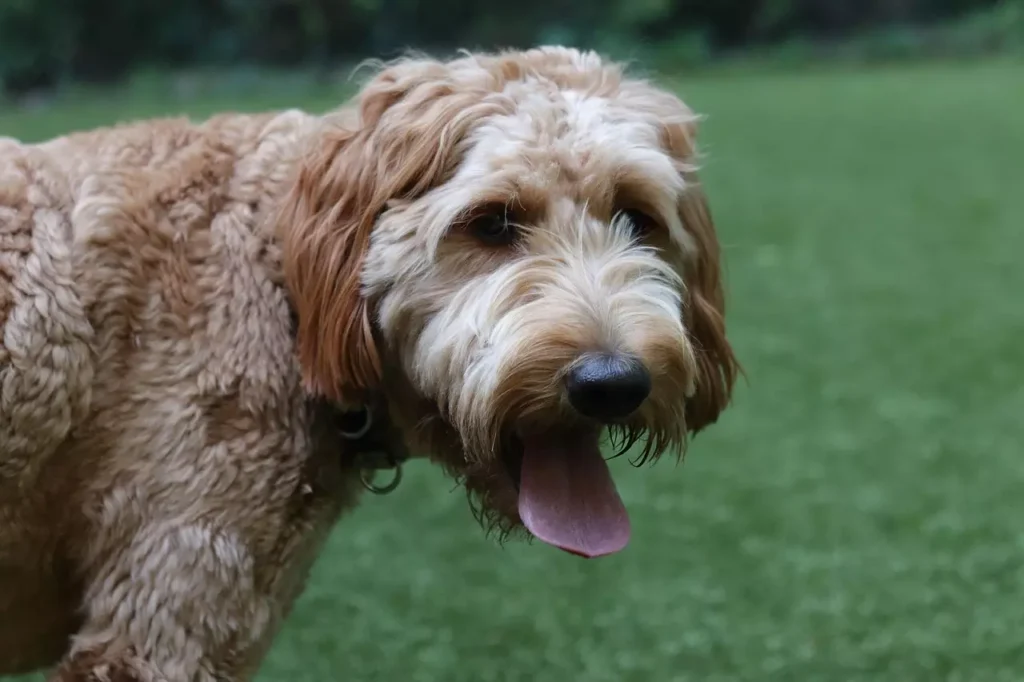
Goldendoodle
The Goldendoodle is a cross between a Golden Retriever and a Poodle. These intelligent, active dogs can make engaging companions, but their adult size, temperament, coat and shedding vary considerably, so prospective owners should be prepared for an unpredictable combination of traits.
Quick Facts
| Attribute | Details |
|---|---|
| Group | Crossbreed; not recognised as a pedigree breed by the Royal Kennel Club |
| Country of origin | Not formally established; intentional Goldendoodle breeding became widely known during the 1990s |
| Original purpose | Primarily companionship; some individuals work in assistance or therapy roles |
| Size & weight | Highly variable; approximately 50–61 cm and 22–41 kg is a guide for medium-to-large dogs, but smaller and larger dogs are possible |
| Life expectancy | Approximately 10–15 years |
| Coat & colours | Straight, wavy or curly; shedding varies. Colours include cream, gold, apricot, red, brown, black and grey |
| Exercise needs | High — substantial daily exercise and mental stimulation, adjusted to the individual |
| Grooming needs | Moderate to high — frequent brushing and often professional grooming |
| Trainability | Often high, but temperament and motivation vary |
| Barking tendency | Variable; may become vocal when excited, worried or under-stimulated |
| Suitable for | Active households prepared for regular training, grooming and variation in adult traits |
History & Origin
The Goldendoodle is a cross between a Golden Retriever and a Poodle. Standard Poodles are commonly used, although Miniature Poodles may be chosen to produce smaller dogs. Later generations can also involve two Goldendoodles or a Goldendoodle crossed back to one of the parent breeds.
Intentional breeding of Goldendoodles became widely known during the 1990s, following growing interest in other Poodle crosses such as the Labradoodle. Goldendoodles are not recognised as a pedigree breed by the Royal Kennel Club, and there is no single UK breed standard governing their size, coat or temperament.
What Were Goldendoodles Bred to Do?
Goldendoodles were developed mainly as companion dogs, with breeders hoping to combine qualities associated with Golden Retrievers and Poodles. Some have also worked successfully in assistance, therapy and other people-focused roles, although suitability for any specialised work must be assessed individually.
Both parent breeds have working retriever ancestry and are commonly associated with intelligence, activity and close cooperation with people. However, crossing them does not guarantee that every puppy will inherit a particular combination of traits.
Goldendoodle Size, Weight & Appearance
Goldendoodle size varies considerably because there is no fixed breed standard. Dogs with a Standard Poodle parent are usually medium to large, while those with Miniature Poodle ancestry may be smaller. Labels such as miniature, medium and standard are used by breeders but are not governed by one recognised UK measurement system.
Purina UK gives approximately 50–61 cm in height and 22–41 kg in weight as a guide for a typical medium-to-large Goldendoodle. Smaller and larger individuals are possible, so prospective owners should ask for the actual size and weight of both parents rather than relying only on a marketing label.
Coats may be straight, wavy or curly and can vary in density and texture. Colours include cream, gold, apricot, red, brown, black, grey and other shades inherited from the parent breeds. Appearance can vary even between puppies from the same litter.
Goldendoodle Temperament & Everyday Life
Goldendoodles are often described as sociable, playful and people-focused, but their temperament is not completely predictable. Parentage, breeding, early socialisation, training and individual experiences all influence how a dog behaves.
Many enjoy being involved in family life and may find long periods alone difficult. Some can be energetic or excitable, particularly when young, and larger individuals may accidentally knock over small children. Introductions should be managed carefully, and children should always be supervised around dogs.
Goldendoodles can live successfully with other dogs and sometimes with cats, but compatibility depends on the individuals involved. Gradual introductions, appropriate management and separate safe spaces may be needed.
Exercise & Mental Stimulation
Exercise requirements depend on the Goldendoodle’s size, age, health, temperament and the working drive inherited from the parents. Many adult Goldendoodles need substantial daily activity, and some larger, energetic individuals may require considerably more than a short walk.
Walks can be combined with retrieving games, swimming where it is safe, scent work, training and opportunities to explore. Mental stimulation is important because an under-stimulated dog may become restless, vocal or destructive.
Puppies should not simply follow an adult exercise routine. Activity should be appropriate for their stage of development, and owners should ask their vet for guidance if they are unsure about running, jumping or more strenuous exercise.
Training & Socialisation
Goldendoodles are often enthusiastic learners, but intelligence does not mean that training happens automatically. Positive, reward-based methods should begin early and remain consistent. Short sessions can help teach recall, settling, polite greetings and walking calmly on the lead.
Early socialisation should introduce puppies gradually to different people, friendly dogs, handling, grooming, household sounds and everyday environments. Socialisation should be positive and controlled rather than overwhelming the puppy with too many experiences at once.
Jumping up and over-excitement can become difficult to manage in a large adult dog, so calm behaviour should be rewarded from an early age. Recall also needs careful practice because individual Goldendoodles may be strongly motivated by wildlife, scents, water or other dogs.
Do Goldendoodles Shed? Grooming & Coat Care
Goldendoodles can shed. Straight or retriever-like coats may release more hair, while some wavy or curly coats shed less but trap loose hairs and mat easily. Coat type and shedding cannot be guaranteed from the Goldendoodle name or generation label alone.
Most require thorough brushing and coat care several times a week, with some coats needing daily attention. Areas behind the ears, around the collar, under the legs and around the feet are particularly easy to miss. Many Goldendoodles also need professional grooming, often approximately every six to eight weeks, depending on coat length and texture.
No dog is completely free from allergens. A low-shedding Goldendoodle may still trigger an allergic reaction through skin flakes, saliva or other allergens. Anyone with allergies should seek medical advice and spend time with the individual dog before making a commitment.
Goldendoodle Lifespan, Health & Veterinary Care
There is no official Goldendoodle lifespan because the dogs vary in size and ancestry. Purina UK uses approximately 10–15 years as a general guide. An individual dog’s longevity can be influenced by size, genetics, body condition, lifestyle and access to veterinary care.
Goldendoodles may inherit health risks associated with either parent breed. Depending on their ancestry, relevant concerns can include hip or elbow dysplasia, inherited eye conditions and certain genetic disorders. Being a crossbreed does not automatically protect a dog from inherited disease.
Responsible breeders should test both parents according to the current recommendations for their respective breeds. Royal Kennel Club guidance for Golden Retrievers includes hip, elbow and eye screening alongside relevant DNA tests. The recommended tests for Poodles differ according to whether the parent is Standard, Miniature or Toy.
Puppy buyers should ask for the registered names of both parents and copies of verifiable results, then check that the tests match the exact parental breeds. A general DNA panel or a statement that the parents were “vet checked” is not necessarily equivalent to the recommended screening.
Routine veterinary checks, dental care, suitable exercise and maintaining a healthy body condition remain important throughout life. Consult a vet if there are concerns about movement, vision, skin, ears, appetite, behaviour or general health.
Feeding & Care Basics
A Goldendoodle should receive a complete, balanced diet appropriate for their age, adult size, health and activity level. A small Goldendoodle and a large, active dog may have very different energy and nutritional requirements.
Use the food manufacturer’s guidance as a starting point and adjust portions according to the individual dog’s body condition with veterinary support where needed. Fresh drinking water should always be available, and treats should be included when considering overall food intake.
Puppies should receive food designed for growth and appropriate to their expected adult size. Sudden dietary changes should be avoided, and concerns about growth, digestion or feeding routines should be discussed with a vet.
Ethical Sourcing & Adoption (UK)
Goldendoodles are not registered as a pedigree breed by the Royal Kennel Club. However, responsible breeders should still provide clear information about ancestry, temperament, living conditions and health testing.
Ask which Poodle variety was used, what generation the puppies are and how large both parents are. Meet the puppy with their mother in the place where they were raised, review original health documentation and avoid sellers who refuse visits, offer immediate delivery or pressure buyers into paying quickly.
Generation labels such as F1 or F1B describe ancestry but do not guarantee size, temperament, shedding or suitability for allergies. These qualities can still vary between individual puppies.
Adoption is another option worth considering. Goldendoodles and other Poodle crosses may occasionally be available through general rescue organisations or breed-specific rescues, where staff can help assess the needs of an individual dog.
Legal Note (UK)
Goldendoodles are not specifically named as a prohibited type in current UK government guidance. General laws concerning welfare, identification and keeping dogs under control still apply. Owners should check current national guidance and any local rules affecting leads, public spaces, livestock and access.
Is the Goldendoodle Right for You?
Best for:
- Active households able to provide substantial daily exercise
- Owners interested in regular training and mental enrichment
- People prepared for potentially demanding coat maintenance
- Households comfortable with variation in adult size and temperament
Think twice if:
- You need a guaranteed low-shedding or allergy-friendly dog
- You want a predictable adult size or coat type
- You cannot provide regular grooming and professional coat care
- The dog would frequently be left alone for long periods
FAQs
What is a Goldendoodle?
A Goldendoodle is a cross between a Golden Retriever and a Poodle. The Poodle parent may be Standard or Miniature, and later-generation Goldendoodles can have more complex ancestry.
What is a Goldendoodle’s temperament like?
Goldendoodles are often sociable, playful and attentive to people, but temperament varies. Parentage, early socialisation, training and individual experiences all matter.
How big do Goldendoodles get?
There is no single standard size. Purina UK gives approximately 50–61 cm and 22–41 kg for a typical medium-to-large Goldendoodle, but Miniature Poodle crosses may be smaller and some dogs fall outside these ranges.
Do Goldendoodles shed?
Some shed noticeably, while others release less loose hair. Straight, wavy and curly coats can have different grooming and shedding patterns, and the result cannot be guaranteed before the coat develops.
Are Goldendoodles hypoallergenic?
No dog can be guaranteed hypoallergenic. A lower-shedding coat may still produce allergens, so individual contact and appropriate medical advice are important for people with allergies.
How much exercise does a Goldendoodle need?
Many are active dogs requiring substantial daily physical and mental activity. The appropriate amount depends on size, age, health and inherited working drive.
How often does a Goldendoodle need grooming?
Many need brushing several times a week or daily, together with professional grooming approximately every six to eight weeks. The schedule depends on the individual coat.
How long do Goldendoodles live?
Approximately 10–15 years is commonly used as a general guide. Lifespan varies according to size, genetics, health and lifestyle.
Are Goldendoodles good family dogs?
They can be affectionate family companions, but suitability depends on the individual dog and household. Their energy and possible adult size should be considered, and children must be supervised around dogs.
What do F1 and F1B Goldendoodle mean?
An F1 Goldendoodle has a Golden Retriever and a Poodle as parents. F1B usually describes a Goldendoodle crossed back to one of the parent breeds. These labels describe ancestry but do not guarantee coat, size or temperament.
What health tests should Goldendoodle parents have?
Testing should follow the current recommendations for both the Golden Retriever and the exact Poodle variety used. Buyers should request verifiable hip, elbow, eye and relevant DNA results rather than accepting a general claim that the parents are healthy.
Sources
- Purina UK — Goldendoodle breed information
- Royal Kennel Club — Golden Retriever information and health testing
- Royal Kennel Club — Standard Poodle information and health testing
- Royal Kennel Club — Miniature Poodle information and health testing
- GOV.UK — Controlling your dog in public
Information checked: September 2026. Crossbreed characteristics can vary considerably; every dog is an individual.