
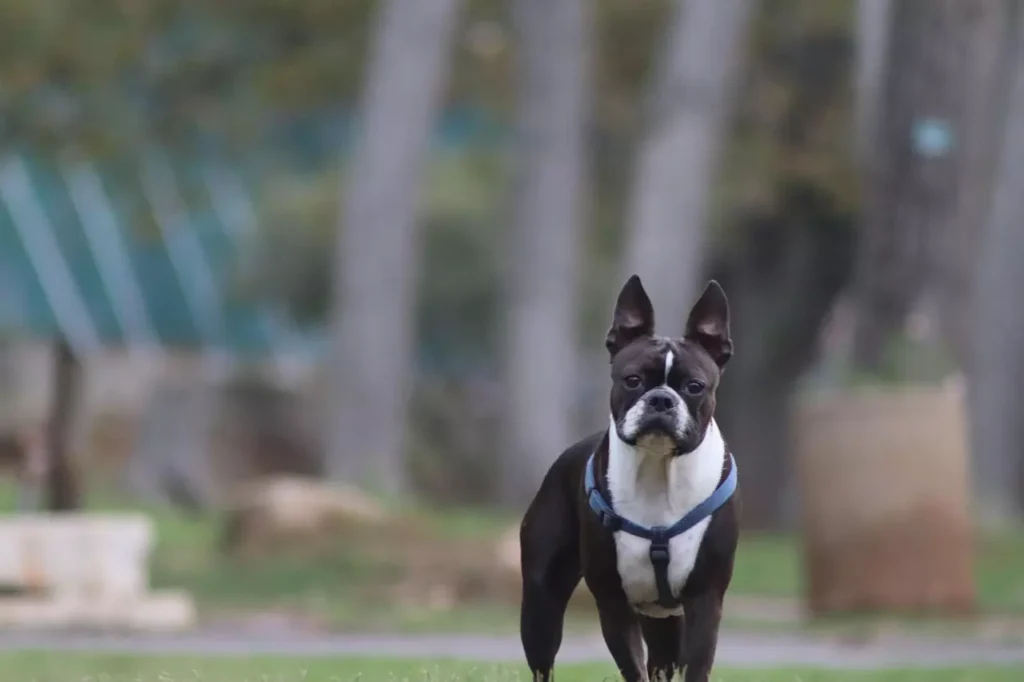
Boston Terrier
The Boston Terrier is a small American companion breed with a short coat, compact build and distinctive white markings. Individual dogs can be playful and people-oriented, but prospective owners should look beyond appearance and understand the health risks associated with the breed’s flat-faced conformation. Breathing function, eye health and the physical fitness of both parents should be considered carefully before choosing a puppy.
Quick Facts
| Attribute | Details |
|---|---|
| Group | Utility |
| Country of origin | United States |
| Original purpose | Developed from bull-and-terrier ancestry and established as a companion breed |
| Size & weight | Small; approximately 38–43 cm and commonly around 7–11 kg, although healthy size varies |
| Life expectancy | Typically over 10 years; individual lifespan varies |
| Coat & colours | Short, smooth coat; brindle, black or seal with characteristic white markings |
| Exercise needs | Up to around one hour daily for a healthy adult, adapted to breathing, fitness and weather conditions |
| Grooming needs | Generally weekly brushing, with regular skin, eye, dental and nail checks |
| Trainability | Often responsive to clear, patient reward-based training |
| Barking tendency | Variable; some are relatively quiet while others bark when alert, excited or distressed |
| Suitable for | Households prepared to manage brachycephalic health risks and provide appropriate exercise, training and company |
History & Origin
The Boston Terrier was developed in Boston, Massachusetts, during the late nineteenth century. Its ancestry included Bulldog and English White Terrier-type dogs, but subsequent breeding established a smaller companion dog with the characteristic markings recognised today.
The American Kennel Club recognised the breed in 1893. Although the Boston’s ancestry included dogs associated with historical blood sports, the modern breed was developed and standardised as a companion.
What Were Boston Terriers Bred to Do?
The Boston Terrier’s modern purpose is companionship. Unlike terriers developed primarily for vermin control, the breed is now classified in the Royal Kennel Club’s Utility group.
Companion breeding does not guarantee identical behaviour. Confidence, sociability, activity and responses to other animals vary according to genetics, early experiences, health, training and the individual home.
Boston Terrier Size, Weight & Appearance
The Boston Terrier is a compact, short-coated dog. PDSA gives an average height of approximately 38–43 cm and an average weight of around 7–11 kg. Healthy weight depends on the individual dog’s build and body condition.
The coat is smooth and short. Breed-standard colours include brindle, black or seal with white markings. Colour and marking patterns should never take priority over breathing function, eye health, sound movement and temperament.
The breed has a short muzzle and relatively large, prominent eyes. These features are associated with particular health risks and should not be exaggerated when selecting dogs for breeding.
Temperament & Living with a Boston Terrier
Boston Terriers can be lively, playful and interested in spending time with people. However, no breed description can guarantee that an individual dog will be friendly with every adult, child, dog or other animal.
Their size can make them manageable in flats and smaller homes, provided their exercise, training and companionship needs are met. Owners in shared buildings should also consider barking and how the dog copes with time alone.
Children and dogs must always be supervised together. The dog should have a quiet place where it can rest without being followed, lifted or disturbed.
Exercise & Mental Stimulation
Up to around one hour of daily activity is a general guide for a healthy adult Boston Terrier. The appropriate amount depends on age, breathing function, fitness, health and weather.
Exercise can be divided into shorter walks, sniffing opportunities, suitable play and reward-based training. Strenuous or prolonged activity is inappropriate when a dog is struggling to breathe or regulate its temperature.
Boston Terriers can overheat more readily than dogs with longer muzzles. During warm weather, choose cooler times of day, provide water and shade, and keep activity gentle. Never leave a dog in a hot car or enclosed warm space.
Laboured breathing, weakness, confusion, collapse or failure to recover normally after activity requires urgent veterinary advice.
Training & Socialisation
Use rewards to teach useful everyday behaviour, including recall, settling, comfortable handling and calm lead walking. Begin in a quiet environment and introduce distractions gradually.
Our guide to teaching a dog to walk nicely on the lead provides a practical starting point.
Socialisation should consist of safe, positive experiences that the puppy can manage. It should not involve forcing interaction with unfamiliar people or dogs. An adult rescue dog may need a programme adapted to its individual history.
Boston Terrier Grooming & Shedding
Boston Terriers shed despite their short coats. Weekly brushing is normally a practical starting point for removing loose hair and checking the skin.
Our guide to brushing your dog’s coat explains how to introduce grooming gradually.
Any facial wrinkles should be inspected regularly and kept clean and dry according to veterinary guidance. Repeated redness, odour, discharge, itching or soreness requires veterinary assessment rather than continued home cleaning.
The prominent eyes should be checked for redness, cloudiness, discharge, squinting or injury. Do not apply human eye products or unprescribed medication. Nails, ears and teeth also need routine care.
Brachycephalic Obstructive Airway Syndrome
The Boston Terrier is brachycephalic, meaning it has a shortened skull and muzzle. Some flat-faced dogs develop brachycephalic obstructive airway syndrome, usually abbreviated to BOAS. This can restrict airflow and affect exercise, sleep and temperature regulation.
Noisy breathing should not automatically be dismissed as normal for the breed. Snorting, persistent snoring while awake, gagging, exercise intolerance, disturbed sleep, overheating or slow recovery after activity may indicate impaired breathing and should be discussed with a vet.
Keeping a dog lean and avoiding heat can reduce additional strain, but management does not change its underlying anatomy. Some affected dogs require specialist assessment or surgery.
Boston Terrier Health & Lifespan
The Royal Kennel Club, PDSA and Dogs Trust give a typical Boston Terrier lifespan of more than 10 years. Individual lifespan is affected by genetics, conformation, health, body condition and veterinary care.
Health concerns reported in the breed include BOAS, eye disease, hereditary cataracts, luxating patellas, spinal abnormalities, skin disease and difficulties giving birth. Not every Boston Terrier will develop these conditions.
Current Royal Kennel Club Good Practice guidance includes eye examination through the BVA/KC/ISDS Eye Scheme. Its Best Practice recommendations include the HC-HSF4 DNA test for hereditary cataracts.
In August 2026, the Royal Kennel Club also recognised BOAS breathing assessment for Boston Terriers through its Respiratory Function Grading scheme. The club states that this test is due to be formally added to its Health Standard and Find a Puppy requirements from January 2027.
Prospective buyers should therefore request documented eye, HC-HSF4 and respiratory-function results for both parents and check the latest recommendations. A general “vet checked” statement is not a substitute for these specific assessments.
Feeding & Weight Management
A Boston Terrier needs a complete, balanced diet appropriate for its age, health and activity. Portions should be adjusted according to body condition rather than relying only on a target weight.
Food used as training rewards contributes to the dog’s total daily intake. Our guide to feeding your dog a balanced diet covers the main principles.
Maintaining a lean, healthy body condition is particularly important because excess weight can place additional strain on breathing, movement and temperature regulation.
Choosing a Boston Terrier Puppy
Visit the place where the litter was raised and see the puppy interacting with its mother. Observe the mother’s breathing while she is calm and after gentle movement. Do not accept obvious respiratory noise or exercise difficulty merely because it is described as normal for Boston Terriers.
Ask to see the parents’ eye, DNA and respiratory-function documentation. Consider the openness of the nostrils, length of muzzle, ability to move freely and absence of exaggerated wrinkles alongside the formal results.
Colour should not be the breeder’s main selling point. Red and white and blue and white are currently listed by the Royal Kennel Club as non-breed-standard colours, but coat colour alone does not establish whether a dog is healthy or responsibly bred.
Ethical Sourcing & Adoption in the UK
Boston Terriers may be available through general or breed-specific rescue organisations. A responsible rescue should explain the individual dog’s health, behaviour, treatment needs and preferred type of home.
If buying a puppy, avoid sellers who refuse visits, offer collection in a public place, continually advertise multiple breeds or pressure buyers to pay immediately. Consider arranging a pre-purchase discussion with an independent vet if you need help interpreting health results.
Owners should budget for the possibility of ongoing respiratory, eye, skin or dental treatment. Insurance exclusions and limits should be examined before committing to a policy.
Legal Note (UK)
The Boston Terrier is not named as a prohibited type under current UK government guidance. Welfare, identification and dog-control laws nevertheless apply to every breed.
Owners remain responsible for keeping their dog under control and meeting its health and welfare needs.
Is the Boston Terrier Right for You?
May suit you if:
- You want a small companion and can provide regular company
- You can offer moderate, carefully managed daily activity
- You are prepared for reward-based training and routine grooming
- You understand the health implications of a flat-faced body shape
- You can verify health testing and budget for veterinary care
Think carefully if:
- You want a dog for long-distance running or strenuous activity
- You cannot adapt exercise during warm weather
- You regard noisy or laboured breathing as harmless
- You are choosing primarily for an extremely flat face or unusual colour
- The dog would regularly be left alone for long periods
FAQs
How long do Boston Terriers live?
The Royal Kennel Club, PDSA and Dogs Trust give a typical lifespan of more than 10 years. Individual lifespan varies.
How big does a Boston Terrier get?
PDSA lists an average height of approximately 38–43 cm and an average weight of around 7–11 kg. Healthy weight depends on build and body condition.
How much exercise does a Boston Terrier need?
Up to around one hour daily is a general guide for a healthy adult, divided into manageable activities. Breathing, fitness and weather must be considered.
Do Boston Terriers have breathing problems?
Some develop BOAS because of their shortened skull and airway anatomy. Noisy or difficult breathing, poor exercise tolerance and overheating require veterinary attention.
Is snoring normal for a Boston Terrier?
It should not automatically be dismissed as normal. Frequent or severe respiratory noise, particularly while awake or exercising, may indicate restricted airflow.
Do Boston Terriers shed?
Yes. They usually shed less visibly than many longer-coated breeds, but weekly brushing is still useful.
Can Boston Terriers live in flats?
They can when their exercise, training, health and companionship needs are met. Barking and time alone should also be considered.
What health tests should Boston Terrier breeders complete?
Current UK recommendations include eye screening and HC-HSF4 DNA testing. BOAS respiratory-function grading was recognised for the breed in August 2026 and is due to enter the formal Health Standard from January 2027.
How much does a Boston Terrier cost in the UK?
Purchase prices and adoption fees vary. Budget for insurance and possible respiratory, eye, skin or dental treatment as well as routine care.
Sources
- Royal Kennel Club — Boston Terrier breed information and current health testing
- Royal Kennel Club — Boston Terrier breed standard
- PDSA — Boston Terrier care and breed-related health information
- Dogs Trust — Boston Terrier breed and rehoming information
- Dogs Trust — brachycephalic dogs and BOAS
- University of Cambridge — Brachycephalic Obstructive Airway Syndrome
- British Veterinary Association — Eye Scheme
- GOV.UK — controlling your dog
Information checked: September 2026. Breed descriptions provide general guidance; every dog is an individual.