
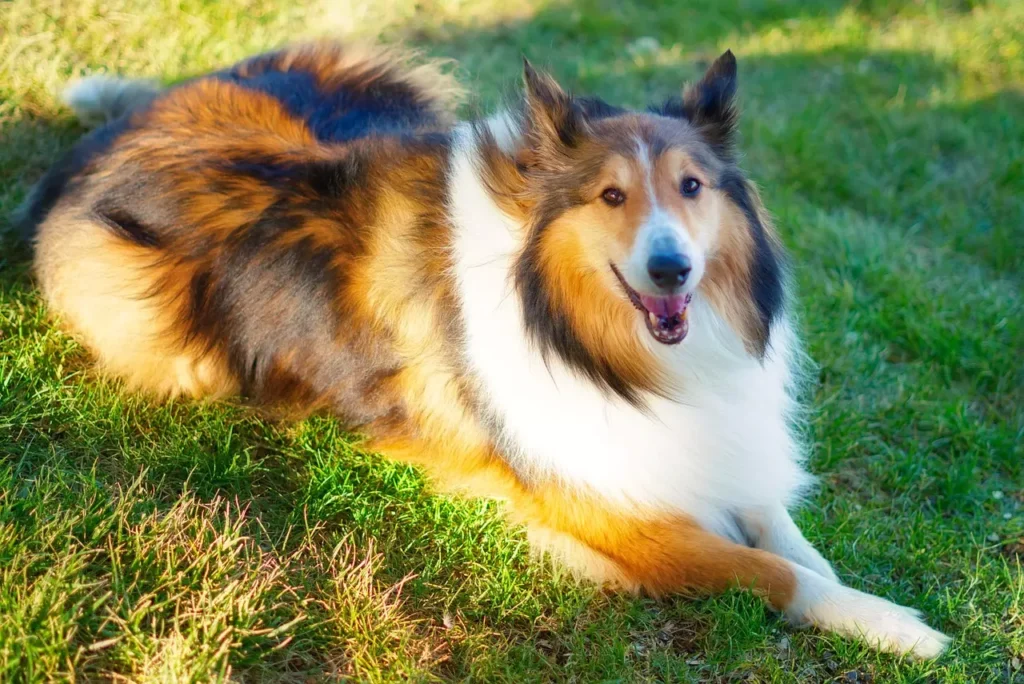
Collie (Rough)
Quick Facts
| Attribute | Details |
|---|---|
| Group | Pastoral |
| Country of origin | Scotland, United Kingdom |
| Original purpose | Herding and managing livestock |
| Size & weight | Medium to large; males approximately 56–61 cm and females 51–56 cm, with healthy weight depending on sex, build and condition |
| Life expectancy | Typically over 12 years |
| Coat & colours | Dense, long double coat in sable and white, tricolour or blue merle |
| Exercise needs | Up to around 1 hour daily, together with play, training and mental stimulation |
| Grooming needs | High; frequent brushing and more intensive care during seasonal shedding |
| Trainability | High; intelligent and generally responsive to gentle, reward-based training |
| Barking tendency | Moderate; many will alert bark or become vocal when excited |
| Suitable for | Active households able to provide companionship, training and regular coat care |
History & Origin
The Rough Collie shares its early history with the Smooth Collie and descends from working sheepdogs used in Scotland. These dogs were valued for their ability to manage livestock in difficult terrain and changing weather.
During the nineteenth century, Rough and Smooth Collies became more clearly defined as separate coat varieties. Queen Victoria’s interest in Collies helped increase their popularity beyond working farms, while selective breeding gradually produced the elegant appearance associated with the modern Rough Collie.
The breed later became widely recognised through books, films and television. Its popularity as a companion should not obscure its working ancestry or need for activity, training and engagement.
What Were Rough Collies Bred to Do?
Rough Collies were developed to help shepherds manage sheep and other livestock. Their work required stamina, awareness of movement, responsiveness to people and the ability to make decisions at a distance.
Most modern Rough Collies are family companions or show dogs, but some retain herding-related behaviour. This may include watching movement closely, circling, chasing or attempting to control people and animals. Suitable games and training can provide safer outlets for these instincts.
Rough Collie Size, Weight & Appearance
The Royal Kennel Club standard gives a height of approximately 56–61 cm for males and 51–56 cm for females. It does not specify one required weight. Adult weight depends on sex, frame, muscle and overall condition, so it is better assessed individually than taken from a rigid breed figure.
The Rough Collie has a long, clean, wedge-shaped head, almond-shaped eyes and small ears with tips that fold forwards when alert. The body should appear strong and capable of comfortable movement rather than heavy or exaggerated.
The abundant double coat consists of a straight, harsh outer layer and a soft, dense undercoat. Feathering is especially noticeable around the neck, chest, legs and tail.
Rough Collie Colours
The three colours recognised by the Royal Kennel Club are sable and white, tricolour, and blue merle. Each may include characteristic white markings.
Merle colouring requires responsible breeding. The Royal Kennel Club does not register puppies produced by a merle-to-merle mating because this combination increases the risk of hearing and vision impairment.
Colour should never take priority over health, temperament, genetic diversity and sound movement when choosing a puppy.
Rough Collie Temperament & Personality
Rough Collies are often attentive, responsive and closely connected to their household. Many are sensitive to voice, movement and changes in their surroundings, which can make them enjoyable to train but also means harsh handling may affect their confidence.
Individual temperament depends on genetics, early experiences, socialisation and the home environment. Some Rough Collies readily approach unfamiliar people, while others are more reserved and need time to assess a situation.
Many will bark to announce visitors, movement outside or excitement. Teaching calm alternative behaviours and avoiding repeated exposure to uncontrollable triggers can help prevent alert barking from becoming excessive.
Exercise & Mental Stimulation
A healthy adult Rough Collie generally needs up to around an hour of daily physical activity, although some individuals may enjoy more. Walks should include time to sniff and explore rather than focusing only on distance or speed.
Training games, scent work, retrieving, suitable agility and controlled herding activities can provide mental stimulation. Rough Collies often enjoy tasks that involve cooperation with their owner.
Exercise should be adjusted for puppies, older dogs and dogs with medical conditions. Growing puppies need shorter, age-appropriate outings, while dogs with joint or mobility concerns may need a plan agreed with their vet.
Training & Socialisation
Rough Collies are generally intelligent and capable learners. Calm, reward-based training is particularly appropriate for their often-sensitive nature. Short, varied sessions help maintain engagement without creating frustration.
Early training should cover recall, settling, cooperative handling and walking calmly on a lead. Controlled exposure to livestock and moving objects is also useful where these are likely to be encountered.
Socialisation should introduce a puppy gradually to suitable people, friendly dogs, traffic, household sounds, surfaces and different environments. The objective is calm confidence, not simply experiencing as many things as possible.
Some Collies can become worried by noise or busy surroundings. Allowing distance and working below the dog’s stress threshold is more productive than forcing it to remain in an overwhelming situation.
Grooming & Shedding
Rough Collies shed and require a substantial grooming commitment. Their dense undercoat can hide tangles close to the skin, particularly behind the ears, around the chest, beneath the legs and through the feathering.
Frequent brushing helps prevent mats and removes loose undercoat. Some dogs benefit from light daily attention combined with a more thorough groom each week. Additional grooming is normally required during seasonal coat changes.
Work through the coat in sections rather than brushing only its surface. Our guide to brushing your dog’s coat explains the general approach.
The double coat should not routinely be shaved. If severe matting, skin disease or a medical procedure makes clipping necessary, seek advice from a vet and an experienced, welfare-conscious groomer.
Nails, ears, teeth and skin should also be checked regularly. Sudden coat loss, persistent itching or inflamed skin requires veterinary attention.
Health & Lifespan
Rough Collies typically live for more than 12 years, although lifespan varies. Genetics, body condition, exercise, preventive healthcare and early recognition of illness can all influence an individual dog’s wellbeing.
Potential breed-related concerns include hip dysplasia, inherited eye conditions, degenerative myelopathy and sensitivity to certain medicines associated with the MDR1 gene variant. Not every Rough Collie develops these conditions.
At the time this page was checked, the Royal Kennel Club listed the following Good Practice pre-breeding screening:
- Eye testing through the BVA/KC/ISDS Eye Scheme, including litter screening
- Hip assessment through the BVA/KC Hip Dysplasia Scheme
Its additional Best Practice recommendations were DNA tests for:
- Collie eye anomaly/choroidal hypoplasia, known as CEA/CH
- Degenerative myelopathy, known as DM
- Multi-drug resistance, known as MDR1
- Progressive retinal atrophy, specifically PRA-rcd2
The MDR1 variant can affect how a dog responds to certain medicines. Owners who know or suspect that their Collie carries the variant should tell their vet before treatment. Medication should never be withheld or altered without veterinary guidance.
Prospective owners should ask for verifiable screening results for both parents. A general statement that the dogs were “vet checked” does not replace the specific eye, hip and DNA results recommended for the breed.
Feeding & Everyday Care
Feed a complete, balanced diet appropriate for the dog’s age, health and activity. Manufacturer instructions provide a starting point, but portions should be adjusted according to body condition and veterinary advice.
The long coat can make changes in body condition difficult to see. Owners should regularly feel over the ribs and monitor the dog’s shape and weight rather than judging condition from the coat alone.
Measure meals and include training treats in the overall daily allowance. Our guide to feeding a dog a balanced diet covers the general principles.
Living with Children and Other Pets
Many Rough Collies can live successfully with considerate children, but suitability depends on the individual dog and household. Interactions must be supervised, and children should learn to recognise when the dog wants space.
The breed’s movement sensitivity and herding ancestry can sometimes lead to chasing or attempts to control running children. Calm management and reward-based training are important.
Rough Collies may also live with other dogs and cats following careful introductions. Separate feeding and resting areas allow each animal to avoid unwanted interaction.
Ethical Sourcing & Adoption in the UK
Rough Collies are sometimes available through general rescue organisations and breed-specific rehoming groups. A responsible rescue should discuss the individual dog’s behaviour, health, grooming needs and suitability for the household.
When buying a puppy, meet the puppy with its mother in the place where it was raised. Ask to see verifiable eye, hip and relevant DNA results for both parents.
For blue merle puppies, confirm that the mating was not merle to merle. Avoid sellers who promote colour as more important than health or charge a premium based mainly on unusual markings.
A responsible breeder should discuss the breed’s health concerns openly, explain the results and remain available after the puppy leaves.
Legal Responsibilities in the UK
Rough Collies are not specifically listed as a prohibited type under current UK government guidance. General dog-control, identification and animal-welfare laws still apply.
Owners must keep their dog under proper control, comply with applicable microchipping requirements and follow local rules concerning leads, livestock and public spaces.
Is a Rough Collie Right for You?
A Rough Collie may suit you if:
- You want an intelligent and responsive companion
- You can provide daily exercise, training and mental stimulation
- You are prepared for frequent and thorough grooming
- You prefer gentle, reward-based training
- You will check comprehensive health results before buying a puppy
Think carefully if:
- You want a low-maintenance or low-shedding coat
- You cannot manage regular barking or sensitivity to movement and noise
- The dog would routinely be left alone for long periods
- You are unable to provide daily activity and interaction
- A breeder cannot provide verifiable eye, hip and DNA results
Frequently Asked Questions
How long do Rough Collies live?
Rough Collies typically live for more than 12 years. Individual lifespan depends on genetics, health, body condition, lifestyle and veterinary care.
How big does a Rough Collie get?
The Royal Kennel Club standard gives a height of approximately 56–61 cm for males and 51–56 cm for females. Healthy weight varies with sex, build and body condition.
Do Rough Collies shed a lot?
Yes. Their dense double coat sheds throughout the year and usually more heavily during seasonal coat changes. Frequent brushing is required.
How much exercise does a Rough Collie need?
A healthy adult generally needs up to around an hour daily, together with mental stimulation. Some individuals may enjoy additional suitable activity.
Are Rough Collies easy to train?
They are generally intelligent and responsive. Gentle, consistent, reward-based training works well, while harsh methods can undermine confidence.
Are Rough Collies good family dogs?
Many can be affectionate family companions, but suitability depends on the individual dog and household. Children and dogs must always be supervised together.
What health tests should Rough Collie breeders complete?
Current RKC guidance includes eye and hip screening, plus DNA tests for CEA/CH, DM, MDR1 and PRA-rcd2. Buyers should request verifiable results for both parents.
How much does a Rough Collie cost in the UK?
Purchase and adoption fees vary over time. Owners should also budget for food, insurance, grooming equipment and veterinary care throughout the dog’s life.
Sources
- Royal Kennel Club — Rough Collie information and current health standard
- Royal Kennel Club — Rough Collie breed standard
- Purina UK — Rough Collie care and grooming information
- British Veterinary Association — canine health screening schemes
- Washington State University — MDR1 information and testing
- GOV.UK — Controlling your dog in public
Information checked: September 2026. Breed descriptions provide general guidance; every dog is an individual.