
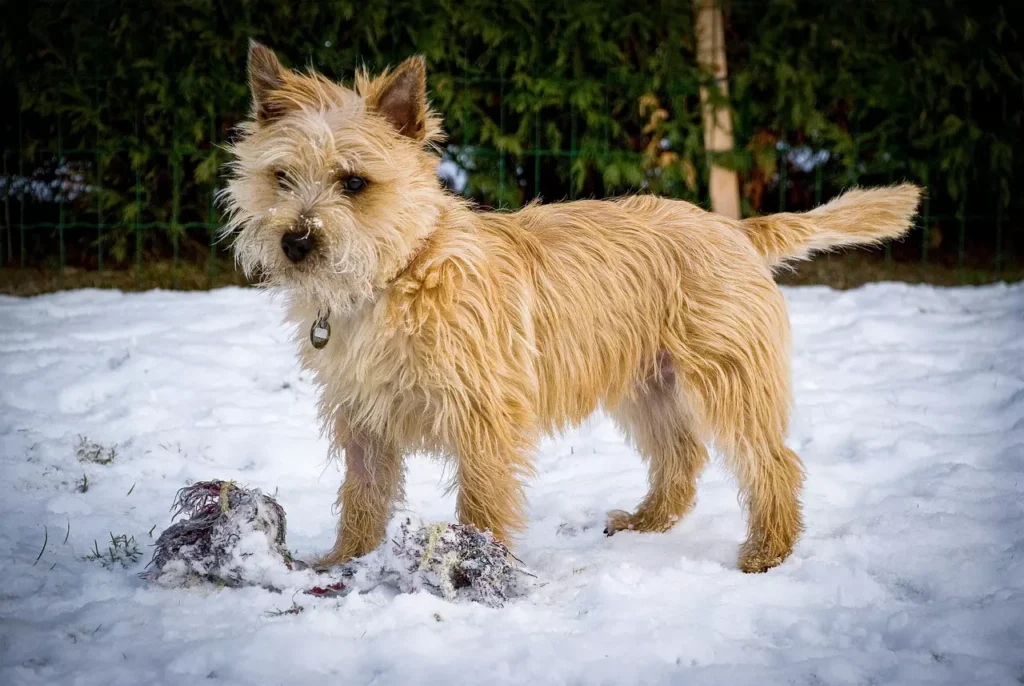
Cairn Terrier
Quick Facts
| Attribute | Details |
|---|---|
| Group | Terrier |
| Country of origin | Scotland, United Kingdom |
| Original purpose | Locating and controlling vermin among stone cairns and rough ground |
| Size & weight | Small; approximately 28–31 cm tall and usually around 6–8 kg |
| Life expectancy | Typically 12 years or more |
| Coat & colours | Weather-resistant double coat; cream, wheaten, red, grey or brindle shades, often with darker points |
| Exercise needs | Up to around 1 hour daily, together with play, exploration and mental stimulation |
| Grooming needs | Moderate; brushing more than once a week and periodic specialist coat care |
| Trainability | Intelligent and capable, but may be independent and easily distracted by scent or movement |
| Barking tendency | Moderate; may alert bark or become vocal when excited |
| Suitable for | Active households prepared for consistent training, coat care and typical terrier instincts |
History & Origin
The Cairn Terrier originated in the Scottish Highlands and islands, where small, hardy terriers were used to control vermin around farms, moorland and rocky ground. The breed takes its name from cairns: piles or outcrops of stones in which animals could hide.
Cairns often worked in demanding weather and terrain, so breeders valued courage, agility, persistence and a protective double coat. The Cairn, Scottish, Skye and West Highland White Terriers share elements of their early ancestry, although they eventually developed into separately recognised breeds.
What Were Cairn Terriers Bred to Do?
Cairn Terriers were bred to locate and pursue vermin among rocks and other confined spaces. Their small size allowed them to negotiate difficult ground, while their determination helped them continue working when faced with an interesting scent or movement.
Modern Cairns are primarily companion dogs, but many retain the curiosity, confidence and hunting instinct associated with their original work. Digging, investigating holes and chasing small animals can therefore be natural behaviours rather than signs of disobedience.
Cairn Terrier Size, Weight & Appearance
The Cairn Terrier is a small but sturdy dog. Adults are generally around 28–31 cm tall and commonly weigh approximately 6–8 kg, although healthy individuals can vary. Overall condition and proportion matter more than achieving one exact number.
The breed has a compact body, strong legs, small pointed ears and an alert expression. Its shaggy appearance comes from a weather-resistant double coat consisting of a harsh outer layer and a softer, insulating undercoat.
Recognised colours include cream, wheaten, red, grey and various brindle shades. Darker colouring around the ears and muzzle is common. Solid black, solid white and black and tan are not accepted under the Royal Kennel Club breed standard.
Cairn Terrier Temperament & Personality
Cairn Terriers are commonly lively, inquisitive and confident. Many form close relationships with their household and enjoy being included in everyday activities. Their small size does not necessarily make them quiet lap dogs: they are active terriers that usually want opportunities to explore and interact.
Individual temperament is shaped by genetics, early experiences, socialisation and training. Some Cairns are sociable with unfamiliar people, while others may initially be more reserved. Their alert nature can also lead to barking when somebody approaches the home or when they notice an unusual sound.
Cairns may live successfully with children who treat dogs calmly and respectfully. Interactions should always be supervised, and a dog must have somewhere quiet to rest without being disturbed. Compatibility with other animals depends on the individual dog, particularly because the breed may have a strong instinct to chase.
Exercise & Mental Stimulation
An adult Cairn Terrier generally needs up to around an hour of daily exercise, although the appropriate amount depends on age, health, fitness and personality. Walks can be divided across the day and combined with play, sniffing and opportunities to explore.
Secure gardens and enclosed exercise areas are useful, but fencing should be checked carefully because terriers may dig or investigate small gaps. Off-lead exercise requires a reliable recall and an appropriate location away from traffic, livestock and other hazards.
Food puzzles, scent games, short training sessions and searching activities can help satisfy a Cairn’s active mind. Puppies should receive age-appropriate exercise rather than being pushed through long or repetitive sessions while they are still developing.
Training & Socialisation
Cairn Terriers are intelligent, but their independence and interest in the environment can make training challenging. Short, varied sessions using rewards are usually more productive than repetition or punishment. Clear household rules and consistent responses from family members help prevent confusion.
Recall deserves particular attention because a Cairn may become absorbed by a scent or moving animal. Begin in a low-distraction environment and increase the difficulty gradually. A long training line can provide additional safety while the skill is developing.
Early socialisation should introduce a puppy carefully to different people, friendly dogs, surfaces, sounds and everyday situations. Practical skills such as recall, settling and walking calmly on a lead are valuable throughout the dog’s life.
Cairn Terrier Grooming & Shedding
Cairn Terriers have a harsh outer coat and soft undercoat. They do shed, although the amount is often relatively low. Brushing more than once a week helps remove loose hair, prevent tangles and identify changes in the skin or coat.
Traditional coat maintenance includes periodic hand stripping, which removes dead outer hairs while preserving the coat’s characteristic texture. Owners who are unfamiliar with the technique should seek advice from an experienced, welfare-conscious groomer. The frequency required depends on the individual coat and whether the dog is being prepared for showing.
Bathing should be occasional and use a dog-appropriate product. Nails, ears, teeth and the hair around the paws should also be checked regularly. See our guide to brushing your dog’s coat for general handling and brushing advice.
Cairn Terrier Health & Lifespan
Cairn Terriers typically live for 12 years or more, although no lifespan can be guaranteed. Genetics, preventive healthcare, suitable exercise, nutrition and maintaining a healthy body condition can all influence an individual dog’s wellbeing.
Not every Cairn develops a breed-related condition. However, published veterinary guidance identifies potential concerns including kneecap instability, eye disease, allergies, liver shunts and Legg–Calvé–Perthes disease. This list is not a diagnosis or a prediction for an individual dog.
At the time this page was checked, the Royal Kennel Club listed eye testing through the BVA/KC/ISDS Eye Scheme as a Best Practice pre-breeding test for Cairn Terriers. Prospective owners should ask a breeder to explain the parents’ health results and provide evidence rather than relying only on verbal reassurance.
Routine veterinary examinations remain important throughout life. Seek veterinary advice if a Cairn develops persistent itching, changes in vision, unusual movement, reduced appetite or another change in their normal behaviour or condition.
Feeding & Everyday Care
Feed a complete, balanced diet suitable for the dog’s age, health and activity level. The quantity printed on the packaging is a starting point rather than a fixed prescription, so portions may need adjusting according to the individual dog’s body condition and veterinary advice.
Measure meals and include training treats in the overall daily allowance. Fresh water should always be available. Our guide to feeding a dog a balanced diet explains the basic principles in more detail.
Cairns generally enjoy company and activity. Owners should gradually teach them to remain settled for short periods alone, rather than suddenly expecting a new puppy or rescue dog to cope with a full working day.
Living with Cats and Other Pets
Some Cairn Terriers can live with cats, particularly when introduced carefully at a young age, but compatibility cannot be assumed. Their original working purpose means that small, fast-moving animals may trigger chasing behaviour.
Introductions should be gradual and managed with physical separation where necessary. Cats need secure escape routes and access to dog-free areas. Rabbits, rodents and similarly small pets should remain safely housed and must not be left accessible to the dog.
Ethical Sourcing & Adoption in the UK
Cairn Terriers occasionally become available through general rescue organisations and breed-specific rehoming services. A responsible rescue should discuss the dog’s known history, behaviour, health and suitability for the household before completing an adoption.
When buying a puppy, meet the puppy with their mother where they were raised. Ask about temperament, socialisation, veterinary care and relevant health screening. For this breed, that includes asking about eye testing under the current Royal Kennel Club health standard.
A responsible breeder should answer questions openly, show original health documentation and ask prospective owners questions in return. Avoid sellers offering immediate collection, multiple unrelated breeds or delivery without allowing you to see the puppy’s living environment.
Legal Responsibilities in the UK
Cairn Terriers are not specifically listed as a prohibited type under current UK government guidance. However, laws concerning control, identification and animal welfare apply to all dogs.
Owners must keep their dog under proper control and follow local rules concerning leads, public spaces and livestock. Dogs in the UK must also be microchipped and recorded with the keeper’s current details, subject to the applicable national regulations.
Is a Cairn Terrier Right for You?
A Cairn Terrier may suit you if:
- You want a small but active and confident dog
- You can provide daily walks, play and mental stimulation
- You are willing to use patient, reward-based training
- You can manage regular brushing and periodic specialist coat care
- You understand that terrier instincts may include chasing, digging and alert barking
Think carefully if:
- You want a consistently quiet or highly compliant dog
- You cannot provide secure exercise and regular interaction
- You have small pets and cannot maintain safe separation
- You are unwilling to work on recall and lead skills
- The dog would routinely be left alone for long periods
Frequently Asked Questions
How long do Cairn Terriers live?
Cairn Terriers typically live for 12 years or more. Individual lifespan varies according to genetics, health, body condition, lifestyle and veterinary care.
How big does a Cairn Terrier get?
An adult Cairn is usually around 28–31 cm tall and commonly weighs approximately 6–8 kg. Healthy size can vary between individuals.
Do Cairn Terriers shed?
Yes, but shedding is often relatively low. Their double coat still needs brushing more than once a week and may require periodic hand stripping.
Are Cairn Terriers good family dogs?
They can be affectionate and entertaining family companions when their exercise, training and boundaries are handled consistently. Suitability depends on the individual dog and household, and children must always be supervised around dogs.
Can Cairn Terriers live in a flat?
Their small size can make flat living possible, provided they receive sufficient outdoor exercise, mental stimulation and training to manage barking. Access to a private garden is helpful but not a substitute for walks.
Can Cairn Terriers live with cats?
Some can, especially following careful early socialisation, but their hunting background means chasing remains a possibility. Introductions need to be gradual, supervised and adapted to both animals.
Are Cairn Terriers easy to train?
They are intelligent and can learn well, but may be independent or distracted by scents and movement. Short, engaging, reward-based sessions usually produce the best results.
How much does a Cairn Terrier cost in the UK?
Purchase and adoption fees change over time and vary between organisations. In addition to the initial fee, owners should budget for food, equipment, grooming, insurance and veterinary care throughout the dog’s life.
Sources
- Royal Kennel Club — Cairn Terrier breed information and current health standard
- Royal Kennel Club — Cairn Terrier breed standard
- Dogs Trust — Cairn Terrier care information
- PDSA — Cairn Terrier breed and health information
- GOV.UK — Controlling your dog in public
Information checked: September 2026. Breed descriptions provide general guidance; every dog is an individual.