
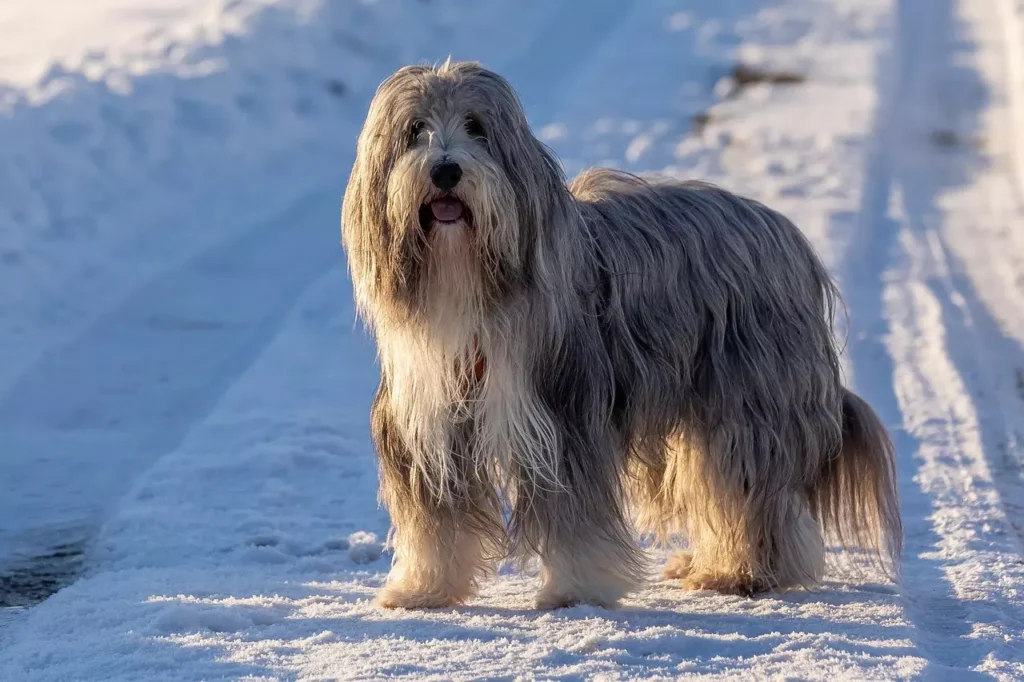
Bearded Collie
The Bearded Collie, often called the Beardie, is an active Scottish herding breed with a long double coat and an intelligent, lively character. Beardies can make engaging companions for active households, but they need consistent training, daily coat care and suitable physical and mental activity.
Quick Facts
| Attribute | Details |
|---|---|
| Group | Pastoral |
| Country of origin | Scotland |
| Original purpose | Herding and moving sheep and cattle |
| Size & weight | Ideal height: males 53–56 cm and females 51–53 cm. The UK breed standard does not specify a fixed weight |
| Life expectancy | Typically over 12 years; individual lifespan varies |
| Coat & colours | Long, shaggy double coat; slate, grey, black, blue, brown, sandy or reddish-fawn, with or without permitted white or tan markings |
| Exercise needs | Up to one hour per day is a general guide, combined with training and mental stimulation |
| Grooming needs | High — daily brushing and careful coat maintenance |
| Trainability | Often high — intelligent and responsive but active and capable of independent decisions |
| Barking tendency | Variable; some are vocal when excited, alert or under-stimulated |
| Suitable for | Active households able to provide daily grooming, training, companionship and suitable exercise |
History & Origin
The Bearded Collie, often called the Beardie, is a Scottish herding breed with a long association with moving cattle and sheep in the Scottish Borders and Highlands.
The first breed standard was created in 1912, but the population became very small by the 1940s. The modern breed was rebuilt from dogs including Jeannie and Bailey, which formed the foundation of the Bothkennar line. A new breed club was established in 1955, and the Royal Kennel Club recognised the breed in 1959.
What Were Bearded Collies Bred to Do?
Bearded Collies were developed to herd and move sheep and cattle across challenging Scottish terrain. Their work required stamina, agility, awareness and enough confidence to make decisions while responding to a handler.
Modern Beardies may still show strong interest in movement and herding-style behaviour. Some may try to follow, circle or chase people, animals or moving objects. Suitable training and management are therefore important even when the dog does not work with livestock.
Bearded Collie Size, Weight & Appearance
The Bearded Collie is a medium-sized, active dog with a lean but strong build. The Royal Kennel Club breed standard gives an ideal height of 53–56 cm for males and 51–53 cm for females.
The UK breed standard does not specify a fixed weight. A healthy weight depends on the individual dog’s height, build, age and body condition, so owners should ask their vet for an assessment rather than relying on an unofficial breed average.
Beardies have a soft, close undercoat beneath a flat, strong and shaggy outer coat. Recognised colours include slate, grey, black, blue, brown, sandy and reddish-fawn, with or without permitted white or tan markings. The long hair beneath the chin forms the characteristic beard that gives the breed its name.
Bearded Collie Temperament & Everyday Life
The UK breed standard describes the Bearded Collie as alert, lively, self-confident and active. Many are affectionate and enthusiastic companions, but temperament varies between individual dogs and is influenced by breeding, socialisation, training and previous experiences.
Their energy and movement can be overwhelming in some households, particularly during adolescence. Interactions with children should always be supervised, and calm behaviour should be rewarded from an early age. Compatibility with other dogs or pets depends on the individuals involved and how introductions are managed.
Beardies generally benefit from regular company and meaningful activity. Owners should introduce time alone gradually and provide an appropriate routine rather than assuming that every dog will cope comfortably with long absences.
Exercise & Mental Stimulation
UK breed and veterinary charities generally describe the Bearded Collie as an active dog requiring daily exercise and mental stimulation. Around one hour is a useful minimum guide for many healthy adults, but the appropriate amount depends on age, health, fitness and temperament.
Walks can be combined with sniffing, play, reward-based training, scent games and appropriately managed canine activities. Beardies often enjoy tasks that allow them to think and work with their owner rather than relying only on repetitive physical exercise.
Puppies need age-appropriate activity while their bodies develop. Owners should ask their vet for individual guidance before introducing sustained running, repeated jumping or demanding exercise.
Training & Socialisation
Bearded Collies are intelligent and often enjoy learning, but they can also become distracted or over-excited. Positive, reward-based training should begin early and remain consistent. Short, varied sessions can help maintain attention and build useful everyday skills.
Priorities include recall, settling calmly, polite greetings, impulse control and walking calmly on the lead. Training should be practised gradually in different environments rather than expected to transfer automatically from the home to busy outdoor settings.
Socialisation should introduce a puppy carefully to people, friendly dogs, handling, grooming, vehicles, sounds and different environments. The aim is to build calm confidence without forcing the puppy into situations they find overwhelming.
Do Bearded Collies Shed? Grooming & Coat Care
Bearded Collies shed. Their long double coat can release hair throughout the year, with the amount varying between individuals and at different stages of coat development. UK breed and welfare guidance consistently recommends frequent, thorough grooming.
Thorough brushing and coat care help prevent tangles and painful matting. Owners need to work through the coat carefully rather than brushing only the surface. Areas behind the ears, beneath the collar, under the legs and around the feet require particular attention.
The breed standard describes a natural protective coat that should not be trimmed for the show ring. Pet owners should discuss practical coat care with an experienced groomer if they are unsure how to maintain it. Nails, ears, teeth, eyes and skin also need routine checks.
How Long Do Bearded Collies Live? Health & Lifespan
Several UK breed and welfare sources describe the Bearded Collie’s typical lifespan as over 12 years, while the Bearded Collie Club reports that many live to around 13–14 years. Individual dogs may live for a shorter or longer period depending on genetics, health, body condition, lifestyle and access to veterinary care.
Current UK breed guidance identifies genetic diversity as an important breeding priority. Recommended checks include DNA testing for collie eye anomaly/choroidal hypoplasia, together with hip and elbow screening. The Bearded Collie Club and PDSA also provide information about health concerns and screening relevant to prospective owners.
Health testing helps breeders make better-informed decisions but cannot guarantee that a puppy will never develop a medical condition. Puppy buyers should ask for verifiable results and check them against the current recommendations rather than accepting a general statement that the parents are healthy.
Owners should arrange routine veterinary care and seek professional advice about changes in movement, vision, skin, appetite, behaviour or general condition. Maintaining a healthy body condition and providing suitable exercise can support long-term wellbeing.
Feeding & Care Basics
A Bearded Collie should receive a complete, balanced diet appropriate for their age, health and activity level. Feeding amounts should be based on the food manufacturer’s guidance and the individual dog’s body condition rather than assumptions about an active breed.
Fresh drinking water should always be available. Treats and training rewards should be included when considering total food intake. Owners who are unsure about portions, puppy growth or body condition should consult their vet.
Ethical Sourcing & Adoption (UK)
Anyone buying a Bearded Collie puppy should choose a responsible breeder who prioritises health, temperament and genetic diversity. Ask to see the puppy with their mother in the environment where they were raised and request verifiable health documentation.
Current Royal Kennel Club recommendations should be checked before buying because health-testing guidance may change. Avoid sellers who refuse visits, provide little information, offer immediate delivery or pressure buyers into paying quickly.
The Bearded Collie is currently identified as a vulnerable native breed in the UK. Adoption may also be possible through general rescue organisations or breed-specific rescues, although availability can be limited.
Legal Note (UK)
Bearded Collies are not specifically named as a prohibited type in current UK government guidance. General laws concerning welfare, identification and keeping dogs under control apply to all owners.
Owners should check current national guidance and local rules affecting leads, public spaces, access and livestock. Herding interest does not remove an owner’s responsibility to keep the dog under control.
Is the Bearded Collie Right for You?
Best for:
- Active households interested in regular training and enrichment
- Owners able to commit to daily coat maintenance
- People looking for an intelligent and lively companion
- Homes able to provide suitable exercise, company and routine
Think twice if:
- You want a low-maintenance or low-shedding dog
- You cannot provide frequent grooming and coat checks
- The dog would regularly be left alone for long periods
- You prefer a quiet, consistently calm companion
FAQs
Do Bearded Collies shed?
Yes. Bearded Collies shed, and their long double coat requires daily care to prevent tangles and matting.
How long do Bearded Collies live?
UK breed and welfare sources generally give a typical lifespan of over 12 years, with around 13–14 years also used as a broad guide. Lifespan varies between individual dogs.
How big does a Bearded Collie get?
The ideal height is 53–56 cm for males and 51–53 cm for females. The UK breed standard does not specify a fixed weight.
What is a Bearded Collie’s temperament like?
Beardies are commonly lively, alert and intelligent. Individual temperament still depends on breeding, socialisation, training and experience.
How much exercise does a Bearded Collie need?
Around one hour per day is a useful minimum guide for many healthy adults, but some need more. Exercise and mental stimulation should be adjusted for the individual dog.
Are Bearded Collies good family dogs?
They can be engaging family companions, but their energy, grooming needs and herding behaviour must suit the household. Children should always be supervised around dogs.
Are Bearded Collies easy to train?
They are intelligent and often enjoy learning, but they may become distracted or over-excited. Consistent, reward-based training works best.
Do Bearded Collies need daily grooming?
Yes. Their long double coat needs careful daily brushing, including areas where tangles are easily missed.
Can Bearded Collies live with other pets?
Some can, but compatibility depends on the individual animals. Their possible herding and chasing behaviour should be considered during gradual introductions.
Sources
- Royal Kennel Club — Bearded Collie breed information and health testing
- Royal Kennel Club — Bearded Collie breed standard
- Dogs Trust — Bearded Collie care, behaviour and grooming
- PDSA — Bearded Collie health, exercise and grooming
- Bearded Collie Club — breed health and screening overview
- GOV.UK — Controlling your dog in public
Information checked: September 2026. Breed descriptions are general guidance; every dog is an individual.