
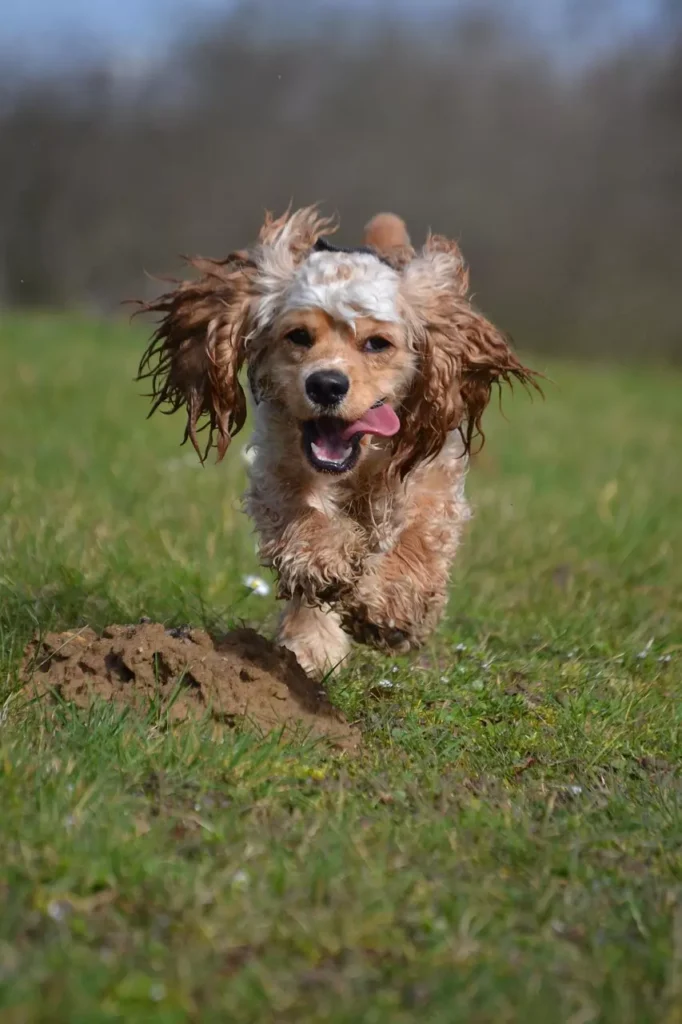
American Cocker Spaniel
The American Cocker Spaniel is a compact gundog developed in North America from Cocker Spaniels of British ancestry. Its long, feathered coat requires substantial care, while its sporting background means daily exercise and mental stimulation remain important. Temperament varies between individuals, so responsible breeding, positive socialisation and reward-based training matter more than general descriptions of the breed.
Quick Facts
| Attribute | Details |
|---|---|
| Group | Gundog |
| Country of origin | United States and Canada |
| Original purpose | Flushing and retrieving game birds |
| Size & weight | Ideal height approximately 37–39 cm for males and 34–37 cm for females; the UK breed standard does not specify a fixed weight |
| Life expectancy | Typically over 10 years; individual lifespan varies |
| Coat & colours | Medium-length silky coat with substantial feathering; available in solid, parti-colour, roan and tricolour combinations |
| Exercise needs | More than two hours per day as a general breed guide, adjusted for age, health and fitness |
| Grooming needs | High; daily coat care and regular professional grooming are usually required |
| Trainability | Often responsive to patient, consistent and reward-based training |
| Barking tendency | Variable; some are vocal when excited, alert, frustrated or worried |
| Suitable for | Active households able to provide extensive coat care, exercise, training and companionship |
History & Origin
The American Cocker Spaniel shares its early ancestry with the English Cocker Spaniel. During the late nineteenth and early twentieth centuries, breeders in North America gradually selected for a smaller, more compact dog with a different head shape and a fuller coat.
By the 1920s, the American and English types had become noticeably different. The American Kennel Club provided separate classes for English-type Cockers in 1936 and recognised the two as separate breeds in 1945.
The American Cocker retained its gundog ancestry but became particularly well known as a companion and show dog. In the UK, it is recognised by the Royal Kennel Club as a distinct breed in the Gundog group.
What Were American Cocker Spaniels Bred to Do?
American Cocker Spaniels descend from dogs used to find, flush and retrieve game birds. Their work required movement through cover, cooperation with a handler and an interest in searching and carrying objects.
Modern companion dogs may still enjoy scent games, retrieving, exploring undergrowth and carrying toys. The strength of these behaviours differs between individuals and should not be assumed from appearance alone.
Providing suitable outlets for searching and retrieving can add variety to daily exercise. Owners must also manage chasing behaviour responsibly around wildlife and other animals.
American Cocker Spaniel Size & Appearance
The American Cocker is a small, compact and strongly built spaniel. The UK breed standard gives an ideal height of approximately 37–39 cm for males and 34–37 cm for females.
The breed standard does not specify a fixed adult weight. Healthy weight depends on height, sex, build, muscle and body condition, so an individual dog should be assessed rather than compared with a single target number.
Distinctive features include a rounded but not exaggerated head, hanging ears, a compact body and a substantial feathered coat. The eyes should not be protruding, and coat should not be so excessive that it hides the dog’s outline or interferes with movement.
Recognised colours include black, buff, red, chocolate, black and tan, parti-colours, roans and tricolours. Health, temperament and functional movement are more important than colour or coat volume.
American Cocker Spaniel Temperament & Home Life
American Cockers can be active, affectionate and interested in being involved with their household. However, breed descriptions cannot predict the personality of an individual dog.
Some are confident around unfamiliar people and animals, while others may be cautious or require more personal space. Behaviour is influenced by genetics, health, early experiences, socialisation, training and the home environment.
The breed is sometimes described as particularly sensitive. Rather than treating this as a fixed personality trait, owners should observe the individual dog’s body language and introduce new experiences at a manageable pace.
Time alone should be taught gradually. Persistent barking, destruction, toileting or distress when left should be investigated with veterinary and appropriately qualified behavioural support.
Are American Cockers Good with Children and Other Pets?
Some American Cocker Spaniels live successfully with children, but compatibility depends on the individual dog and the household. Children should be taught not to pull the ears or coat, disturb the dog while resting or eating, or prevent it from moving away.
All interaction between dogs and children requires responsible adult supervision. The dog should have access to a quiet resting area where it will not be disturbed.
Some American Cockers enjoy living with other dogs or cats, while others may not. Introductions should be gradual and managed according to the animals involved. Gundog ancestry may contribute to interest in birds or smaller animals, so supervision remains important.
How Much Exercise Does an American Cocker Need?
The Royal Kennel Club currently lists more than two hours of daily exercise as its general guide for the breed. This should not mean forced running or continuous high-intensity activity.
Exercise can be divided between walks, safe opportunities to explore, sniffing, retrieving, training and suitable play. The appropriate amount depends on age, health, fitness, weather and the individual dog’s ability to settle and recover.
Puppies need shorter, age-appropriate activity with plenty of rest. Repetitive jumping, forced long-distance running and excessive high-impact exercise should be avoided while the dog is developing.
Older dogs and dogs with joint, heart or other health conditions may require an adapted routine developed with veterinary advice.
Training & Socialisation
American Cockers can learn effectively through rewards, but they should not automatically be described as easy to train. Motivation, confidence, distractions and previous learning all influence progress.
Useful skills include recall, calm lead walking, settling, releasing objects and remaining comfortable during grooming and veterinary handling. Training should begin in quiet surroundings and gradually progress to more distracting places.
Our guide to teaching a dog to walk nicely on the lead provides a practical reward-based starting point.
Socialisation should involve safe, positive experiences rather than forced interaction. Puppies should be allowed to observe and move away instead of being required to greet every person or dog.
Harsh corrections can increase fear or conflict without teaching the desired response. Sudden behavioural changes should also be discussed with a vet because discomfort can affect behaviour.
American Cocker Spaniel Grooming & Shedding
American Cocker Spaniels shed and require substantial coat maintenance. The Royal Kennel Club lists daily grooming, reflecting the length and density of the coat and feathering.
Hair can mat behind the ears, beneath the collar or harness, in the armpits, around the legs and close to the skin. Brushing only the surface may leave hidden tangles underneath.
Our guide to brushing a dog’s coat explains how to introduce grooming gradually and check that the coat is free from knots.
Many companion dogs need regular professional grooming, but the interval depends on coat length, texture, lifestyle and the chosen trim. Owners still need to maintain the coat between appointments.
The feathering should remain functional and should not restrict movement, conceal skin problems or make everyday care unnecessarily difficult.
Ear, Eye & Dental Care
The long, heavily coated ears require regular checks. Owners should look for redness, discharge, odour, discomfort or repeated head shaking and seek veterinary advice if these occur.
Hair should not be removed from inside the ear canal and cleaning products should not be used without suitable professional guidance. Ear disease can be painful and requires proper assessment.
The eyes should also be monitored for redness, cloudiness, discharge, squinting or changes in vision. Eye discomfort can require prompt veterinary attention.
Teeth and gums need routine care. Tooth brushing should be introduced gradually using dog-safe products, while difficulty eating, persistent bad breath or facial swelling should be assessed by a vet.
American Cocker Spaniel Health & Lifespan
American Cocker Spaniels typically live for more than 10 years, although lifespan varies between individuals. Genetics, body condition, preventive care, lifestyle and access to veterinary treatment can all influence long-term health.
Eye disease is an important consideration in the breed. Current Royal Kennel Club Good Practice guidance includes examination through the BVA/KC/ISDS Eye Scheme together with gonioscopy for pectinate ligament abnormality.
To meet current Best Practice, breeders should additionally complete the DNA test for progressive retinal atrophy, known as prcd-PRA, and hip assessment through the BVA/KC Hip Dysplasia Scheme.
The RKC also places the American Cocker in Breed Watch Category 2, meaning that particular conformational features may require attention if exaggerated. Puppy buyers should consider comfortable movement, clear eyes, open nostrils, functional coat and overall health rather than selecting for an extreme appearance.
Potential health problems are not limited to the formally screened conditions. Ear, skin, dental and other medical problems may occur, so routine veterinary examinations remain important.
Changes such as persistent scratching, lameness, eye discomfort, repeated ear problems, appetite changes or altered behaviour should be assessed by a vet rather than diagnosed from an online breed description.
Feeding & Everyday Care
An American Cocker Spaniel needs a complete, balanced diet suitable for its age, health and activity. Feeding amounts should be measured for the individual dog and adjusted according to body condition.
Our guide to feeding a dog a balanced diet explains the main principles. Treats used during training should be included when considering total daily intake.
Fresh drinking water should always be available. Owners should also plan for grooming costs, preventive healthcare, insurance or veterinary bills, suitable equipment, training and care during holidays or working hours.
Ethical Sourcing & Adoption in the UK
The American Cocker Spaniel is less common in the UK than the English Cocker, so finding a suitable puppy may take time. Availability should not take priority over welfare and responsible breeding.
A responsible breeder should allow buyers to meet the puppy with its mother where the litter was raised. They should provide verifiable eye, gonioscopy, prcd-PRA and hip results and explain how they consider temperament, genetic diversity and conformation.
A certificate showing a routine veterinary examination is not a replacement for formal screening or DNA-test results. Buyers should verify documentation through official databases where possible.
Avoid sellers who refuse visits, arrange collection in public places, offer several breeds continuously or pressure buyers to pay immediately.
Spaniel rescue organisations may occasionally have American Cockers available. A responsible rescue should assess the individual dog and provide honest information about its known behaviour, health, grooming needs and preferred home.
Legal Note (UK)
The American Cocker Spaniel is not named as a prohibited type under current UK government guidance. However, identification, welfare and dog-control laws apply to every breed.
Owners must keep their dog under control and follow national and local rules affecting public spaces, livestock and access.
Is the American Cocker Spaniel Right for You?
May suit you if:
- You can provide substantial daily exercise and mental stimulation
- You are prepared for daily coat care and regular professional grooming
- You will use patient, reward-based training
- You can check the ears, eyes, skin and coat routinely
- You are prepared to verify the parents’ health-test results
Think carefully if:
- You want a low-maintenance coat
- You cannot provide the breed’s exercise and training requirements
- The dog would regularly be left alone for long periods
- You are unwilling to budget for professional grooming
- You are choosing primarily for coat colour or an exaggerated show appearance
FAQs
How long do American Cocker Spaniels live?
The Royal Kennel Club lists the breed’s typical lifespan as more than 10 years. Individual lifespan depends on genetics, health and care.
How big does an American Cocker Spaniel get?
The ideal UK height is approximately 37–39 cm for males and 34–37 cm for females. The UK breed standard does not specify one fixed weight.
How much exercise does an American Cocker Spaniel need?
The Royal Kennel Club gives more than two hours per day as its general guide. Exercise should be adapted to the individual dog’s age, health and fitness.
Do American Cocker Spaniels shed?
Yes. Regular brushing helps manage loose hair but does not stop shedding.
How often do American Cockers need grooming?
Their long, feathered coat generally requires daily attention and regular professional grooming. The exact schedule depends on coat and lifestyle.
Are American Cocker Spaniels easy to train?
Many respond well to patient, reward-based training, but ease of training varies. Distractions, motivation and previous experiences all affect learning.
Are American Cockers good with children?
Some make suitable family companions, but compatibility depends on the individual dog and household. Adult supervision is always required.
Can American Cocker Spaniels live with cats?
Some can following careful assessment and gradual introductions. The individual animals’ behaviour is more important than breed labels.
What health tests should breeders complete?
Current RKC Good Practice includes BVA/KC/ISDS eye testing and gonioscopy. Best Practice additionally includes prcd-PRA DNA testing and BVA/KC hip assessment.
Is an American Cocker the same as an English Cocker Spaniel?
No. They share early ancestry but are recognised as separate breeds with different standards, proportions and coat characteristics.
Sources
- Royal Kennel Club — American Cocker Spaniel breed information
- Royal Kennel Club — American Cocker Spaniel breed standard
- Royal Kennel Club — Health Standard
- British Veterinary Association — Eye Scheme and gonioscopy
- British Veterinary Association — Hip Dysplasia Scheme
- Spaniel Aid UK — Rescue and rehoming
- Second Chance Spaniel Rescue — UK spaniel rescue
- GOV.UK — Controlling your dog in public
Information checked: September 2026. Breed descriptions provide general guidance; every dog is an individual.