
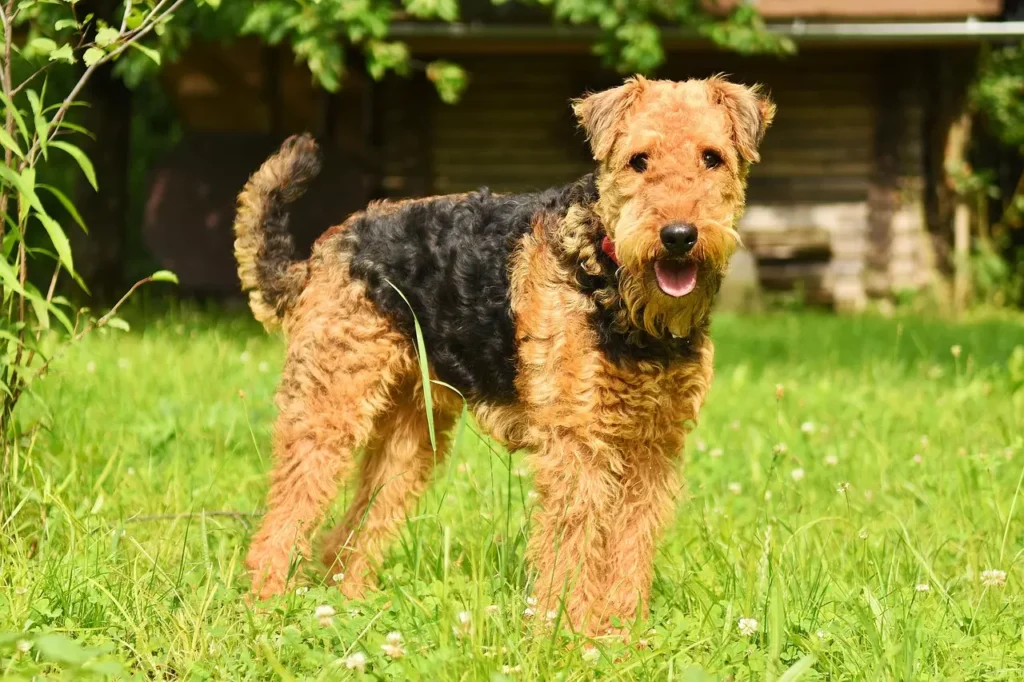
Airedale Terrier
The Airedale Terrier is the largest recognised terrier breed, developed in Yorkshire as a versatile working dog. Airedales can be active, alert and interested in their surroundings, but temperament varies between individuals. They need consistent reward-based training, regular exercise, appropriate outlets for terrier behaviour and ongoing care for their dense, wiry coat.
Quick Facts
| Attribute | Details |
|---|---|
| Group | Terrier |
| Country of origin | United Kingdom — Yorkshire |
| Original purpose | Versatile working terrier used around waterways for controlling vermin, scent work and other tasks |
| Size & weight | Large terrier; desirable height approximately 58–61 cm for males and 56–59 cm for females; healthy weight varies by build |
| Life expectancy | Typically over 10 years; individual lifespan varies |
| Coat & colours | Dense, hard and wiry coat with an undercoat; black or grizzle saddle with tan colouring |
| Exercise needs | Up to around one hour per day as a general guide, with additional training and mental stimulation |
| Grooming needs | Moderate to high; frequent brushing or combing and regular professional trimming or hand stripping |
| Trainability | Capable and responsive, but needs patient, consistent and reward-based training |
| Barking tendency | Variable; some are vocal when alert, excited, frustrated or under-stimulated |
| Suitable for | Active households prepared for regular training, coat care and secure management of a large terrier |
History & Origin
The Airedale Terrier originated in Yorkshire, particularly around the valley of the River Aire. Early dogs were sometimes known as Waterside Terriers because they worked around riverbanks and waterways.
The breed was developed from local working terriers, with Otterhound ancestry commonly associated with its scenting ability, size and usefulness around water. Breeders aimed to create a versatile dog capable of controlling vermin and working across varied terrain.
Airedales were later used for tasks including tracking, guarding, carrying messages and assisting military and Red Cross personnel during the World Wars. Modern Airedales are principally companions, although their working ancestry continues to influence their activity, curiosity and training needs.
What Were Airedale Terriers Bred to Do?
Airedales were expected to perform several jobs rather than specialise in one narrow role. Their work included following scent, dealing with vermin, retrieving and assisting people in demanding environments.
This background may be reflected in behaviours such as digging, searching, carrying objects, investigating scents and chasing movement. The strength of these behaviours differs between individuals.
Owners can provide appropriate outlets through scent games, retrieving, food searches, structured play and reward-based training. These activities do not remove the need for safe management around wildlife, livestock and smaller animals.
Airedale Terrier Size, Weight & Appearance
The Airedale is the largest breed in the Royal Kennel Club’s Terrier group. The UK breed standard gives a desirable height of approximately 58–61 cm for males and 56–59 cm for females.
The breed standard does not prescribe one fixed adult weight. Healthy weight depends on sex, height, build, muscle and overall body condition, so owners should assess the individual dog rather than aim for an arbitrary number.
Airedales have a sturdy, athletic outline, a long head, folded ears and a dense coat. The recognised colouring consists of a black or grizzle saddle with tan on areas including the head, ears and legs.
Sound movement and functional proportions are more important than exaggerated size, coat or facial furnishings.
Airedale Terrier Temperament & Home Life
Airedales can be active, observant and engaged with their surroundings. Some enjoy meeting unfamiliar people and dogs, while others may be more selective or cautious. Breed alone cannot predict an individual dog’s behaviour.
Temperament is influenced by genetics, early development, socialisation, health, training and previous experiences. Labels such as stubborn, dominant or fearless do not explain why a particular dog behaves in a certain way.
Their size and enthusiasm can make calm household skills especially important. Teaching an Airedale to settle, greet without jumping and move away from exciting situations can make daily life easier and safer.
Time alone should be introduced gradually. Persistent barking, destruction, toileting or distress when left should be investigated rather than dismissed as misbehaviour.
Are Airedales Good with Children and Other Pets?
Some Airedales live successfully with children, but suitability depends on the individual dog and the household. Their size and energy mean that excited play can become physically overwhelming even without aggressive intent.
Children should be taught to respect the dog’s food, bed and need to move away. Every interaction between dogs and children requires responsible adult supervision.
Airedales may live with other dogs or cats following careful assessment and gradual introductions. Their terrier ancestry means that interest in chasing smaller animals must be considered. They should not automatically be assumed safe with rabbits, rodents or other small pets.
Exercise & Mental Stimulation
The Royal Kennel Club lists up to around one hour of daily exercise as a general breed guide. Individual requirements vary according to age, health, fitness, temperament and the intensity of the activity.
Many adult Airedales enjoy purposeful walks, sniffing, training and opportunities to explore safely. Exercise should include mental engagement rather than relying only on distance, speed or repetitive ball throwing.
Scent games, searching for food, retrieving and learning practical skills can provide useful enrichment. An unsettled dog may also need more sleep, a calmer environment or help with frustration rather than simply increasing physical exercise.
Puppies should receive shorter, age-appropriate activity and should not be forced to run long distances or repeatedly jump while developing. Exercise for older dogs and dogs with health conditions should be adapted with veterinary guidance.
Training & Socialisation
Airedales can learn a wide range of skills, but their interest in scent, movement and the surrounding environment may compete with the handler for attention. Training should use rewards that the individual dog values.
Useful skills include recall, calm lead walking, settling, dropping or exchanging objects and remaining comfortable during grooming. Sessions are often most effective when they are short, clear and gradually increased in difficulty.
Our guide to teaching a dog to walk nicely on the lead provides a reward-based starting point for managing a strong, active dog.
Socialisation should consist of controlled, positive experiences rather than forced interaction. Puppies and adult rescue dogs should be allowed to observe, process and move away when they need more space.
Punishment may increase anxiety or conflict without teaching the required behaviour. Sudden behavioural changes should also prompt a veterinary check because pain and illness can affect responses.
Recall, Chasing & Secure Exercise
Airedales may become distracted by scents, wildlife or fast movement. Recall should first be practised in quiet places before progressing to more challenging environments.
A long training line attached to a suitable harness can provide controlled freedom while recall is developing. It should be used away from roads and handled carefully to reduce the risk of injury.
Off-lead exercise is safest in secure areas unless the individual dog has dependable recall under the conditions involved. Gardens should have suitable fencing, and owners should consider the possibility of digging as well as jumping or pushing through gaps.
Airedale Terrier Grooming & Shedding
The Airedale has a hard, wiry outer coat with a softer undercoat. The Royal Kennel Club describes the breed as non-shedding, but owners may still find some loose hair, and no dog should be presented as guaranteed not to shed or trigger allergies.
The coat needs frequent brushing or combing to prevent tangles, particularly around the beard, legs and areas affected by a collar or harness. Our guide to brushing a dog’s coat explains how to introduce grooming gradually.
Regular professional coat care is usually required. Hand stripping removes dead outer coat while helping retain a traditional wiry texture. Clipping is another practical option for many companion dogs, although it can alter coat texture and colour over time.
The appropriate schedule depends on coat, lifestyle and the owner’s preferred finish. Owners should discuss this with a groomer experienced with wire-coated terriers.
The beard should be checked and cleaned when necessary, while nails, teeth, ears, paws and skin need routine attention. Persistent itching, odour, redness or hair loss requires veterinary advice.
Airedale Terrier Health & Lifespan
Airedale Terriers typically live for more than 10 years, although lifespan varies between individuals. Genetics, body condition, lifestyle, preventive care and access to veterinary treatment can all influence long-term health.
The Royal Kennel Club currently lists hip and elbow assessment through the BVA/KC schemes as Best Practice health screening for the breed. These schemes evaluate the parent dogs themselves; a statement that they were simply examined by a vet is not an equivalent result.
Prospective puppy buyers should ask for copies of both parents’ scores and verify results where possible. Scores should be considered alongside temperament, genetic diversity, general health and the breeder’s approach to welfare.
Joint problems are not the only conditions that can affect an Airedale. Owners should arrange routine veterinary checks and seek advice about persistent lameness, stiffness, skin problems, digestive changes, unusual lumps or changes in behaviour.
No breed profile can diagnose an individual dog. Sudden swelling of the abdomen, repeated unsuccessful attempts to vomit, collapse or breathing difficulty require urgent veterinary attention.
Feeding & Everyday Care
An Airedale should receive a complete, balanced diet appropriate for its age, health and activity. Feeding amounts should be measured for the individual dog and adjusted according to body condition.
Our guide to feeding a dog a balanced diet explains the main principles. Treats used during training should be included when considering total daily intake.
Fresh water should always be available. Owners should also budget for grooming, training, preventive healthcare, insurance or veterinary costs, suitable equipment and care when they are away.
Ethical Sourcing & Adoption in the UK
Airedale Terriers can occasionally be found through breed-specific and general rescue organisations. A responsible rescue should assess the individual dog and explain its known behaviour, health and preferred home.
A responsible breeder should allow buyers to meet the puppy with its mother where the litter was raised. They should provide verifiable hip and elbow results for both parents and openly discuss temperament, health, socialisation and genetic diversity.
Buyers should avoid sellers who refuse visits, arrange collection in a public place, cannot show genuine documentation or pressure them into making an immediate payment.
A waiting list is preferable to buying from an unsuitable source. The availability of a puppy should never be treated as more important than welfare and responsible breeding.
Legal Note (UK)
The Airedale Terrier is not named as a prohibited type under current UK government guidance. However, identification, welfare and dog-control laws apply to every breed.
Owners must keep their dog under control and prevent it from worrying livestock or pursuing wildlife where restrictions apply. Local rules concerning leads, access and public spaces should also be followed.
Is the Airedale Terrier Right for You?
May suit you if:
- You can provide regular exercise, training and mental stimulation
- You are prepared for ongoing brushing and professional coat care
- You enjoy teaching a capable dog through rewards and structured activities
- You can provide secure boundaries and manage chasing behaviour responsibly
- You understand the physical and financial commitment of a large terrier
Think carefully if:
- You want a small or very low-maintenance dog
- You are unwilling to arrange regular grooming
- You expect dependable off-lead behaviour without continued training
- The dog would regularly be left without company or suitable activity for long periods
- You have small pets and cannot safely manage introductions and separation
FAQs
How long do Airedale Terriers live?
The Royal Kennel Club lists the breed’s typical lifespan as more than 10 years. Individual lifespan depends on genetics, health and care.
How big does an Airedale Terrier get?
The desirable UK height is approximately 58–61 cm for males and 56–59 cm for females. The breed standard does not prescribe one fixed weight.
How much exercise does an Airedale need?
Up to around one hour per day is a general breed guide. Some individuals may need additional activity and enrichment depending on age, health and energy level.
Do Airedale Terriers shed?
They are generally considered a low-shedding breed, but some loose hair is still possible. Regular coat care remains necessary.
Are Airedales hypoallergenic?
No dog can be guaranteed hypoallergenic. Allergens are associated with substances including saliva and skin particles, not only visible shedding.
Are Airedale Terriers easy to train?
They are capable learners but can become distracted by their surroundings. Patient, consistent, reward-based training is important.
Are Airedales good family dogs?
Some make suitable family companions, but compatibility depends on the individual dog and household. Their size and energy require careful management around children.
Can an Airedale live with cats?
Some can following careful assessment and gradual introductions. Terrier ancestry means chasing behaviour must be considered, particularly around smaller animals.
How often does an Airedale need grooming?
Frequent brushing or combing and regular professional grooming are normally needed. The exact schedule depends on coat, lifestyle and whether it is hand stripped or clipped.
What health tests should Airedale breeders complete?
Current Royal Kennel Club Best Practice guidance lists BVA/KC hip and elbow assessment. Buyers should verify both parents’ results and check for any updated recommendations.
Sources
- Royal Kennel Club — Airedale Terrier breed information and health testing
- Royal Kennel Club — Airedale Terrier breed standard
- British Veterinary Association — Hip Dysplasia Scheme
- British Veterinary Association — Elbow Dysplasia Scheme
- Airedale Rescue — UK rescue and rehoming
- Airedale Terrier Club of Scotland — Breed Rescue
- GOV.UK — Controlling your dog in public
Information checked: September 2026. Breed descriptions provide general guidance; every dog is an individual.