
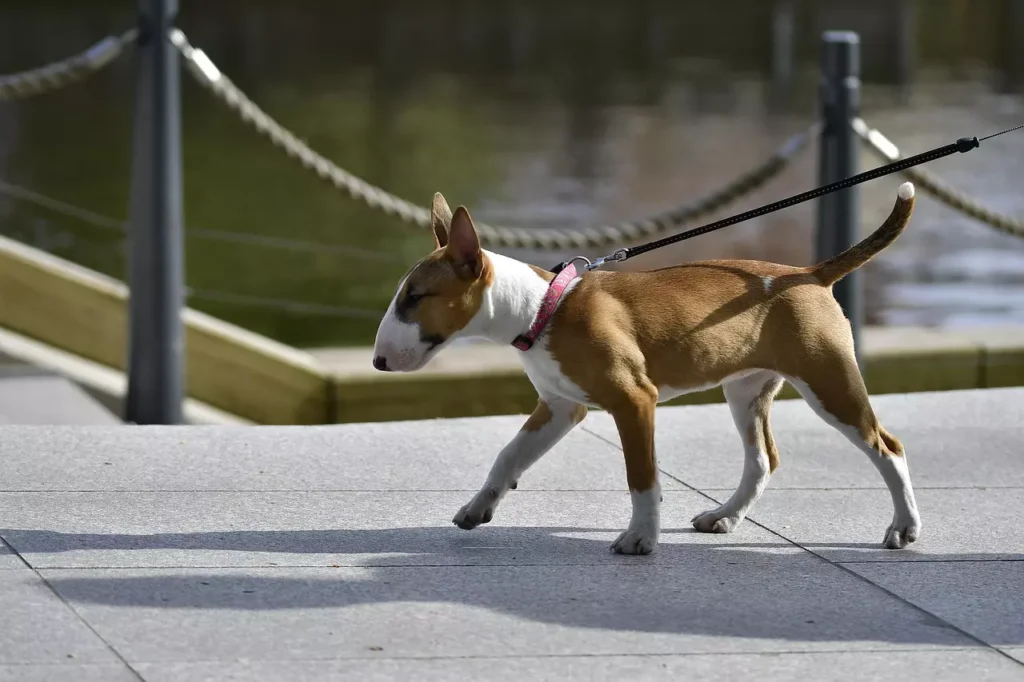
Bull Terrier
The Bull Terrier, also commonly called the English Bull Terrier, is a medium-sized British breed recognised by its muscular build and distinctive curved head. Bull Terriers are often energetic, playful and strongly people-oriented, but individual temperament varies and early reward-based training is particularly important. This guide covers their size, exercise, health, lifespan, legal status and suitability for different UK households.
Quick Facts
| Attribute | Details |
|---|---|
| Group | Terrier |
| Country of origin | United Kingdom |
| Original purpose | Developed from bull-and-terrier dogs; later established mainly as a companion and show breed |
| Size & weight | Medium, muscular and substantial; the UK breed standard sets no fixed height or weight limits |
| Life expectancy | Typically over 10 years; a large 2024 UK study reported a median of approximately 12 years |
| Coat & colours | Short, flat coat; white, brindle, black brindle, red, fawn, tricolour and recognised combinations with white |
| Exercise needs | Moderate; around one hour daily is a broad starting point, with play and mental stimulation adjusted to the individual |
| Grooming needs | Low; usually weekly brushing, plus regular nail, dental, ear and skin care |
| Trainability | Medium; intelligent and capable but may be persistent, excitable or easily distracted |
| Barking tendency | Variable and influenced more by the individual dog, environment and training than breed alone |
| Suitable for | Active, well-prepared households committed to companionship, early training and responsible management |
History & Origin
The Bull Terrier was developed in England during the 19th century from Bulldog and terrier-type ancestry. Early bull-and-terrier dogs were associated with historical blood sports, but the modern breed was subsequently developed for a different role as a distinctive companion and show dog.
Birmingham breeder James Hinks is widely associated with establishing a more consistent Bull Terrier type during the 19th century. Early examples were commonly white, while coloured Bull Terriers became more established during the 20th century.
The name English Bull Terrier is still widely used, particularly to distinguish the standard breed from the Miniature Bull Terrier. In the UK breed register, however, its official name is simply Bull Terrier.
What Were Bull Terriers Bred to Do?
The Bull Terrier’s ancestry combined the strength of historical Bulldogs with the agility and determination associated with terriers. Its role changed as organised blood sports were prohibited and breeders increasingly selected dogs for companionship and exhibition.
Modern Bull Terriers are not working fighting dogs. However, strength, persistence, energetic play and interest in movement may still influence individual behaviour. These traits need constructive outlets through training, exercise and enrichment.
Bull Terrier Size, Weight & Appearance
Bull Terriers are medium-sized dogs with a dense, muscular and substantial build. Contrary to many online tables, the current UK breed standard specifies neither a fixed height nor a fixed weight range. It instead asks for substance appropriate to the dog’s overall size, quality and sex.
This means figures such as 45–55 cm or 25–35 kg may describe some adults but should not be presented as official limits. Individual dogs can fall outside commonly quoted ranges.
The breed’s most recognisable feature is its long, curved head. Viewed from the front, the head should appear full and oval rather than interrupted by a pronounced stop. The eyes are relatively small and triangular, while the ears are naturally upright.
The body is strong and rounded, with muscular limbs and a short tail. Movement should remain balanced and functional rather than being compromised by exaggerated bulk or head shape.
Standard Bull Terrier vs Miniature Bull Terrier
The Bull Terrier and Miniature Bull Terrier are separate recognised breeds in the UK. They share many features, including the characteristic head, short coat and muscular outline, but the Miniature Bull Terrier has its own size requirement.
A small Bull Terrier is not automatically a registered Miniature Bull Terrier. Pedigree, registration and the applicable breed standard determine which breed the dog belongs to.
Health-test requirements may also differ, so prospective owners should check guidance for the exact breed rather than assuming information about one applies completely to the other.
Bull Terrier Temperament & Personality
Bull Terriers are often described as lively, entertaining and strongly attached to people. Some enjoy being involved in most household activities and may become unsettled if expected to spend long periods alone without gradual preparation.
However, temperament cannot be guaranteed from breed alone. Genetics, early development, pain, socialisation, training and previous experiences all affect how an individual dog responds to people, animals and unfamiliar situations.
Some Bull Terriers are confident and sociable, while others may need more distance or time. Their physical strength means that fear, frustration and overexcitement should be addressed early with qualified, reward-based support.
Are Bull Terriers Good Family Dogs?
A carefully matched Bull Terrier can become an affectionate family companion, but suitability depends on the individual dog and household. Their muscular build and enthusiastic play can be overwhelming for young children or vulnerable adults even when the dog is being friendly.
Children must always be supervised around dogs and taught to respect resting, eating and withdrawal. The dog should have a quiet place where interaction is never forced.
Prospective owners should avoid claims that every Bull Terrier is automatically excellent or unsuitable with children. A rescue organisation or responsible breeder should help assess the particular dog rather than relying on a stereotype.
Living with Other Dogs and Smaller Pets
Responses to other dogs vary considerably. Some Bull Terriers are sociable, while others may be selective, easily overexcited or uncomfortable with close interaction. Introductions should be gradual and managed rather than left for the dogs to “sort out”.
The breed’s terrier ancestry may contribute to an interest in chasing smaller animals. Living successfully with cats or other pets depends on the individual dog’s history, behaviour and the household’s ability to supervise and separate animals when required.
Even animals that appear comfortable together should not automatically be left unsupervised. Advice should be tailored to the individual pets involved.
Exercise & Mental Stimulation
Bull Terriers are usually moderately active dogs that need daily physical exercise and mental engagement. Around an hour of suitable exercise is often used as a broad guide, but the correct amount depends on age, health, fitness and personality.
Walks can be combined with sniffing, exploration, play and reward-based training. Repetitive high-impact activity should be managed carefully in growing puppies, and dogs with mobility or health conditions may need an exercise plan agreed with their vet.
Searching games, food puzzles and learning practical skills can provide useful mental stimulation. Activities should encourage calm engagement as well as energetic play.
Training & Socialisation
Bull Terriers can learn effectively, but some are persistent, excitable or easily distracted. Training works best when expectations are consistent, sessions are manageable and the dog is rewarded for making the desired choice.
Important skills include settling, calm greetings, recall, leaving objects, comfortable handling and walking politely on a lead. These should be taught before strength and excitement make everyday situations harder to manage.
Punishment, intimidation and painful equipment can increase fear or conflict. If behaviour becomes difficult or poses a safety concern, owners should seek help from a qualified, reward-based behaviour professional.
Socialisation should provide positive experiences without overwhelming the puppy. Quality matters more than forcing contact with large numbers of people or dogs.
Grooming & Shedding
Bull Terriers have short coats and do shed. A weekly brush is normally sufficient to remove loose hair and check the skin, although shedding may vary throughout the year. Our guide to brushing a dog’s coat correctly explains how to introduce grooming positively.
Check the ears, feet and nails regularly. Teeth should be cleaned with dog-safe toothpaste, supported by veterinary dental examinations.
Skin irritation, recurring ear trouble, redness or persistent scratching should be assessed by a vet. Repeated symptoms should not be dismissed as normal for the breed.
Bull Terrier Health & Lifespan
Dogs Trust and the Royal Kennel Club describe Bull Terrier lifespan as typically over 10 years. A large 2024 study using records from more than half a million UK dogs reported a median lifespan of approximately 12 years for the breed.
This is a population estimate rather than a prediction for an individual dog. Genetics, body condition, environment, preventive care and access to veterinary treatment can all influence health and longevity.
Health concerns associated with Bull Terriers can include congenital deafness, kidney disease, heart disease, kneecap problems and allergic skin disease. White Bull Terriers can also be affected by lethal acrodermatitis, an inherited disorder for which genetic carrier testing is available.
Not every dog will develop these conditions. Owners should arrange routine veterinary care and seek advice about changes in hearing, thirst, urination, movement, breathing, skin or general behaviour.
Hearing and BAER Testing
Congenital deafness is an established health concern in Bull Terriers. Hearing cannot be assessed reliably by clapping, calling the puppy or observing whether it follows its littermates.
The BAER test measures the electrical response of the hearing pathway and can assess each ear separately. Current Royal Kennel Club best-practice guidance recommends BAER hearing testing, including litter screening.
Prospective owners should ask for the individual puppy’s documented result rather than accepting a general statement that the parents can hear. Dogs with partial or complete hearing loss can still have a good quality of life, but their training and safety management may need adapting.
Feeding & Weight Management
Feed a complete diet appropriate for the dog’s age, health and activity. Portions should be measured and adjusted according to body condition rather than estimated from appetite alone. Our guide to feeding a dog a balanced diet covers the basic principles.
A muscular build should not be confused with excess weight. Owners should be able to assess the ribs, waist and abdominal outline, with guidance from a vet or veterinary nurse where necessary.
Extra body weight can affect mobility and general health. Treats used during training should be included within the dog’s overall daily food allowance.
Ethical Sourcing & Adoption in the UK
Bull Terriers may be available through general or breed-specific rescue organisations. Rescue staff should discuss known history, behaviour, health, response to other animals and the type of household likely to suit the individual dog.
Anyone buying a puppy should visit the breeder, see the puppy with its mother and examine original health-test documentation. At minimum, ask about BAER hearing results and discuss the wider screening used for kidney, heart, kneecap and inherited skin concerns.
Responsible breeders should prioritise functional conformation, stable temperament and genetic diversity. Avoid sellers using unusual colour, extreme head shape, exceptional muscularity or the label “rare” as a substitute for health evidence.
Are Bull Terriers Banned in the UK?
The recognised Bull Terrier breed is not automatically prohibited under current UK banned-dog guidance. It is distinct from a dog assessed as a prohibited Pit Bull Terrier type.
However, UK law explains that assessment of a prohibited type is based on physical characteristics rather than only the name, registration or description given to a dog. Anyone with a genuine concern about a dog’s legal classification should obtain appropriate professional legal advice.
General dog-control law applies to all breeds. Owners must keep their dog under control in public, at home and in other private places.
Is the Bull Terrier Right for You?
May suit you if:
- You want an active, people-oriented companion
- You can provide daily exercise and mental stimulation
- You are committed to consistent reward-based training
- You can safely manage a strong and sometimes exuberant dog
- You are prepared to investigate health testing and obtain suitable insurance
Think carefully if:
- You want a dog that requires very little interaction or training
- The dog would routinely be left alone for long periods
- You cannot manage energetic play or a strong adult dog
- You expect automatic compatibility with every dog, cat or smaller pet
- You are choosing primarily for an exaggerated head, unusual colour or intimidating appearance
FAQs
Is an English Bull Terrier the same as a Bull Terrier?
Yes. English Bull Terrier is a commonly used alternative name, while the official UK breed name is Bull Terrier.
How big does a Bull Terrier get?
Bull Terriers are generally medium-sized and muscular. The UK breed standard sets no fixed height or weight limits, so commonly quoted ranges should not be treated as official boundaries.
How long do Bull Terriers live?
They typically live for more than 10 years. A large 2024 UK study reported a median lifespan of approximately 12 years.
How much exercise does a Bull Terrier need?
Around one hour daily is a useful broad guide for many adults, divided between walks, play and mental stimulation. Individual requirements vary.
Are Bull Terriers easy to train?
They can learn well but may be persistent, excitable or distracted. Short, consistent and reward-based sessions are usually most effective.
Do Bull Terriers shed?
Yes. Their short coat sheds, although weekly brushing is normally sufficient for routine coat care.
Are Bull Terriers good with children?
Some are suitable family companions, but their strength and energetic play require supervision. Suitability must be assessed for the individual dog and household.
Can Bull Terriers live with cats?
Some can, particularly following careful assessment and managed introductions. Others may have a strong chase response and may not suit homes with smaller animals.
Are white Bull Terriers more likely to be deaf?
Congenital deafness is an established concern in the breed, particularly in white dogs, but coat colour cannot confirm an individual dog’s hearing. A documented BAER test is required.
Are Bull Terriers banned in the UK?
The recognised Bull Terrier breed is not automatically prohibited. It should not be confused with a dog legally assessed as a prohibited Pit Bull Terrier type.
Sources
- Dogs Trust — Bull Terrier breed and care information
- PDSA — English Bull Terrier health and care
- Royal Kennel Club — Bull Terrier breed standard
- Royal Kennel Club — Bull Terrier health testing and breed overview
- Scientific Reports — Longevity of companion dog breeds in the UK
- GOV.UK — Controlling your dog in public
- GOV.UK — Banned dogs and assessment by type
Information reviewed: September 2026. Breed descriptions provide general guidance; every Bull Terrier is an individual.