
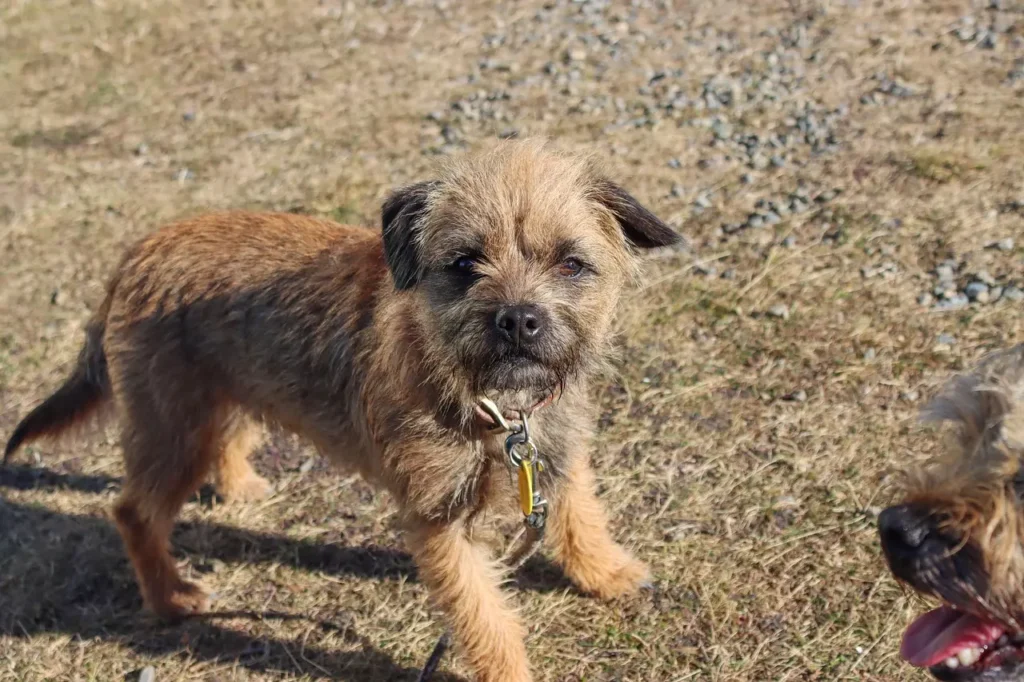
Border Terrier
The Border Terrier is a small British working terrier developed around the border between England and Scotland. Compact but active, these dogs can be engaging companions for owners prepared to provide daily exercise, patient training and secure surroundings. Their hunting background may influence chasing, digging and recall, while their wiry double coat requires regular care.
Quick Facts
| Attribute | Details |
|---|---|
| Group | Terrier |
| Country of origin | United Kingdom; developed around the England–Scotland border |
| Original purpose | Working with foxhound packs and pursuing quarry underground |
| Size & weight | Small; approximately 25–28 cm and commonly around 5–7 kg, although healthy size varies |
| Life expectancy | Typically over 12 years; individual lifespan varies |
| Coat & colours | Harsh, wiry outer coat with a dense undercoat; red, wheaten, grizzle and tan, or blue and tan |
| Exercise needs | About one hour daily as a general minimum for a healthy adult, plus play and mental stimulation |
| Grooming needs | Brushing several times a week and periodic specialist coat care |
| Trainability | Capable of learning well but may be distracted by scent and movement |
| Barking tendency | Variable; some readily alert, bark or vocalise when excited |
| Suitable for | Active households able to provide companionship, training and securely managed exercise |
History & Origin
The Border Terrier developed in the countryside around Northumberland and the Scottish Borders. The breed worked alongside the Border Foxhounds and was known locally by names including the Reedwater Terrier and Coquetdale Terrier before its modern name became established.
These dogs needed the stamina to accompany a hunt and a body small enough to work underground. The breed’s practical working background shaped its compact build, weather-resistant coat and determined approach to following scent.
What Were Border Terriers Bred to Do?
Border Terriers were used to pursue foxes and other quarry, including working below ground. They also performed general vermin-control work around farms and rural properties.
Modern Border Terriers are usually companions, but selective breeding for work can still influence their behaviour. Digging, searching and chasing are not signs that a dog is being deliberately difficult; owners need to manage these behaviours and provide safer alternatives.
Border Terrier Size, Weight & Appearance
The Border Terrier is a small, narrow and workmanlike dog. PDSA gives an average height of approximately 25–28 cm and an average weight of around 5–7 kg. Healthy weight depends on the individual dog’s frame and body condition.
The head is traditionally described as resembling that of an otter. The coat consists of a harsh outer layer and a close undercoat. Recognised colours include red, wheaten, grizzle and tan, and blue and tan.
Temperament & Living with a Border Terrier
Border Terriers can be lively, curious and interested in participating in household activities. Individual temperament varies, and breed alone cannot guarantee how a dog will behave around children, visitors or other animals.
Their manageable size can suit town, country or flat living when their needs are met. Owners in flats should consider barking, access to outdoor space and the practicalities of providing enough daily activity.
Interactions between dogs and children must always be supervised. Children should not disturb a dog while it is eating, sleeping or resting, and the dog should have access to a quiet place of its own.
Exercise & Mental Stimulation
Around one hour of daily exercise is a useful minimum guide for many healthy adult Border Terriers. Some individuals enjoy more, while puppies, older dogs and dogs with medical conditions need appropriately adjusted activity.
Walks can be combined with sniffing, searching, suitable play and short training sessions. A secure digging area or supervised scent games can provide outlets for natural terrier behaviour without allowing the dog to damage fencing or pursue wildlife.
A garden is useful but does not replace walks and interaction. Fencing should be checked carefully because some terriers will dig underneath, squeeze through small gaps or follow an interesting scent.
Training, Recall & Socialisation
Border Terriers can learn effectively with clear, reward-based training. Begin new skills in a quiet environment before gradually adding distance and distractions.
Recall deserves particular attention because scent and movement may compete strongly with the handler. Until recall is dependable in a particular environment, use secure areas or an appropriately handled long training line rather than taking unnecessary risks.
Our guide to teaching a dog to walk nicely on the lead provides a practical starting point for everyday lead skills.
Socialisation should introduce the puppy to varied experiences at a pace it can manage. It does not require unrestricted contact with every person or dog. Adult rescue dogs may need a programme based on their individual history.
Border Terrier Grooming & Shedding
Border Terriers shed despite having relatively short coats. Brushing several times a week can remove loose hair, identify tangles and provide an opportunity to examine the skin.
Our guide to brushing your dog’s coat explains how to introduce grooming gradually and avoid turning it into a struggle.
A mature wiry coat may also need periodic hand-stripping or other specialist grooming. Hand-stripping removes dead outer hairs and is commonly used to retain the traditional coat texture. Owners should ask an experienced groomer to assess the individual coat rather than attempting an unfamiliar technique without guidance.
Nails, teeth, paws and ears also require regular checks. Persistent itching, hair loss, sore skin, ear discharge or signs of discomfort need veterinary assessment.
Border Terrier Health & Lifespan
The Royal Kennel Club, PDSA and Dogs Trust give a typical Border Terrier lifespan of more than 12 years. This is a general breed guide and cannot predict the lifespan of an individual dog.
Conditions reported in Border Terriers include luxating patellas, skin and ear disease, canine epileptoid cramping syndrome, gallbladder mucocoele and spongiform leucoencephalomyelopathy. Not every dog will develop these conditions, and unusual movement or behaviour cannot be diagnosed from a breed profile.
SLEM: spongiform leucoencephalomyelopathy is an inherited neurological condition sometimes called shaking puppy syndrome. The Royal Kennel Club currently lists DNA testing for SLEM as its Good Practice pre-breeding test for Border Terriers.
Prospective buyers should ask to see both parents’ results and verify them where possible. A carrier is not the same as an affected dog, and responsible breeding decisions depend on the combination of both parents’ results. Buyers should not attempt to interpret a single test result without understanding the planned mating.
CECS: canine epileptoid cramping syndrome is also reported in the breed, but it is not the same condition as SLEM. Owners should not begin a restricted or specialist diet merely because of the breed. Episodes involving unusual movement, stiffness, collapse or altered awareness require veterinary investigation.
The Border Terrier Health Group also monitors breed health concerns including gallbladder disease. A DNA result does not replace consideration of family history, physical health, temperament and genetic diversity.
Feeding & Weight Management
A Border Terrier needs a complete, balanced diet appropriate for its age, health and activity. Manufacturer instructions offer a starting point, but portions should be adjusted according to body condition and veterinary advice.
Training rewards and chews form part of the dog’s overall food intake. Our guide to feeding your dog a balanced diet explains the main principles.
Do not place a Border Terrier on a gluten-free or otherwise restrictive diet simply to prevent a breed-associated condition. Dietary investigation or treatment should be based on an individual veterinary assessment.
Living with Other Animals
Some Border Terriers live successfully with dogs or cats, particularly following suitable assessment and gradual introductions. This cannot be assumed from breed alone.
The breed’s working history creates a significant concern around rabbits, rodents and other smaller animals. Physical separation and secure housing may be necessary even when the dog appears calm under supervision.
Outdoors, owners should prevent chasing of livestock and wildlife. Reliable management is more important than assuming that affection at home will override hunting behaviour.
Ethical Sourcing & Adoption in the UK
Border Terriers and terrier crosses are available through rescue organisations. A responsible rescue should discuss the individual dog’s health, behaviour, history and suitability for homes with children or other animals.
When buying a puppy, visit where the litter was raised and see the puppy interacting with its mother. Ask for documented SLEM results for both parents and discuss other health problems among their close relatives.
A statement that the dogs have been “health checked” is not a substitute for seeing the relevant documents. Avoid sellers who refuse visits, offer collection in a public place, advertise many breeds continuously or demand an immediate payment.
Legal Note (UK)
The Border Terrier is not named as a prohibited type under current UK government guidance. However, welfare, identification and dog-control laws apply to every breed.
Owners must keep their dog under control and prevent it from worrying livestock. Local restrictions concerning leads, wildlife and access should also be followed.
Is the Border Terrier Right for You?
May suit you if:
- You want a small but active companion
- You enjoy regular walks and reward-based training
- You can provide secure boundaries and manage recall carefully
- You are prepared for brushing and periodic specialist coat care
- You can provide company, play and opportunities to use scent
Think carefully if:
- You want a consistently quiet or very low-energy dog
- You cannot prevent digging or escape from your garden
- You expect reliable off-lead recall without ongoing training
- You keep small animals and cannot guarantee secure separation
- The dog would regularly be left alone for long periods
FAQs
How long do Border Terriers live?
The Royal Kennel Club, PDSA and Dogs Trust give a typical lifespan of more than 12 years. Individual lifespan varies according to genetics, health and care.
How big does a Border Terrier get?
PDSA lists an average height of approximately 25–28 cm and an average weight of around 5–7 kg. Healthy weight depends on the dog’s frame and body condition.
How much exercise does a Border Terrier need?
Around one hour daily is a useful minimum guide for many healthy adults, with additional play and mental stimulation. Individual needs vary.
Do Border Terriers shed?
Yes. Their short, wiry coats lose hair throughout the year. Brushing several times a week and appropriate periodic grooming help manage the coat.
Do Border Terriers need hand-stripping?
Hand-stripping is commonly used to remove dead outer coat and retain its traditional texture. Ask an experienced groomer to assess the individual dog and explain the available options.
Are Border Terriers easy to train?
They can learn well through rewards, but scent and chasing opportunities may be powerful distractions. Recall requires gradual, consistent practice.
Can Border Terriers live with cats?
Some can following careful assessment and gradual introductions. They should not automatically be considered safe with cats or smaller animals.
What is SLEM in Border Terriers?
SLEM is an inherited neurological condition for which a DNA test is available. The Royal Kennel Club currently lists this test as Good Practice before breeding.
How much does a Border Terrier cost in the UK?
Purchase prices and adoption fees vary. Check current costs directly and budget for food, equipment, grooming, training, insurance and veterinary care.
Sources
- Royal Kennel Club — Border Terrier breed information and SLEM testing
- Royal Kennel Club — Border Terrier breed standard
- PDSA — Border Terrier care and breed-related health information
- Dogs Trust — Border Terrier breed and rehoming information
- Border Terrier Health Group — health considerations when buying a puppy
- Border Terrier Health Group — 2025 breed health report
- GOV.UK — controlling your dog
Information checked: September 2026. Breed descriptions provide general guidance; every dog is an individual.