
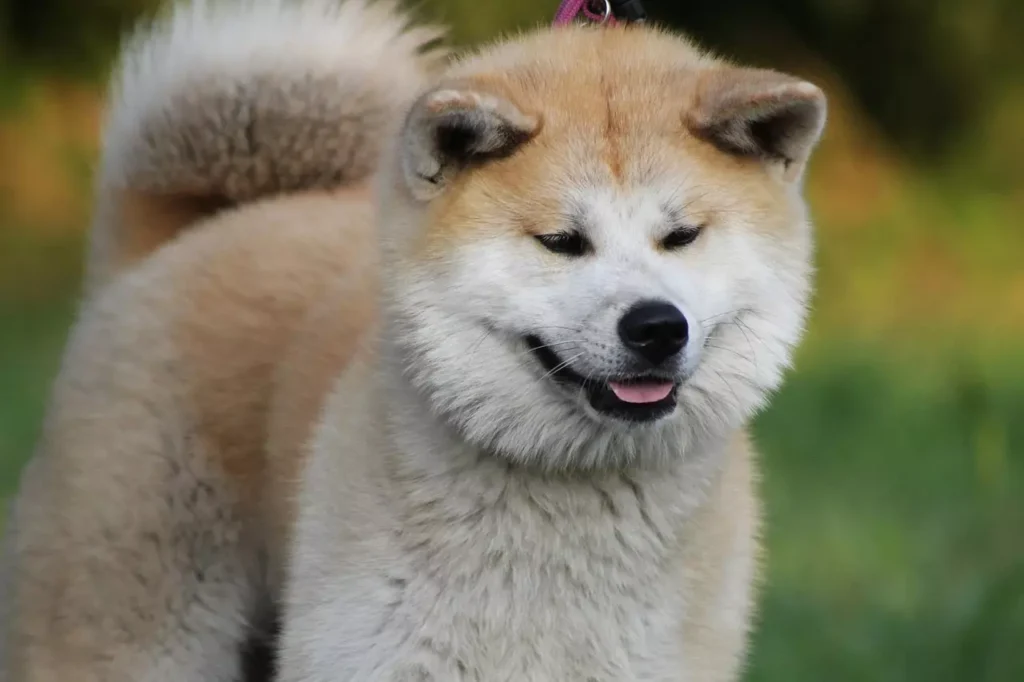
Akita
The Akita is a large, powerful spitz-type dog with Japanese origins, a dense double coat and an independent character. In the UK, the Akita and Japanese Akita Inu are recognised as separate breeds; this profile covers the heavier Akita type developed further in the United States. Akitas can form strong bonds with their household, but their size, strength and training needs usually make them better suited to experienced owners.
Quick Facts
| Attribute | Details |
|---|---|
| Group | Utility |
| Country of origin | Japan; the modern Akita type was developed further in the United States |
| Original purpose | Hunting and guarding |
| Size & weight | Large; approximately 61–71 cm and commonly around 31–59 kg |
| Life expectancy | Usually around 10–12 years; individual lifespan varies |
| Coat & colours | Short, dense double coat; several colours and clearly defined markings are recognised |
| Exercise needs | About two hours or more each day, adjusted for age, health and fitness |
| Grooming needs | Weekly brushing, increasing during periods of heavy seasonal shedding |
| Trainability | Intelligent and capable, but independent; needs consistent reward-based training |
| Barking tendency | Variable; some are relatively quiet but may bark to alert |
| Suitable for | Experienced, active households able to manage a large and powerful dog responsibly |
History & Origin
The Akita has its roots in Japan, where its ancestors were associated with hunting large game and guarding. These northern spitz-type dogs developed protective double coats, substantial builds and the strength required to work in demanding conditions.
The breed later developed along different lines in Japan and the United States. The heavier type became established internationally as the American Akita. In the UK, the Royal Kennel Club calls this breed simply the Akita, while the more traditionally Japanese type is registered separately as the Japanese Akita Inu.
Akita vs Japanese Akita Inu
Akita and Japanese Akita Inu are not interchangeable breed names under current UK registration. The Royal Kennel Club separated them in 2006 and now maintains an individual breed standard for each.
The Akita covered on this page is generally heavier in bone, broader through the head and accepted in a wider range of colours and markings. The Japanese Akita Inu is usually lighter and more refined, with a narrower range of recognised colours. Anyone choosing a puppy should check its registration documents rather than relying only on a seller’s description.
What Were Akitas Bred to Do?
Dogs behind the modern Akita were historically used for hunting and guarding. These roles required strength, courage, awareness and the ability to work independently. Historical sources also record their use in dog fighting, although this has no place in responsible modern ownership.
Many Akitas still display traits associated with their working ancestry, including alertness, physical confidence and an interest in pursuing moving animals. These tendencies vary between dogs but should be considered when planning training, exercise and introductions to other pets.
Akita Size, Weight & Appearance
Akitas are large, strongly built dogs. The UK breed standard gives a height at the withers of 66–71 cm for males and 61–66 cm for females. Weight is not fixed by that standard, although approximately 31–59 kg is commonly used as a general guide.
Typical features include a broad head, relatively small erect ears, a powerful body and a large tail carried curled over the back. The short outer coat stands away from the body over a soft, dense undercoat. Individual dogs may be somewhat larger or smaller than published guides.
Akita Temperament & Family Life
Akitas are often described as dignified, confident and reserved, but breed labels cannot predict an individual dog’s behaviour. Genetics, early experiences, health, learning and the way a dog is handled all contribute to temperament.
Many develop close relationships with familiar people while remaining less interested in attention from strangers. Their size and strength require calm, responsible management. Contact between dogs and children should always be supervised, and children should be taught not to disturb a dog while it is eating, sleeping or using a resting place.
Compatibility with other dogs and household pets varies. Some Akitas may find close interaction with unfamiliar dogs difficult, while their hunting ancestry can contribute to chasing behaviour around smaller animals. Introductions should be gradual and based on the individual animals involved.
Exercise & Mental Stimulation
An adult Akita generally needs about two hours or more of suitable daily activity. This can include walks, exploring, sniffing, training and play rather than continuous high-impact running. Exercise should be adapted to the dog’s age, health, fitness and the weather.
Because an Akita may be powerful and interested in chasing, secure areas are the safest choice for off-lead exercise. Young dogs need controlled activity while they are growing, and older dogs or those with joint conditions may need an exercise plan agreed with a vet.
The dense coat offers protection in colder conditions but can make warm-weather exercise uncomfortable. During hot weather, choose cooler parts of the day, provide water and shade, and stop activity if the dog appears uncomfortable.
Training & Socialisation
Akitas are intelligent dogs, but intelligence does not always mean automatic obedience. They can be independent and may lose interest in repetitive sessions. Short, consistent training using rewards is more appropriate than physical correction or confrontational methods.
Early socialisation should introduce a puppy gradually to different people, environments, surfaces, sounds and suitable dogs without forcing interaction. Socialisation is not simply meeting as many dogs as possible; the aim is to build calm, positive experiences and help the dog feel safe.
Useful priorities include recall, settling, handling, leaving objects and walking calmly on the lead. Because of the breed’s adult size, practising these skills before a puppy becomes physically powerful is particularly valuable.
Do Akitas Shed? Grooming & Coat Care
Akitas shed throughout the year and can lose considerably more undercoat during seasonal coat changes. Their dense coat normally needs brushing at least weekly, with more frequent attention when loose undercoat is being released.
Regular brushing of your dog’s coat removes loose hair and provides an opportunity to check the skin. Grooming should be introduced gradually with rewards so the dog becomes comfortable with being handled.
The coat should not be shaved simply to keep the dog cool. Routine care should also include checking the ears, nails and teeth. Seek veterinary advice if grooming reveals persistent itching, redness, hair loss, sores or other skin changes.
Akita Health & Lifespan
Akitas commonly live for around 10–12 years. A large UK longevity study published in 2024 reported a median of approximately 11.4 years for the breed, but no figure can predict the lifespan of an individual dog.
Potential health concerns reported in Akitas include hip dysplasia, inherited eye conditions, skin or immune-mediated disorders, thyroid disease and gastric dilatation-volvulus (GDV). This does not mean every Akita will develop these conditions.
The Royal Kennel Club currently lists hip assessment and eye testing among its recommended pre-breeding screening for Akitas, alongside attention to genetic diversity. Prospective owners should ask to see the parents’ official results and discuss family health history with the breeder.
GDV is an acute veterinary emergency affecting the stomach. Anyone who suspects it should contact a veterinary practice immediately rather than waiting to see whether the dog improves. Routine veterinary checks remain important throughout an Akita’s life.
Feeding & Everyday Care
An Akita needs a complete and balanced diet appropriate for their age, size, activity and health. Portions should be adjusted using the dog’s body condition and the food manufacturer’s guidance rather than breed averages alone.
Fresh water should always be available. Treats used during training need to be included in the dog’s overall food allowance. Owners should ask their vet or veterinary nurse for individual guidance if weight, appetite, digestion or feeding requirements change.
Akitas also need secure fencing, a comfortable resting area and enough indoor space for a large dog. Time alone should be introduced gradually; an Akita should not simply be expected to cope with long absences without preparation.
Ethical Sourcing & Adoption in the UK
Akitas can sometimes be found through general and breed-specific rescue organisations. A responsible rescue should assess each dog and explain any known medical, behavioural or home-management needs before adoption.
When buying a puppy, meet the puppy with their mother where they were raised. Ask about temperament, socialisation, genetic diversity, hip assessment and eye screening. Health results should be verifiable rather than given only as a verbal assurance.
Avoid sellers who offer several unrelated breeds, refuse visits, suggest meeting in a car park, cannot show relevant records or pressure buyers into paying immediately. Registration by itself does not guarantee good health, temperament or responsible breeding.
Legal Note: Are Akitas Banned in the UK?
Akitas are not named among the prohibited dog types in current UK government guidance. However, laws concerning control, welfare, identification and public access apply to Akitas just as they do to other dogs.
Government guidance explains that classification as a prohibited type can depend on physical characteristics rather than the breed name written on documents. Owners should check current rules for their part of the UK and any local restrictions covering leads, public spaces or livestock.
Is an Akita Right for You?
Best for:
- Experienced owners comfortable handling a large, powerful dog
- Active households able to provide substantial daily exercise
- People prepared to continue reward-based training throughout the dog’s life
- Homes with secure boundaries and enough space
- Owners willing to manage shedding and regular grooming
Think twice if:
- You are looking for an easy first dog
- You cannot safely manage a strong dog on the lead
- The dog would routinely be left alone for long periods
- You want unrestricted off-lead exercise in unsecured places
- You have smaller pets but cannot manage careful assessment and separation
FAQs
Are Akitas banned in the UK?
No. Akitas are not named among the prohibited types in current UK government guidance. Owners must still keep their dog under control and follow all applicable dog-control and welfare laws.
What is the difference between an Akita and a Japanese Akita Inu?
They are recognised as separate breeds in the UK. The Akita is generally the heavier, American-developed type, while the Japanese Akita Inu retains the more refined Japanese type and has a different breed standard.
How big does an Akita get?
The UK standard gives a height of 66–71 cm for males and 61–66 cm for females. Approximately 31–59 kg is commonly used as a general weight guide, although individual size varies.
How long do Akitas live?
Around 10–12 years is a reasonable general guide. A 2024 UK study reported a median lifespan of approximately 11.4 years for the breed.
Do Akitas shed a lot?
Yes. Akitas have dense double coats and can shed heavily, particularly during seasonal coat changes. Weekly brushing is a minimum practical starting point.
Are Akitas good family dogs?
An Akita can live successfully in a suitable family home, but this depends on the individual dog, training and household. Their size and strength require careful management, and children must always be supervised around dogs.
Are Akitas suitable for first-time owners?
They are generally better suited to experienced owners because they are large, strong and independent. A committed first-time owner would need substantial preparation and support from a qualified reward-based trainer.
Can Akitas live with other dogs or cats?
Some can, but compatibility cannot be assumed. Individual assessment, gradual introductions and safe management are essential, particularly because some Akitas may chase smaller animals or be uncomfortable around unfamiliar dogs.
Sources
- Dogs Trust — Akita breed information
- PDSA — Akita health and care guide
- Royal Kennel Club — Akita overview and health screening
- Royal Kennel Club — Akita breed standard
- Royal Kennel Club — Japanese Akita Inu and UK breed distinction
- British Veterinary Association — Hip Dysplasia Scheme
- British Veterinary Association — Hereditary Eye Disease Scheme
- Scientific Reports — UK dog breed longevity study
- GOV.UK — Current prohibited dog guidance
Information checked: September 2026. Breed descriptions provide general guidance; every dog is an individual.