
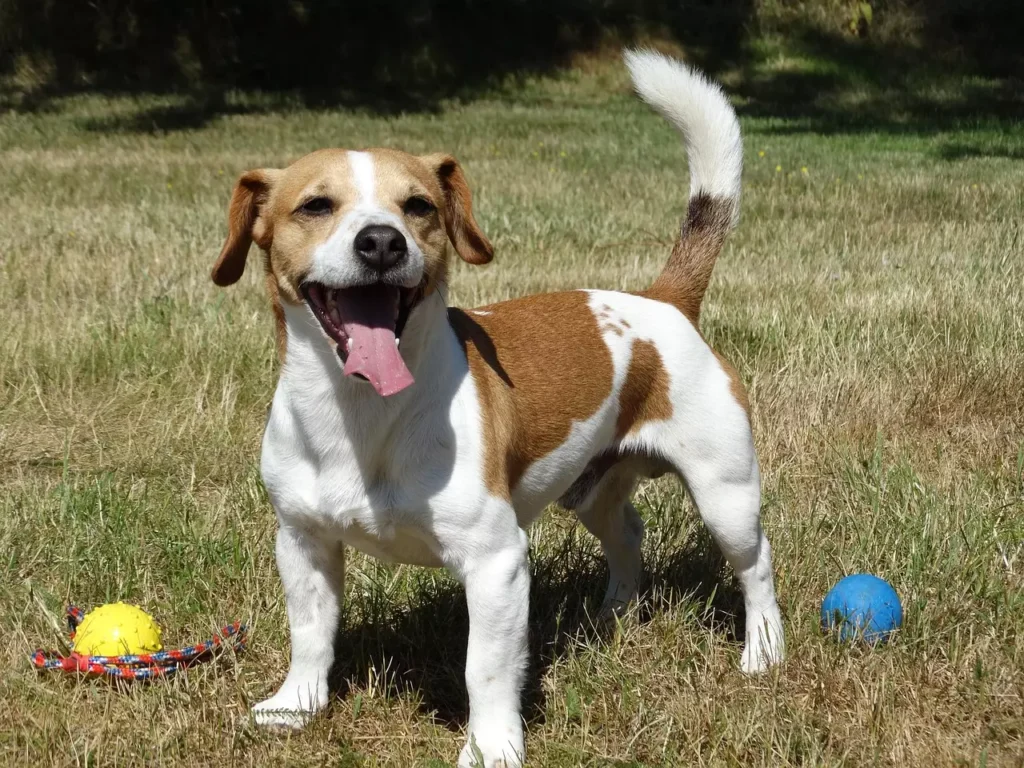
Jack Russell Terrier
The Jack Russell Terrier is a small but highly active working breed with roots in nineteenth-century England. Developed for fox hunting, it is known for alertness, confidence, intelligence and determination. The breed can be an engaging companion for active owners, but its size should not be mistaken for low needs: daily exercise, mental stimulation, reward-based training and careful management of the chase instinct are important.
Quick Facts
| Attribute | Details |
|---|---|
| Group | Terrier; officially recognised by the Royal Kennel Club since 2016 |
| Country of origin | England (historic working roots); the modern recognised breed was developed further in Australia |
| Original purpose | Working fox terrier, developed to follow hounds and bolt foxes from dens |
| Size & weight | Royal Kennel Club standard height: 25–30 cm; weight should be proportionate to height and build |
| Life expectancy | A 2022 UK VetCompass study estimated life expectancy at birth at 12.72 years; individual dogs vary |
| Coat & colours | Smooth, broken or rough weatherproof coat; white predominates with black and/or tan markings |
| Exercise needs | High for a small dog; daily walks, play, training and enrichment, with up to one hour a general guide for many healthy adults |
| Grooming needs | Low to moderate; usually weekly brushing, adjusted for coat type and shedding |
| Trainability | Intelligent and capable, but often independent and easily distracted by movement or scent |
| Barking tendency | Often moderate to high, although training, routine and individual temperament make a difference |
| Suitable for | Active owners able to provide secure exercise, reward-based training and regular mental stimulation |
Where Do Jack Russells Come From? History & Origin
The Jack Russell Terrier takes its name from the Reverend John Russell, who developed a strain of fox terriers in England during the nineteenth century. These dogs were intended to travel with foxhounds and work below ground. Function mattered more than a uniform appearance, which helps explain why the name “Jack Russell” has historically covered a range of small working terrier types.
Dogs descended from British working terriers were later developed in Australia into a more standardised breed. The Royal Kennel Club officially recognised the Jack Russell Terrier in 2016. The recognised breed is distinct from the taller Parson Russell Terrier, although the two share closely related history. Traditional working clubs may use a broader definition of the Jack Russell than the modern show standard.
What Were Jack Russells Bred to Do?
Jack Russells were developed as working fox terriers. Their historic task was to follow the hunt and bolt a fox from its den rather than simply chase it across open ground. This demanded a compact, flexible body together with courage, persistence, quick reactions and the ability to work independently.
Those traits remain relevant in modern homes. Many Jack Russells enjoy digging, chasing, searching and following scent trails. Owners can provide safer outlets through scent games, structured play, training and suitable dog sports. Because a strong chase instinct is possible, off-lead exercise should take place only where it is safe and permitted.
Jack Russell Size, Weight & Appearance
The Royal Kennel Club breed standard gives an ideal height of 25–30 cm. It does not prescribe a fixed weight, stating instead that substance and weight should be proportionate to height. The international FCI standard uses approximately 5–6 kg as an ideal guide across that height range, but real dogs may be lighter or heavier according to build, sex and ancestry.
A recognised Jack Russell should be strong, active and slightly longer than tall, without exaggeration. The coat may be smooth, broken or rough and should be weatherproof. White should predominate, with black and/or tan markings. Dogs commonly described as Jack Russells outside the show ring can vary more widely in size, proportions and appearance.
Jack Russell Temperament & Everyday Life
Jack Russells are commonly described as bold, alert, friendly and confident. They are often affectionate with familiar people and enthusiastic about activity, but their intelligence and working independence can make them demanding companions. A small body does not mean low exercise or training needs.
Temperament is never guaranteed by breed alone. Genetics, early experiences, health, training and the home environment all influence behaviour. Some Jack Russells are sociable with dogs and visitors, while others need more space and carefully managed introductions. Prospective owners should choose the individual dog rather than relying only on a breed label.
Exercise & Mental Stimulation
The Royal Kennel Club lists up to one hour of daily exercise as a general guide, while Dogs Trust describes Jack Russells as high-energy dogs needing walks, opportunities to explore, play and daily enrichment. The right amount depends on the dog’s age, health, fitness and personality, so a fixed target should not be treated as a rule for every individual.
Many adults enjoy varied walks, sniffing, searching games, retrieving toys and short training sessions. Secure spaces are valuable because movement and scent can trigger chasing. Puppies need age-appropriate activity rather than forced long-distance exercise, while older or unwell dogs may require an adapted routine agreed with a vet.
Training & Socialisation
Jack Russells can learn quickly, but they may also become distracted or make their own decisions. Short, engaging sessions and rewards that the dog genuinely values are usually more effective than repetition or punishment. Useful priorities include recall, settling, leaving items, cooperative handling and walking calmly on the lead.
Early socialisation should be positive and gradual rather than overwhelming. Puppies need safe exposure to different people, dogs, sounds, surfaces and environments while still being allowed to retreat. Training cannot remove every instinct, so management remains important around wildlife, livestock, roads and smaller pets.
Do Jack Russells Shed? Grooming & Coat Care
Jack Russells do shed. Dogs Trust describes the breed as having a short coat with moderate shedding, although the amount and the most suitable grooming routine vary between smooth, broken and rough coats. Loose hair can be noticeable even when the coat looks easy to maintain.
Weekly brushing and coat care is a practical starting point. Rough or broken coats may need additional attention, and owners who want to preserve their texture can seek advice from an experienced groomer. Nails, ears, teeth, paws and skin should also be checked regularly, particularly after walks through dense vegetation.
How Long Do Jack Russells Live? Health & Lifespan
A 2022 VetCompass study using UK veterinary records estimated the Jack Russell Terrier’s life expectancy at birth at 12.72 years. This is a population estimate rather than a prediction for an individual dog: some live for a shorter time and others considerably longer. Genetics, preventive care, body condition, dental health, diet, exercise and access to veterinary treatment can all influence health and longevity.
For registered breeding dogs, the Royal Kennel Club strongly recommends DNA testing for primary lens luxation (PLL). Its further best-practice recommendations include DNA tests for late-onset ataxia (LOA) and spinocerebellar ataxia (SCA), together with eye testing through the BVA/KC/ISDS Eye Scheme. A responsible breeder should explain the parents’ results rather than merely saying that they are “health tested”.
No screening programme can guarantee that a dog will remain healthy. Owners should arrange routine veterinary care and seek advice about changes in vision, balance, movement, appetite, behaviour or general condition.
Feeding & Care Basics
A Jack Russell should receive a complete, balanced diet appropriate for age, health and activity. Feeding instructions are a starting point, not an exact prescription. Portions should be adjusted using the dog’s body condition and veterinary advice rather than assuming that every small terrier needs the same amount.
Fresh water should always be available. Food used during training should be included in the daily allowance. Sudden diet changes can upset digestion, so transitions are normally made gradually unless a vet advises otherwise.
Ethical Sourcing & Adoption (UK)
Jack Russells and Jack Russell-type dogs are regularly available through UK rescue organisations. Adoption gives staff an opportunity to match an individual dog’s known behaviour, history and needs with a suitable household. Ask how the dog responds to handling, visitors, other dogs, being left alone and smaller animals.
When buying a puppy, meet the mother with the litter where they were raised and ask to see relevant health-test results. For registered Jack Russell Terriers, check the parents’ PLL status and ask about LOA, SCA and eye testing. Avoid sellers who will not show the living environment, offer several unrelated breeds, pressure buyers into a quick decision or suggest that registration alone guarantees health.
Legal Note (UK)
The Jack Russell Terrier is not named as a prohibited type in current UK government guidance. However, the law concerning control applies to every dog. Owners must prevent their dog from being dangerously out of control in public and private places.
Local lead requirements and rules around livestock, wildlife and access can also apply. A strong chase instinct makes secure fencing, reliable management and attention to signs especially important. Owners should check current government and local guidance rather than relying on a breed profile as legal advice.
Is the Jack Russell Terrier Right for You?
Best for:
- Active owners who enjoy daily walks, play and training
- People looking for a small dog with a lively working-terrier character
- Households able to provide secure exercise and mental stimulation
- Owners prepared to use patient, reward-based training
Think twice if:
- You expect a small dog to need very little activity
- You cannot safely manage chasing, digging or an unreliable recall
- You want a naturally quiet dog with little interest in movement or scent
- You have smaller pets and cannot provide careful assessment, introductions and separation
FAQs
Is the Jack Russell Terrier recognised by the Royal Kennel Club?
Yes. The Royal Kennel Club officially recognised the Jack Russell Terrier in 2016. However, the name “Jack Russell” is also used more broadly for traditional working terriers and dogs that may not match the recognised standard.
Where do Jack Russells come from?
Their working roots are in nineteenth-century England, where the Reverend John Russell developed fox terriers for hunting. Dogs from this British working background were later developed into a standardised breed in Australia.
What is a Jack Russell’s temperament like?
They are often bold, alert, confident and energetic. Individual temperament varies, and some dogs are more sociable, sensitive or independent than others.
How much exercise does a Jack Russell need?
Up to one hour a day is a general guide for many healthy adults, combined with play, exploration, training and enrichment. The appropriate routine depends on age, health and the individual dog.
How long do Jack Russells live?
A 2022 UK VetCompass study estimated life expectancy at birth at 12.72 years. This is a population average, so an individual dog may live for a shorter or longer time.
How big is a Jack Russell Terrier?
The Royal Kennel Club standard gives an ideal height of 25–30 cm. Weight should be proportionate to height and build rather than fixed at one figure.
Do Jack Russells shed?
Yes. Shedding is commonly moderate, although coat type and the individual dog affect how much loose hair owners notice.
Are Jack Russells easy to train?
They are intelligent and capable learners but can be independent and easily distracted. Short, consistent, reward-based sessions usually work best.
Can Jack Russells live with cats?
Some can, particularly after careful assessment and gradual introductions, but others have a strong chase instinct and may not be suitable. Safe management and separation may still be necessary.
Are Jack Russells good family dogs?
They can be engaging family companions when their exercise, training and management needs are met. Suitability depends on the individual dog and household, and children should always be supervised around dogs.
Sources
- Royal Kennel Club — Jack Russell Terrier breed information and health screening
- Royal Kennel Club — Jack Russell Terrier breed standard
- Dogs Trust — Jack Russell Terrier care, exercise and behaviour
- Scientific Reports — 2022 VetCompass study of UK dog life expectancy
- Jack Russell Terrier Club — Royal Kennel Club recognised UK breed club
- Jack Russell Terrier Club of Great Britain — traditional working-terrier information
- Fédération Cynologique Internationale — Jack Russell Terrier standard
- GOV.UK — controlling your dog in public
Information checked: September 2026. Breed descriptions are general guidance; every dog is an individual.