
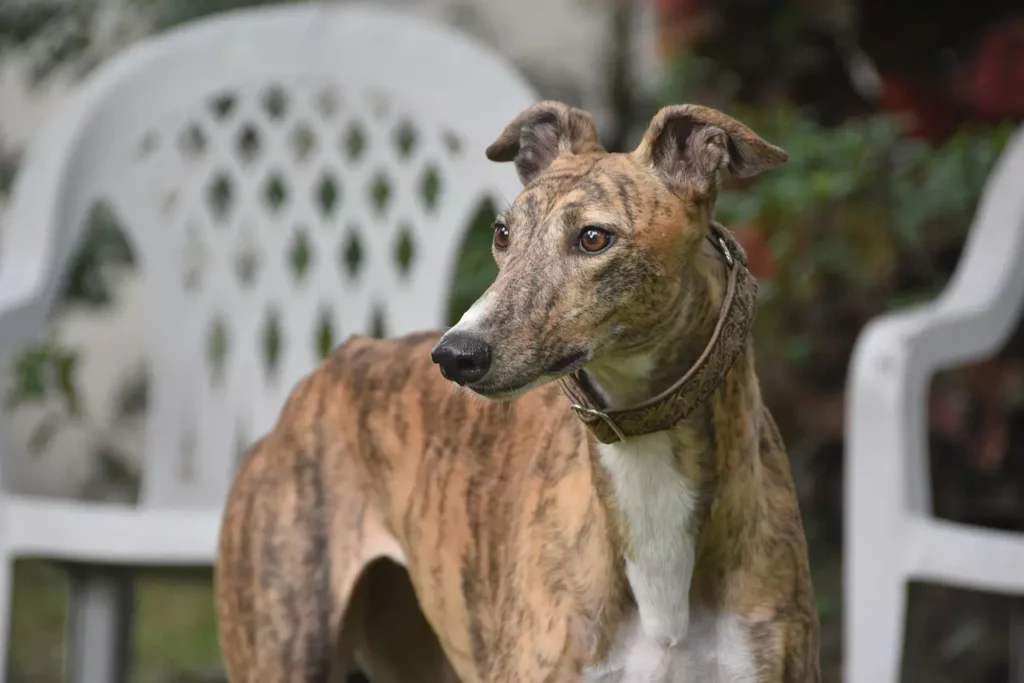
Greyhound
The Greyhound is a large sighthound developed in Britain for pursuing game by sight and later associated with racing. Athletic outdoors but often relaxed at home, Greyhounds can make rewarding companions when their exercise, training and individual prey drive are properly understood. Many available in the UK are retired racing dogs, although their temperament, confidence and experience of domestic life can vary considerably.
Quick Facts
| Attribute | Details |
|---|---|
| Group | Hound (sighthound) |
| Country of origin | Great Britain; developed from long-established European sighthounds |
| Original purpose | Pursuing game by sight and speed; later racing and companionship |
| Size & weight | Large; ideal UK height is 71–76 cm for males and 69–71 cm for females. Weight varies by sex, build and whether the dog comes from racing or show lines |
| Life expectancy | Typically over 10 years; a large 2024 UK study reported a median of approximately 11.5 years |
| Coat & colours | Short, fine coat; colours include black, white, red, blue, fawn, brindle and combinations with white |
| Exercise needs | Moderate; daily walks, enrichment and securely managed opportunities for faster movement according to the individual dog |
| Grooming needs | Low; occasional or weekly brushing, plus regular nail, dental and skin care |
| Trainability | Medium; responds well to patient, reward-based training, although recall may be affected by the instinct to chase |
| Barking tendency | Often low, but behaviour varies between individuals |
| Suitable for | Households able to provide companionship, safe exercise and time for a new or retired racing Greyhound to adjust |
History & Origin
Dogs with the long legs, deep chest and streamlined outline associated with sighthounds have existed for centuries. Similar dogs appear in ancient artwork, but these depictions should not be treated as proof that the modern Greyhound can be traced directly to one ancient breed.
The Greyhound recognised today was developed in Britain. Its speed, eyesight and ability to pursue moving game made it valuable for coursing. The breed later became closely associated with organised racing, while show lines developed alongside racing and working dogs.
What Were Greyhounds Bred to Do?
Greyhounds were bred to locate and pursue game by sight rather than following a scent trail. Their long legs, flexible movement, deep chest and lean, muscular build support rapid acceleration and high-speed running over relatively short distances.
Modern Greyhounds may come from show, racing or companion backgrounds. Although many no longer work, an interest in chasing moving animals can remain strong. This instinct varies between individuals and should be considered when choosing exercise areas and introducing smaller animals.
Greyhound vs Lurcher
A Greyhound is a recognised pedigree sighthound, whereas a Lurcher is a crossbreed normally produced from a sighthound and another breed or type of working dog. Greyhounds therefore have a defined breed standard, while Lurchers can differ much more widely in size, coat and appearance.
Both may share speed, a streamlined outline and an instinct to chase, but neither temperament nor behaviour can be predicted from appearance alone. Read our Lurcher breed profile for a closer comparison.
Greyhound Size, Weight & Appearance
The UK breed standard describes an ideal height of 71–76 cm for males and 69–71 cm for females. It does not specify one official weight range, and actual weight varies according to sex, height, build and background. Racing Greyhounds may also differ in build from dogs produced primarily for the show ring.
A Greyhound should have an athletic, streamlined appearance with a long head and neck, a deep chest, powerful hindquarters and a noticeably tucked abdomen. The short, fine coat occurs in black, white, red, blue, fawn and brindle, as well as combinations of these colours with white.
Greyhound Temperament & Personality
Greyhounds are often described as calm and affectionate companions, but breed descriptions cannot predict the personality of an individual dog. Confidence, sociability and responses to unfamiliar situations are influenced by genetics, early experiences, training and previous living conditions.
Some Greyhounds enjoy meeting people and other dogs, while others prefer quieter surroundings or need more time to feel comfortable. A retired racing dog may also be encountering particular household sights, sounds and routines for the first time.
Can Greyhounds Live in Flats?
A Greyhound may live successfully in a flat or smaller home if the building, household and daily routine meet the dog’s needs. Indoor floor area alone does not determine suitability; reliable outdoor access, regular walks, comfortable resting space and the ability to manage stairs or shared entrances are also important.
Individual behaviour matters. A dog that finds being alone difficult, reacts strongly to nearby animals or is unsettled by communal noise may require additional management. Prospective adopters should discuss their accommodation honestly with the rescue organisation responsible for matching the dog.
Exercise & Mental Stimulation
Greyhounds are capable of impressive speed, but this does not mean they require continuous strenuous exercise. Many adults are moderately active and enjoy daily walks combined with opportunities to sniff, explore and move more freely in an appropriately secure place.
The amount and intensity of exercise should reflect the dog’s age, health, fitness and previous routine. Newly adopted, older or injured Greyhounds may need a gradual programme. Off-lead exercise should only be considered where it is safe, permitted and appropriate for that individual dog’s recall and chase response.
Food puzzles, scent games, calm training sessions and opportunities to investigate their environment can provide mental stimulation without relying only on physical exertion.
Training, Recall & Socialisation
Greyhounds can learn household routines and useful skills through patient, reward-based training. Sessions should be short enough to maintain engagement, with rewards chosen for the individual dog. Punishment or forced exposure can increase anxiety and should not be used.
Recall requires particular care because a fast-moving animal may trigger an immediate chase response. A secure field or suitable long training line can provide safer practice. Everyday skills such as walking calmly on a lead, settling on a bed and waiting at doors are especially useful during the transition to home life.
Socialisation does not mean making a dog interact with everything. It should involve gradual, positive experiences while allowing the dog enough distance to remain comfortable.
Can Greyhounds Live with Cats and Smaller Pets?
Some Greyhounds can live with cats or other smaller animals, but this should never be assumed from breed descriptions or calm behaviour indoors. Individual prey interest, previous experience and response to movement must be assessed carefully.
A reputable rescue should explain whether a particular dog has been assessed around cats and what that assessment can and cannot predict. Introductions require close supervision, physical separation when necessary and management tailored to all the animals involved.
A basket muzzle may sometimes be recommended as an additional safety measure during training or early introductions. It does not replace supervision, secure handling or appropriate separation.
Grooming, Shedding & Cold Weather
Greyhounds have a short, fine coat and do shed, although grooming is normally straightforward. Occasional or weekly brushing can remove loose hair and gives owners an opportunity to check the skin, feet and body for changes.
Nails should be checked frequently because excessive length can affect comfort and movement. Teeth also require regular home care and veterinary assessment. Introduce grooming gradually and pair handling with rewards so that it becomes a predictable experience.
Some Greyhounds feel the cold because of their fine coat and lean build. A correctly fitted coat may help during cold or wet weather, but clothing should be chosen according to the individual dog and conditions rather than used automatically.
Greyhound Health & Life Expectancy
Dogs Trust describes Greyhound lifespan as typically over 10 years. A 2024 study using records from more than half a million UK dogs reported a median lifespan of approximately 11.5 years for the breed. This is a population estimate, not a prediction for an individual dog.
UK veterinary research has identified periodontal disease, overgrown nails, injuries and osteoarthritis among commonly recorded problems in Greyhounds receiving primary veterinary care. Regular dental care, nail checks, appropriate exercise and routine veterinary examinations are therefore particularly worthwhile.
Greyhounds are deep-chested dogs, so owners should also understand gastric dilatation-volvulus, commonly called GDV or bloat. Sudden abdominal swelling, distress or repeated unsuccessful attempts to vomit require immediate veterinary attention.
Tell the veterinary team that the patient is a Greyhound and provide any available racing, medical and medication history. Treatment and anaesthetic decisions should be based on the individual dog rather than on a general assumption that every Greyhound will respond in the same way.
Feeding & Everyday Care
Feed a complete diet appropriate for the Greyhound’s age, health, activity and body condition. The correct amount depends on the individual dog rather than on breed alone. Our guide to feeding a dog a balanced diet explains the basic principles.
A healthy Greyhound naturally has a more defined waist and abdominal tuck than many other breeds, but owners should not rely on appearance alone when deciding whether the dog is underweight or overweight. Ask a vet or veterinary nurse to demonstrate an appropriate body-condition assessment.
Provide a comfortable bed large enough for the dog to stretch out fully. Fresh water should always be available, and changes in appetite, weight, thirst, movement or behaviour should be discussed with a vet.
Adopting an Ex-Racing Greyhound
Many Greyhounds available for adoption in the UK have retired from racing. Moving into a home can introduce unfamiliar experiences such as household appliances, different floor surfaces, stairs, glass doors, other types of dog and spending time without kennel companions.
This does not mean every former racer will struggle with home life. Some adjust quickly, while others benefit from a slower routine and additional support. A responsible rescue will assess each dog, discuss the prospective home and try to make a suitable individual match.
Follow the rescue organisation’s instructions regarding leads, collars, harnesses and muzzles. Equipment should fit correctly, and freedom should be increased according to the dog’s demonstrated behaviour rather than a fixed timetable.
Ethical Sourcing & Breeding in the UK
Adoption is a practical option because specialist Greyhound organisations regularly have retired dogs seeking homes. Ask about the dog’s known history, behaviour assessment, health care, response to other animals and the support available after adoption.
Anyone buying a puppy should visit the place where the dogs are raised, meet the mother and ask for verifiable health information. Current Royal Kennel Club guidance recommends attention to genetic diversity and lists a DNA test for Greyhound neuropathy among its breed-specific best-practice considerations.
A responsible breeder or rescue should answer questions openly and should not pressure someone into making an immediate decision.
Legal Note (UK)
Greyhounds are not prohibited simply because of their breed or a previous racing career. However, UK dog-control law applies to all dogs, and owners are responsible for keeping their dog under control in public and private places.
Lead requirements, dog-control orders and access restrictions can vary by location. Owners must also manage chasing behaviour responsibly around livestock, wildlife, other animals and roads. Check current government and local-authority guidance rather than relying on assumptions about the breed.
Is the Greyhound Right for You?
May suit you if:
- You want a large dog that may be relaxed at home after appropriate exercise
- You can provide daily walks and securely managed outdoor activity
- You are prepared to use patient, reward-based training
- You can give a newly adopted dog time to adjust to domestic life
- You are willing to manage an individual dog’s chase instinct responsibly
Think carefully if:
- You expect reliable off-lead recall without gradual training and assessment
- You cannot provide secure handling around wildlife or smaller animals
- The dog would regularly be left alone for long periods without preparation
- You cannot accommodate a large bed, safe transport and the costs associated with a large dog
- You expect every retired racer to arrive already familiar with household life
FAQs
What is the typical Greyhound temperament?
Greyhounds are often calm and affectionate at home, but temperament varies between dogs. Previous experience, socialisation, health and the home environment all influence behaviour.
How big does a Greyhound get?
The UK breed standard gives an ideal height of 71–76 cm for males and 69–71 cm for females. Individual dogs may be taller or shorter, and weight varies with sex, build and background.
How long do Greyhounds live?
They typically live for more than 10 years. A large 2024 UK study reported a median Greyhound lifespan of approximately 11.5 years, although individual lifespan varies.
Do Greyhounds need a lot of exercise?
Many are moderately active rather than constantly energetic. They need daily walks, enrichment and suitable opportunities to move, with exercise adjusted for age, health and personality.
Can a Greyhound live in a flat?
Some can, provided they receive regular outdoor access, exercise and companionship. The dog’s individual behaviour and ability to manage communal spaces or stairs should be considered.
Can Greyhounds live with cats?
Some can live with cats following an individual assessment and carefully managed introductions. Others retain a strong chase response and may not be suitable for a home with smaller animals.
Do retired Greyhounds need muzzles?
The decision should be based on individual assessment, rescue guidance and the situation. A muzzle can provide additional safety but does not replace secure handling, supervision or separation.
Do Greyhounds shed?
Yes. Their short coat sheds, although grooming is usually straightforward and an occasional or weekly brush is often sufficient.
What do Greyhounds hunt?
Greyhounds were historically used to pursue game by sight, particularly fast-moving animals such as hares. Modern pet Greyhounds may retain an instinct to chase even if they have never hunted.
Are Greyhounds good family dogs?
A suitably matched Greyhound can become a rewarding family companion. Suitability depends on the individual dog, the household, supervision of children and responsible management around other animals.
Sources
- Dogs Trust — Greyhound breed and care information
- Greyhound Trust — Homing a Greyhound
- Greyhound Trust — Homing process
- Greyhound Trust — Care and training resources
- Royal Kennel Club — Greyhound breed standard
- Royal Kennel Club — Greyhound health screening and breed overview
- Scientific Reports — Longevity of companion dog breeds in the UK
- Royal Veterinary College — Common disorders recorded in UK Greyhounds
- GOV.UK — Controlling your dog in public
Information reviewed: September 2026. Breed descriptions provide general guidance; every Greyhound is an individual.